
‘Scarlet’ Review: Mamoru Hosoda's Supernatural, Gender-Swapped Hamlet is Another On-Brand Overambitious Spectacle
Something shifted for Mamoru Hosoda after he made Belle. That simple, small-scale Hosoda you loved for Mirai is gone. Now he's in his maximalism era and his latest, Scarlet, proves he might be there for a while. 2021's Belle saw the Japanese filmmaker exploring the virtues of grief through a modernist Beauty and the Beast retelling in a VR environment. Scarlet revisits the exploration of the virtues of grief and modernism, but this time with a gender-swapped, supernatural adaptation of Hamlet. To me, Hosoda is like the Guillermo del Toro of Japanese animators, as his ambitions exceed his grasp, but damn it, he cultivates a striking animated spectacle nonetheless.
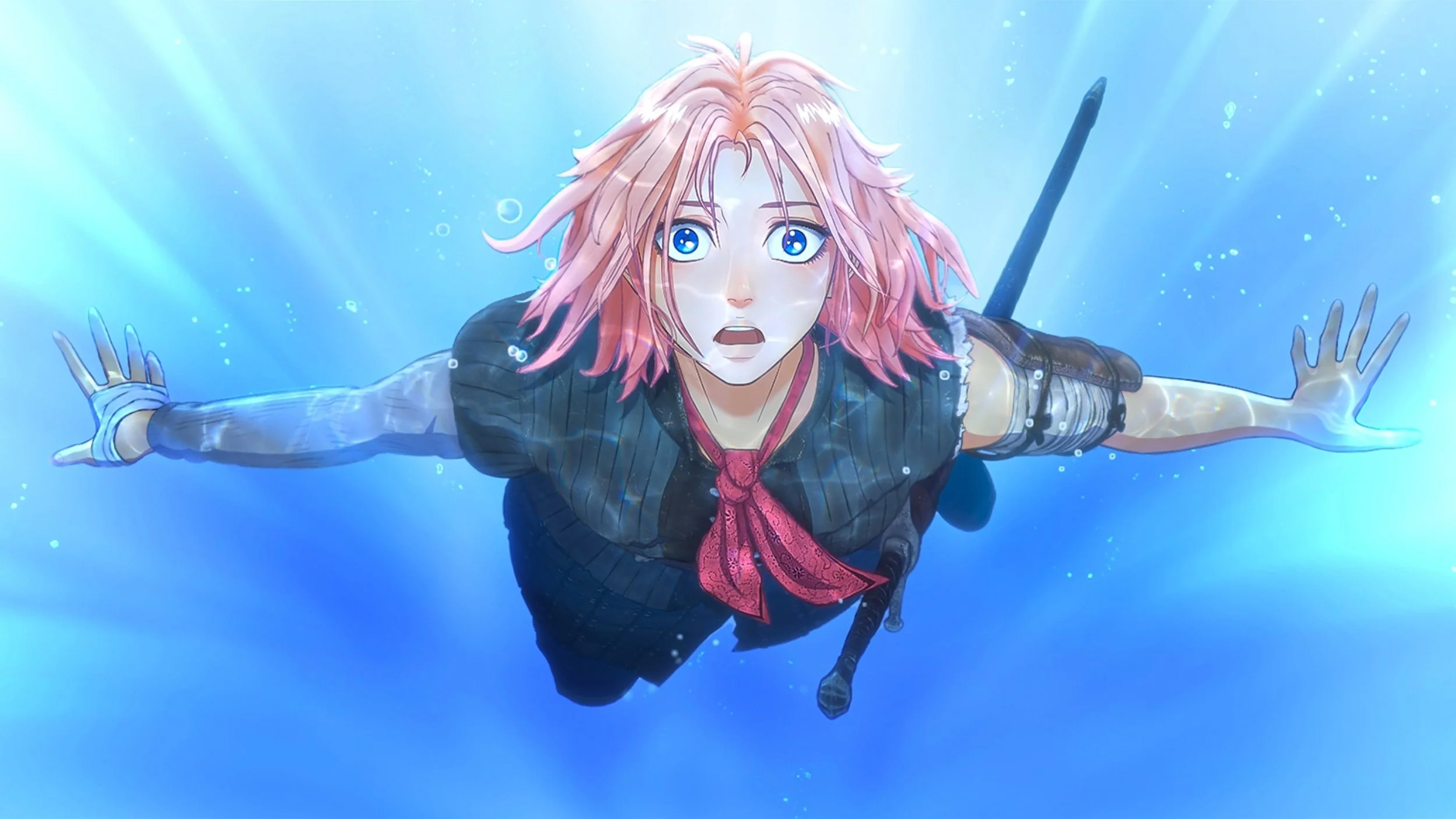
Image copyright (©) Courtesy of Sony Pictures Classics
MPA Rating: PG-13 (for strong violence/bloody images.)
Runtime: 1 Hour and 51 Minutes
Language: Japanese
Production Companies: Studio Chizu, Nippon Television Network Corporation, Sony Pictures Entertainment (Japan) Inc., Kadokawa Corporation, Toho Co. Ltd.
Distributor: Sony Pictures Classics
Director: Mamoru Hosoda
Writer: Mamoru Hosoda
Cast: Mana Ashida, Masaki Okada, Kôji Yakusho
U.S Release Date: December, 12 2025 (Limited) | February 6, 2026 (Nationwide)
Princess Scarlet (Mana Ashida) watches her uncle Claudius (Kôji Yakusho) carry out a coup and murder her father, the king, in medieval Denmark. She is banished and spends a large portion of her childhood in secret sword-fighting training. When Scarlet finally returns home, on a mission to exact her revenge, she is poisoned and falls into a coma.
She finds herself in the "Otherworld," a paranormal purgatory where individuals from all backgrounds and eras — past and present — live side by side. She encounters Hijiri (Masaki Okada), a pacifist nurse. After discovering that Claudius is also there, Scarlet and Hijiri set out to find him on a perilous journey through the different badlands knowing that if they are killed in the Otherworld, they will vanish into thin air. However, during their journey, Hijiari makes every effort to persuade Scarlet that there is more to life than vengeance.
Hosoda is at his most approachable and maximalist in Scarlet.
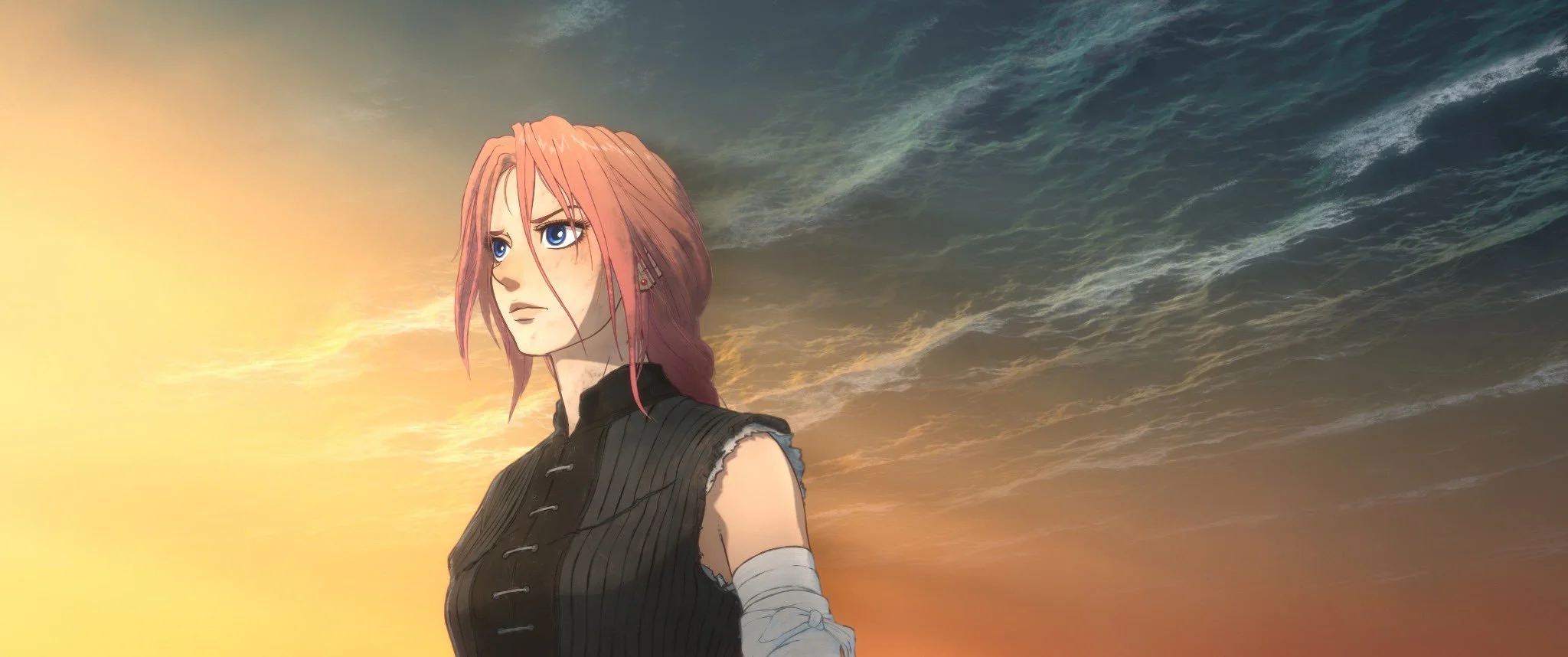
Mana Ashida as Scarlet in “Scarlet’. Courtesy of Sony Pictures Classics
For better or worse, if you know Hosada's game, a lot of Scarlet will seem like the director revisiting his greatest hits. If you aren’t, might I suggest taking a look at Belle and Mirai? Perhaps make it a double feature since Scarlet combines elements of both films: character-driven narrative and 3D-2D hybrid animation techniques. It might be overwhelming to take in at once if this is your first Hosoda.
The beautiful animation quality from Studio Chizu is an improvement over their previous work, Belle included. Scarlet’s initial set-up is just "girl Hamlet" drawn in 2D with gothic colors. Yet, once the titular rage-fueled princess enters the Otherworld, she gets hit with that colorful cel-shaded 3D beam, and so do her surroundings — once again taking cues from Belle. Contrary to Belle's VR world "U," which was overwhelming and only featured in segments of the narrative, Scarlet's supernatural Otherworld, where the majority of the story takes place, is grounded, sprawling, and fully realized.
In this 3D landscape, Hosoda adeptly executes an epic scope for his protagonist and the action on her quest. The action sequences are intense and violent, making great use of the backdrop in 3D composition and movement, illustrating an insane level of combat as Scarlet's bright blue eyes see red — as bright as her hair — when she encounters Claudius' goons in the Otherworld. The film's swashbuckling Hamlet-echo-fighter heroine is still afforded the opportunity to get her hands dirty in numerous set pieces.
In terms of aesthetics, Scarlet is more visually and narratively accessible than Belle. Its fantastical supernatural realm is reminiscent of George Miller's Furiosa, but with a medieval wardrobe, and if it were rendered in the same cel-shaded graphics program as The Legend of Zelda: The Wind Waker. The backgrounds consist of deserted sandy wastelands, volcanic terrains reminiscent of Pompeii, with numerous dusty oases and storms. Besides that, there is a storm dragon with swords in its face that horrifically kills homicidal sinners with a single thunderstrike.
Hosoda’s bites more than he can chew with his barrage of themes.
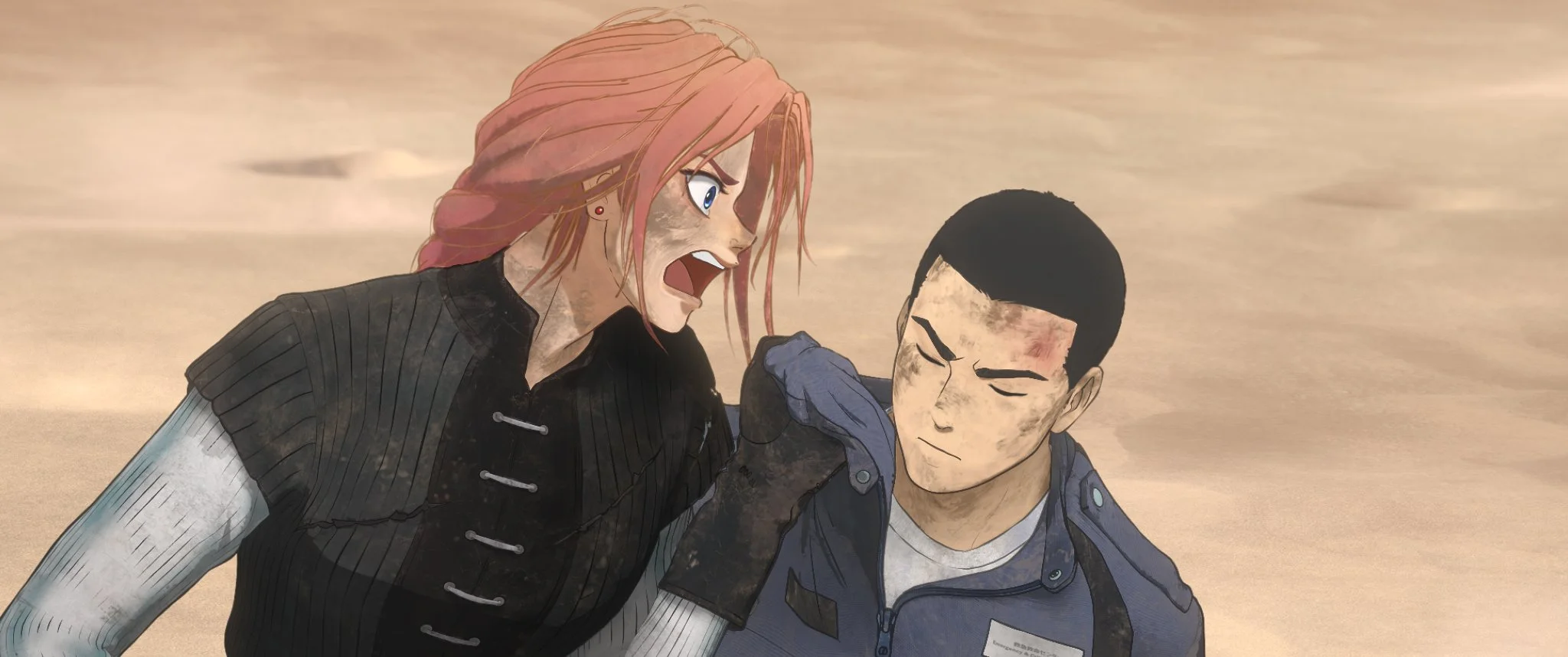
Mana Ashida as Scarlet and Masaki Okada as Hijiri in “Scarlet’. Courtesy of Sony Pictures Classics
This is Hosoda, after all, and the man delivers on three separate themes simultaneously while exploring the Otherworld's setting and experimenting with time, all while flying by the seat of his pants. Scarlet is most successful when its subversive anti-war character arc is shaped by Scarlet's healing process, influenced by her developing relationship with Hijiri. His pacifism challenges Scarlet's worldview, offering reflection on her purpose outside seeking retribution. The two characters have a potent budding chemistry and a positive influence on each other's moralistic values. I love how during the action sequences, Scarlet, heeding Hijiri suggestions to not kill her foes, goes full Daredevil, kicking ass with brutality but still showing mercy.
That said, the movie spends most of its time on our two heroes reflecting on the lives they used to live. There isn't much of a sense of urgency, which makes the already unnecessary two-hour runtime feel even longer. The lines between our reality and Hamlet do blur, particularly with regards to Claudius, the selfish dictator of an impoverished land, full of false promises of an “infinite land” that he had not been to himself, weaponizing his followers’ desperation for his gain. And then there’s the sloppily executed yet well-intentioned no-borders theme. Hosoda likes to show the Otherworld's melting pot in slow, rambling beats, like when Hijiri learns to hula dance with a Hawaiian woman. Yet the meandering lets some themes, primarily its no-borders/false-kings narrative feel underdeveloped. As the two reach Claudius’ Castlevania-like castle, the tone intensifies in a snap, leaping into war-filled chaos, missing a bridging scene or two to add cohesiveness.
As it enters its second half, Scarlet fully symmetrizes as a maximalized adaptation of Hamlet and as an introspective journey of self-discovery through potent psychological and supernatural cues. I couldn't help but get excited when Rosencrantz and Guildenstern joined the battle to see how they would contribute to Hosoda's passionate vision. Even if it falters in its other themes when it gets too big for its britches, Hosoda compensates with unwavering sincerity throughout. At a certain point, it explained why it was programmed at NYFF, as they usually don’t program animated features to the festival.
Final Statement
Even though I miss Hosoda's simple work, Scarlet is another stunning effort a visionary whose stories are frustratingly overambitious but still captivating.
Please consider supporting Rendy Reviews. We’re an independent run, Gen-Z and Black-owned entertainment outlet. You can donate to our Paypal or Venmo to help keep our site running. Or become a subscriber for access to 13-years worth of reviews, exclusive interviews, and more! A free way to support is a sign up for the Rendy Reviews’ newsletter and get weekly emails about latest on movie reviews, interviews with film artisans, features, and more.
