
‘Victorian Psycho’ Review: Maika Monroe Is a Devilish Delight in This Gothic Feminist Horror
Psycho Maika, Monroe thee, Victoria-a‑a‑a‑a‑a‑a‑an better. Run, run, run, run, run awayyyyyyyy.
Silly indulgence aside, Maika Monroe, one of the top scream queens of the 21st century, has often been the object of horror. She avoided STDs in It Follows, used her foresight to solve crimes against Satanists in Longlegs, and was watched by Burn Gorman in Watcher. In Zachary Wigon’s Victorian Psycho, Monroe finally steps away from the “always the frightsmaid” role as a governess who preys on a family. Prim and proper, she gets her way in this period horror, based on the novel by Virginia Feito.
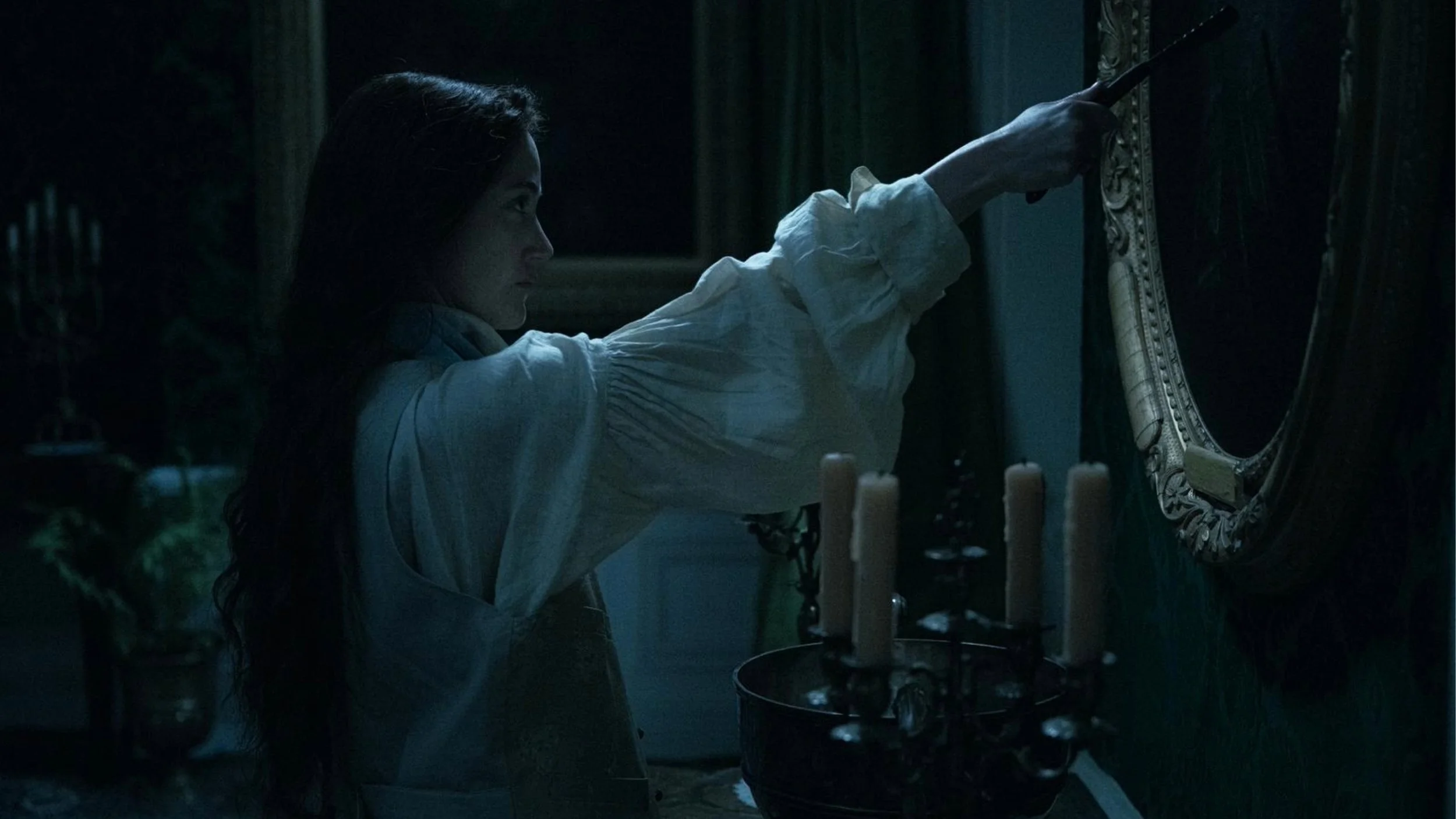
Image copyright (©) Courtesy of Bleecker Street
MPA Rating: R (for strong bloody violence and brief sexual material.)
Runtime: 1 Hour and 30 Minutes (90 minutes)
Language: English
Production Companies: Anonymous Content, Anton, Traffic.
Distributor: Bleecker Street
Director: Zachary Wigon
Screenwriter: Virginia Feito
Cast: Maika Monroe, Thomasin McKenzie, Jason Isaacs, Ruth Wilson, Jacobi Jupe, Evie Templeton
U.S Release Date: November 13, 2026
In 1858, Winifred Notty (Monroe) arrives at a gothic manor, Ensor House, as governess to the Pounds family. The phrenologist patriarch, Mr. Pounds (Jason Isaacs), and his stern wife (Ruth Wilson) impose properness in the household, including their children Andrew (Jacobi Jupe) and Drusilla (Evie Templeton), and the staff. Winifred seems to come undone as the lines blur between reality and her dreams of being part of the family. She finds confidence with the kind scullery maid Ms. Lamb (Thomasin McKenzie). As staff members start disappearing and the rumors about Notty’s past rear their heads, she tries her damnedest to be part of the Pounds’ world.
Maika Monroe turns repression into a deliciously deranged performance.

Maika Monroe in Bleecker Street's VICTORIAN PSYCHO | Credit: Courtesy of Bleecker Street
In his sophomore feature, Zachary Wigon upgrades from a hotel room where Margaret Qualley tortured Christopher Abbott in (Sanctuary) to an expansive manor. He employs many of the same directorial tricks, staging madness from a distance and keeping the camera pinned on Notty’s deteriorating psychological state through intense composition. Overhead shots highlight the character’s descent into madness while amping up Jeremy Reed’s luxurious, Victorian production decor. It’s an impressive step up from a directorial front. He continues to show his strength as a character‑actor director above all else, extracting the highest degree of deranged behavior from his chameleon lead actress. But I can’t give him too much credit, because the film belongs to Maika Monroe’s performance, every bit worth the slash.
I find it insane that this is Monroe’s first time enacting terror, because she friggin’ kills it. From the onset, Winifred is already far gone from reality, putting her demented psychosis at bay as she looks onward in vacant, dissociative states. She guides the viewer as an unreliable narrator, starting with “I am the sanest person I’ve ever known,” remarking on all the oddities occurring. Even when the material falls flat in its humor, her commitment to proper line delivery and breathy vocal changes keeps it buoyant. Her cold mid-violence glare is deeply unsettling. She’s a commanding, devilish delight.
Victorian Psycho is like Saltburn in the vein of an Emily Brontë novel (if Saltburn was good). It bears a classist, feminist satirical tone as Winifred spends more time under the Pounds’ dark rules and punishment; the nature of the patriarchy and the discarding of women seeps into the forefront. It’s run like old China where if the first-born ain’t a boy, they don’t mean shit. The film uncovers the madness that lies within when the repressed and neglected are forced into traditional fancy behaviors. The thing about the Pounds that makes the Saltburn comparison so vital is that they are also fucked up freaks, forcing their staff to sleep in a doggy kennel when they make a mistake or cutting their hair to use the rest as a whip if a hair strand is found in soup. The supporting cast has fun with it, with Wilson and Isaacs exemplifying their cruelty in their own demented yet entertaining ways. Wilson operates on peak haterade as Isaacs weaponizes his phrenologist charisma and dialect. Jacobi Jupe and Evie Templeton highlight their spoiled brattiness and slightly unsettling unraveling at a certain point. It has a slow‑simmering feminist core that becomes more engaging the longer it progresses. It’s increasingly easy to root for Winifred.
A bloody good time that never quite reaches its full potential.

Maika Monroe and Ruth Wilson in VICTORIAN PSYCHO | Courtesy: Bleecker Street
Feito’s script shows instances of solid comedic wit, and gags about the correlation between pineapples and wealth got good laughs out of me, but it falls prey to “first feature screenplay” syndrome. It’s tonally confusing, wanting to be atmospheric but not pushing its humor potential to the height of its abilities. The same goes for its horror beats, which don’t go far enough in delivering gore or satisfying kills.
While I like Wigon’s direction and the prose, his directorial choices clip the film’s wings and the catharsis potential. As much as I’m a Sanctuary ride‑or‑die, Wigon fails to understand that the women killed shouldn’t have more gratifying deaths than the men; those men are worse than Winifred could ever be.
Though I wish I liked it more, especially in its opening segments, I eventually had a blast with Victorian Psycho. It’s a delightfully bloody good time, held together by a twisted, chilling, career‑best Maika Monroe.
