
‘Prima Facie’ Review: Cynthia Erivo Carries Legal Drama That Fails its Own Case
I love this current trend of stage productions that originated with a white lead actress being handed to Cynthia Erivo for film adaptations. However, Prima Facie’s heavy topic is more distressing than anything Elphaba dealt with in Wicked.
Based on Aussie playwright Suzie Miller’s one-woman show starring Jodie Comer, which landed her her first Tony Award, Prima Facie is the story of a barrister who is often handed sexual assault cases and isn’t that affected by it until she’s raped by a co-worker in her own home. Cynthia Erivo gives a fantastic performance in Susanna White’s film adaptation, but its focus on the wrong thing saps the potential of what could have been a damning critique of the protection of assault and predators within the court of law.
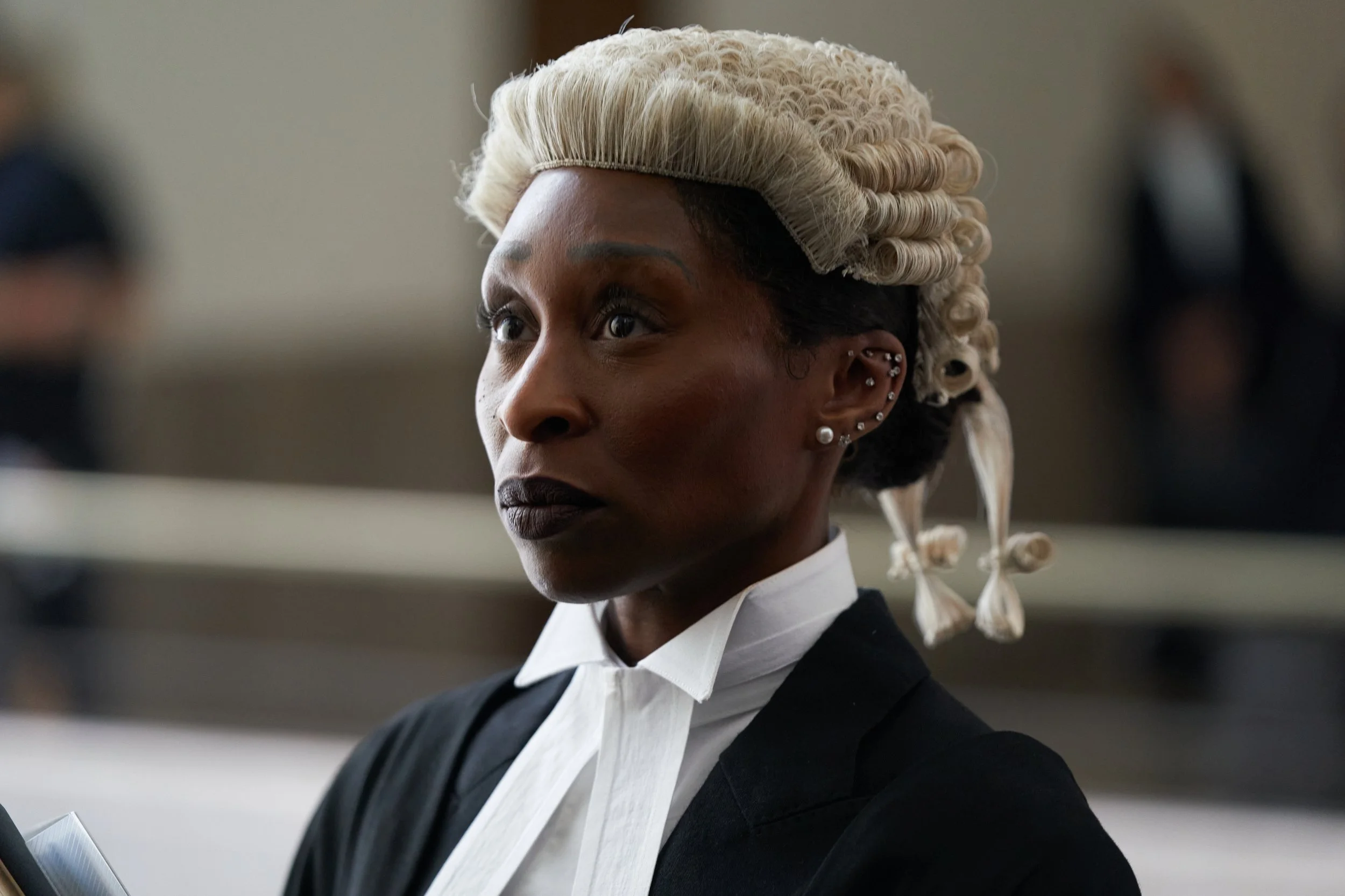
Image copyright (©) Courtesy of TIFF
MPA Rating: Not Yet Rated
Runtime: 1 Hr and 46 Minutes
Language: English
Production Companies: Bunya Productions, Embankment Films
Distributor: N/A
Director: Susanna White
Screenwriter: Suzie Miller
Cast: Cynthia Erivo, Daniel Ings, Elizabeth Dulau, Noma Dumezweni, Toheeb Jimoh, Harry Treadaway, Sarah Junillon, Elliot Levey, Simon Russell Beale
U.S Release Date: N/A
The film follows Tessa (Erivo), a fierce, hard-working British defense barrister with a promising career. Unlike her fellow lawyers who got the nepo-leg up to their careers, or “thoroughbreds,” as she describes them, Tessa earned her place in her field as a Cambridge grad from a working-class background. Her hard-working path deposits some self-consciousness and imposter syndrome. But that doesn’t affect her because, in the chambers, she’s regarded as one of the best in the firm. She’s an unstoppable force in court, with an inner monologue akin to Robert Downey Jr.’s Sherlock Holmes, overanalyzing every facet of her plaintiff or defendant. She’s often assigned to tackle sexual assault cases, even when some make her seem a little like “a woman not believing a woman.” Tessa’s only concerned with facts and evidence, knowing the just, fair law will be upheld.
Everything is going well in her personal life too; she’s been offered a transfer to an esteemed chamber to work with other high-profile barristers. Her hot-blooded younger brother Johnny (Toheeb Jimoh) is about to be a dad. And her slow-burning romance with her co-worker Julian (Daniel Ings), a charming fellow lawyer who comes from law royalty, is starting to take off.
That’s until, after a nice date, late into the evening, Julian forces himself on Tessa and rapes her. Now having to work with her assailant, her entire world is shattered, and she second-guesses herself and the system she dedicated her life to upholding.
Cynthia Erivo gives a powerhouse performance trapped inside two different movies.
Prima Facie is another demonstration of Cynthia Erivo’s exemplary power. As Tessa, she textures a lived-in, flourishing character. In the scenes laying out her personal and professional life, Erivo effortlessly switches from a force to be reckoned with to intimate tenderness, a resounding vulnerability, and humanity. When she has to face her trauma during the trial scenes and, of course, the distressing dissociative state in the graphic depiction of her rape, she delivers a shattering portrayal. Sometimes, the movie itself impedes her performance, as it insists on unnecessary metaphorical imagery of shattered glass when her subtle facial cues are all you need to note her emotional distress.
If you went into Prima Facie unaware of its source material, you might think the movie was a character study of a woman with immense imposter syndrome trying to remain professional in a strictly white space, and the burgeoning weight of taking SA cases. Suzie Miller, who also penned the film version, spends ample time in its first hour developing Tessa’s personal and professional life. You would’ve fooled me if you told me this was a failed 2010s ABC drama pilot intending to air between Grey’s Anatomy and Scandal. Before the film’s true identity is revealed, it has the same contemporary spirit (the first time I’ve ever seen iPhone’s NameDrop contact exchange put to film) as a Shonda Rhimes series. Not that I’m averse to it, but it plays like a completely separate movie.
The justice system fails Tessa, and eventually Prima Facie does too.
When the rape occurs and the film reveals its real premise, the story unravels Tessa’s short-term, immediate reaction and that’s about it. It completely fast forwards over the subsequent 1107 days (literally stamped on screen) in her professional and personal life whatsoever and skip to the trial. It’s as if a whole second act or secret third act was missing. Although Tessa is depicted as a complete person, the alluring portrait is padded with attention to the events before for longer than it needs to and could’ve been summarized in less time.
By the final reel, the film leans completely into being a courtroom drama, pointing out the legal hypocrisies and misogyny toward women and assault survivors, but here is where it sacrifices Tessa’s character.
There are some nuances in how director Susanna White handles the material with Tessa’s Blackness in mind. One of the most raw, chilling scenes is her mom, June (Noma Dumezweni), going to Tessa’s aid, cleaning her bathroom, and throwing away her weave – all while Tessa sits on her couch silent, traumatized.
I’m also of two minds that, while it characterizes Tessa in detail, with a racial and class undercurrent aligning with her insecurities – she is essentially the only Black barrister in her chambers – the movie is afraid of outright addressing her Blackness. It’s felt during the trial sequence where Tessa, on the stand, sees herself facing the same disarming tactics as the women she cross-examines.
Yet all the build-up feels neglected considering how much it emphasizes a generalized statistic of sexual assault among women in her testimony. The on-the-nose imagery dampens it further, with shots of women looking at each other across the courtroom, turning a once-enticing character portrait into a schlocky PSA until the film’s credits restate the same statistic in its closing infographic. Like the justice system, the film fails its lead and her incredible performance by devolving her into a preachy caricature. Because it neglects the long-term effects, the emotional impact falls flat. It doesn’t help that the motifs of shattered glass also reappear aggressively during this sequence. The trial scene is predominately effective because of the fierce dialogue between Erivo and Elliot Levey as Julian’s pseudo sexist-skewing lawyer.
All in all, Prima Facie is an uneven, heavy-handed, disappointing missed opportunity as a legal drama, despite Erivo’s riveting lead performance. It squanders its character‑driven poignancy and a worthy call to action, ultimately turning what could have been a nuanced critique of the justice system against rape survivors into an overly generalized PSA.
