
‘Fair Play’ Review: Phoebe Dynevor and Alden Ehrenreich Engage in a Pre-Marital Power Struggle in Engrossing Netflix Psychological Drama
Fair Play
R: Pervasive language, sexual content, some nudity, and sexual violence
Runtime: 1 Hour and 53 Minutes
Production Companies: T-Street, Star Thrower Entertainment, MRC
Distributor: Netflix
Director: Chloe Domont
Writer: Chloe Domont
Cast: Phoebe Dynevor, Alden Ehrenreich, Eddie Marsan, Rich Sommer
Release Date: September 29, 2023 | October 13, 2023 (Netflix)
In Select Theaters + Netflix
The past several years have seen the quintessential workplace drama sub-genre pop up on television more than in movies. Shows like Succession and Industry are hot tea with complex character writing and exhilarating business bullshit. Oh yeah, and The Morning Show exists too. The movies these days are solely fictionalized versions of recent notable economic or social events. Writer/director Chloe Domont (in her feature debut) finally brings the audience back to those Wall Street, Falling Down, or Basic Instinct—wait, these are all Michael Douglas movies—days of cinema, offering intense psychological drama through a contemporary lens. Plus, there's something objectively funny about how Netflix purchased this flick out of Sundance when, as far as streaming services go, this gives more MAX vibes than anything else.

Fair Play. (L to R) Alden Ehrenreich as Luke and Phoebe Dynevor as Emily in Fair Play. Cr. Courtesy of Netflix
Young newly engaged couple Emily (Phoebe Dynevor) and Luke (Alden Ehrenreich) are data analysts at an intense hedge fund company where sleeping with co-workers is against company policy. They keep their relationship on the down low: platonic co-workers during the day, handsy and horny in their shared Manhattan apartment at night. One day, a Project Manager gets fired and throws a fit, leaving a boss position in the open. Emily tells Luke she overheard rumors that their stern boss, Campbell (Eddie Marsan), might choose him for it. Turns out Emily is the one picked for the job. Emily and Luke's relationship is tested as she enters the new role. Can their new dynamic chop the hedges of their engagement?

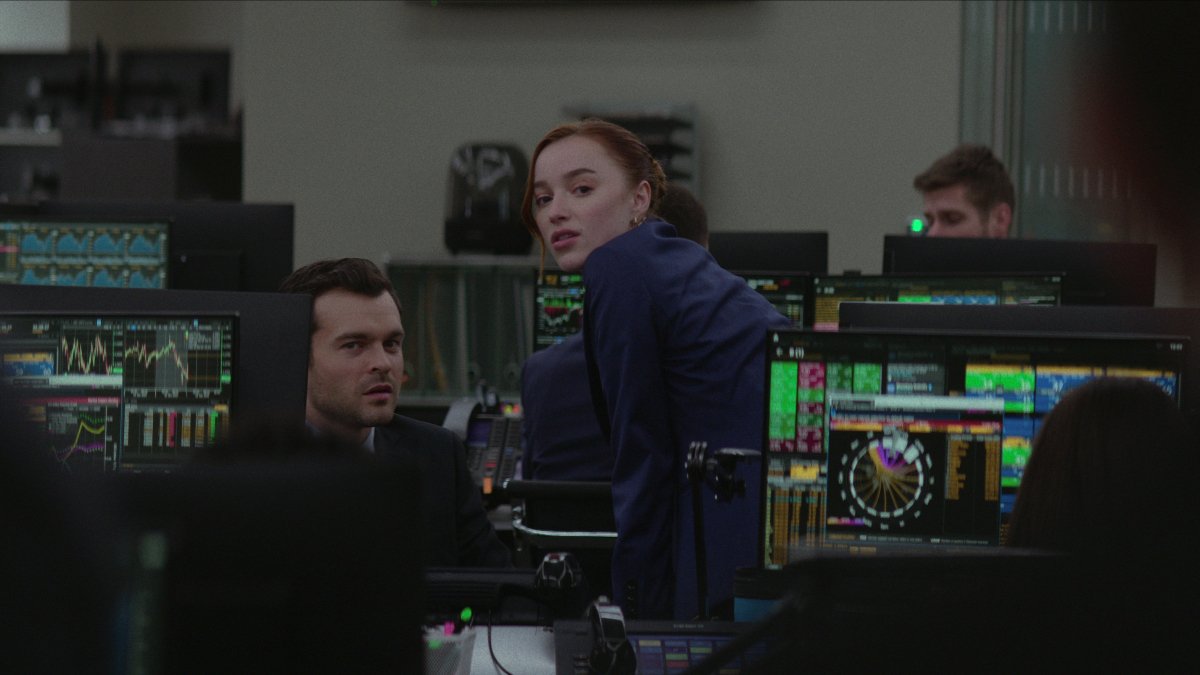
For her debut, Domont's direction reveals a deft hand at mediating juicy tension in her couple's power struggle. Emily and Luke's secretive relationship is hot and steamy, with many wide and medium shots exhibiting equal footing. Once Emily gets that raise, though, Domont plays with various angles and perspectives, amplifying the dramatic beats and power shifts between them at their job and home. When Emily returns home from a private 2 AM meeting at a bar with Campbell to tell Luke the news of her promotion, the shot framing starts positioning slightly at a low angle despite her being shorter than Luke. Most of the shot framing makes Emily look as powerful as her new job title. Then, when she loses that power, the camera levels her in a static medium shot. With a simple over-the-shoulder look at Ehrenreich, she's visually at a lower level when there's a power imbalance.
Menno Mans' cinematography also complements the couple's bubbling tension through dark lighting in their apartment—only seen at night—and a gritty exterior that captures an old-school noir portrait seen in classic NYC-set flicks. A muted color correction across the board added to my immersion into the setting for the first time. The palette matches that gray area in business and their relationship.

Fair Play. (L to R) Alden Ehrenreich as Luke and Phoebe Dynevor as Emily in Fair Play. Cr. Courtesy of Netflix
Domont's narrative straightforwardly examines gender roles in the workplace. When men don't get their way, their emotional fragility is transparent, and Luke is the most blatant case. Since his and Emily's occupation is finance, it's par for the course that it's a meatheaded cutthroat environment. Inappropriate comments are common, and insecurities and envy lie in every department. A man would've filled the open PM role in any other instance. But Domont illustrates how Emily rightfully earned it in early workplace scenes where she handled herself with quick-minded confidence and skill.
As Emily and Luke go to work after her promotion, all that’s missing is a voiceover that chimes, "Let the battle begin. FIGHT." At first, there's some sympathy towards him, but he quickly goes 0 to 100 with how he treats Emily. If Luke can't win at work, he wins at home, where he makes any excuse not to touch her, drowning himself in his career. He's just one notch shy of buying a golden, triple-locked chastity belt. Luke is as pathetic as your typical finance bro. Even if I try to criticize the lack of subtlety in his character, it'll push the movie into fantasy territory. He radiates resentment in every glimpse and reaction to Emily getting invited out for drinks with her boss after a long, hard day. He gives condescending responses when Emily questions his emotions. Not a single compliment to her breaking a glass ceiling at her job. It's hard to decipher whether Domont intentionally laid out all his pettiness on a silver platter or wanted to heighten the methods Luke uses to increasingly ice Emily out. Either way, it's entertaining as hell (for the most part) to see how far he goes in being a complete petty bitch.

Fair Play. (center L to R) Alden Ehrenreich as Luke and Phoebe Dynevor as Emily in Fair Play. Cr. Courtesy of Netflix
Alden Ehrenreich delivers a frighteningly good portrayal of this petty beta male archetype. He delves into his most unhinged side without making it look like a chore. It's hard to say he and Dynevor share great chemistry, not as a romantic couple but as a fiery screen presence in their characters' parting drifts.
Phoebe Dynevor is a powerhouse in this film. Let me preface: I never watched Bridgerton. Considering its British setting, it's not my cup of tea. So this is my introduction to Dynevor, and yeah, she's incredible. Firstly, she showcases a strong, consistent American accent as concrete as Sarah Snook on Succession. Her attitude and conviction easily fit the scene. She embodies that forceful Jessica Chastain type of girl-bossy grit and confidence. Dynevor expertly holds her own against Ehrenreich as Emily plays her cards, trying to succeed at a game their job boxed the lovers in. She plays up her seductive nature well by being mad directly at him. And when he shuts her down, you see the pain and sadness in her big ol' eyes. But she compartmentalizes those feelings when she goes on her hot girl hard worker shit at work.

Fair Play. (L to R) Phoebe Dynevor as Emily, Eddie Marsan as Campbell, Rich Sommer as Paul in Fair Play. Cr. Slobodan Pikula / Courtesy of Netflix
Eddie Marsan is noteworthy and genuinely harrowing every moment he's onscreen as the firm's big boss, Campbell. I know him primarily from his minor comedic roles in films like The World's End or whatever role Guy Ritchie puts him in (seriously, Marsan is in most Ritchie films). But in Fair Play, his charisma and intimidating glare vacuum the energy out of every room. The movie already had me on the edge of my seat, but when he entered a room, I was too close to the brink of collapsing from the chair.

Guys, let's not classify Fair Play as an erotic thriller. That statement is not necessarily a critique of the movie itself. I’m talking to the audiences out of Sundance and the marketing folks at Netflix describing it as "sexy," "hot," and "erotic." Um, it's not that at all. It's an entertaining psychological drama. Sex plays a prominent role, and Domont showcases how power correlates with horniness. Most of the film has either party trying not to give in to each other's advances, especially in sex. It has erotic elements, but they never fuck, and that's the basis of their dynamic. A significant turning point kicks the "erotic" description out the window. If anyone still comes out of the movie calling it "sexy," run away from them. Steer clear. Watch ‘90s erotic thrillers like those Michael Douglas movies to remind you of the definition.

Fair Play may be apparent in its study of gender and power, even under the guise of a premarital couple. Regardless, first-time writer/director Chloe Domont creates a stellar debut with her meticulous filmmaking and nostalgic demonstration of tension, matched with powerful performances by her leads Phoebe Dynevor and Alden Ehrenreich, making this psychological drama a ball.

