'White Noise' Review: Noah Baumbach's Colorful Farce on Hysteria is His Most Ambitious Flick Yet
White Noise
R: Some language, sexual references, and drug use
Runtime: 2 Hours and 16 Minutes
Production Companies: Heyday Films, NBGG Pictures, A24
Distributor: Netflix
Director: Noah Baumbach
Writer: Noah Baumbach
Cast: Adam Driver, Greta Gerwig, Raffey Cassidy, May Nivola, Sam Nivola
Release Date: November 25, 2022 / December 30, 2022
In Theaters & Netflix

Hilarious and horrifying, lyrical and absurd, ordinary and apocalyptic. White Noise dramatizes a contemporary American family's attempts to deal with the mundane conflicts of everyday life while grappling with the universal mysteries of love, death, and the possibility of happiness in an uncertain world.

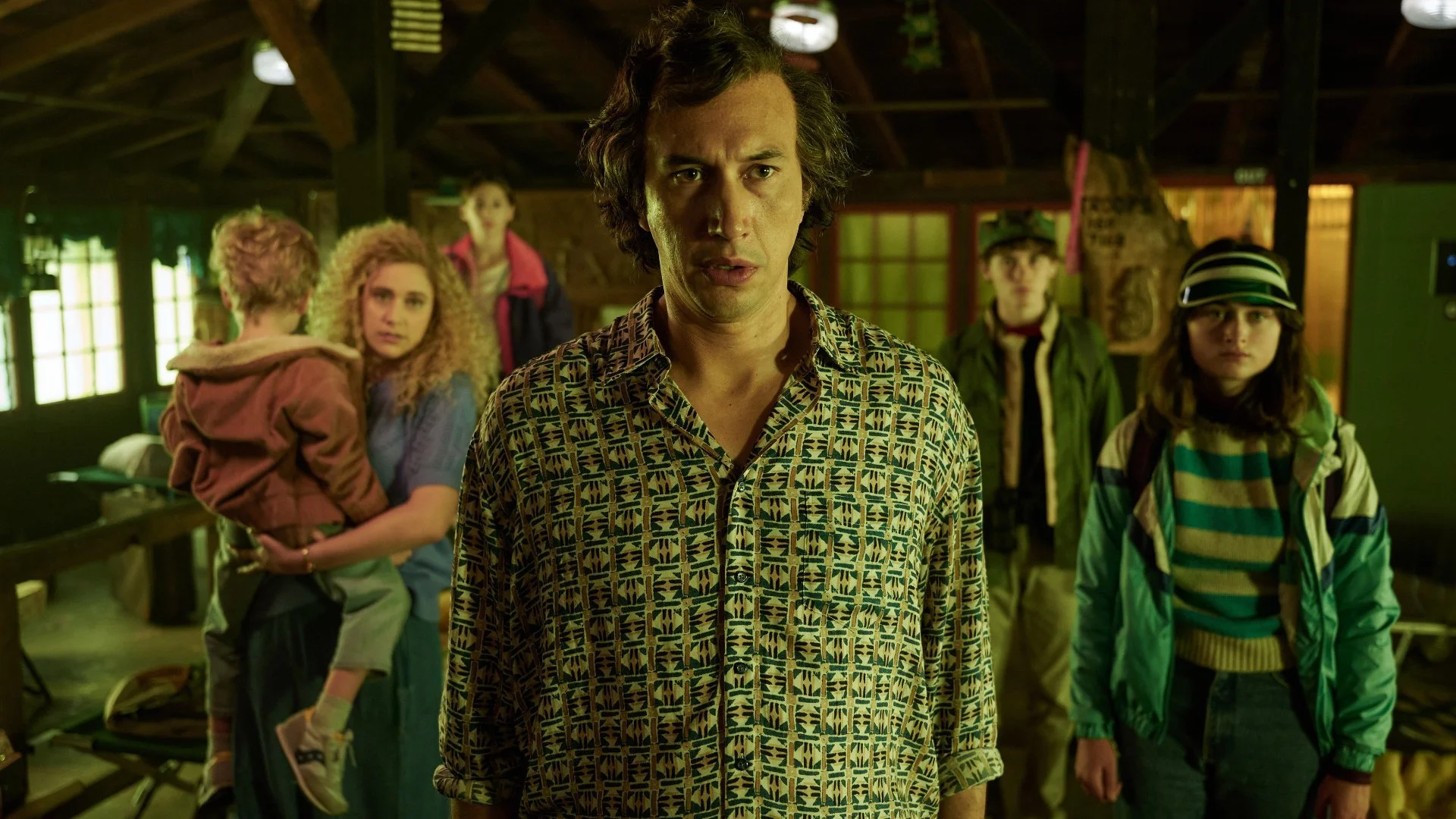
Baumbach's back with a bleak new bag. After throwing his dirty laundry at cinephiles with his previous film (Marriage Story) and helming slice-of-life dramedies, it was only appropriate for the writer/director to pull back from original narratives and pen an adapted screenplay for the first time. Based on the 1985 postmodern novel of the same name by Don DeLillo, White Noise tells the story of Jack Gladney (Adam Driver), a professor of Hitler studies living in the ‘70s with his loving wife Babbette (Greta Gerwig), and their mix of step-kids/biological kids Denise (Raffey Cassidy), Wilder, Heinrich (Sam Nivola), and Steffie (May Nivola). He’s successfully living the white suburban middle-class life without a care. When an airborne toxic event threatens the world, the family jumps ship and hits a road full of existential dread, shiny supermarkets, and kooky characters.

For Baumbach—who has navigated within the confines of grounded and quirky tales—White Noise’s sci-fi roots challenge him to expand his skillset as a filmmaker. Regarding direction, he confidently displays multiple styles and tones to craft an ambitious farce that speaks on the relative condition of mortality and existentialism. Through Gladney and his family attempting to outrun disaster, Baumbach experiments with action, suspense, and horror. The narrative’s structure is not so secure, but he consistently applies a dreadful, unnerving atmosphere. For someone who is praised for his screenplays rather than his direction, White Noise is mostly a “style over substance” case; the film’s entertainment value is fueled by the new tricks Baumbach has up his sleeve. He is constantly throwing darts at a wall to expand on the central theme, and by doing so, he delivers the most ambitious project in his resume yet.
Baumbach is an actor’s director who pulls great performances from his stars, especially with his collaborative partner/co-writer Greta Gerwig. The main showcase comes from Adam Driver who is delightfully charming. Mix the DNA of a young Harvey Keitel and Richard Kind and you’d get Jack Gladney. His body movements and cadence are engrossing as he tries to keep his family life afloat amid disaster. Adam Driver brings a natural vulnerability to his performance that correlates with the central theme, even when the theme of dread pivots directly to Gerwig.

Speaking of “White Noise”, Baumbach is finally working with Black actors! Not that we were clamoring for this to happen, but hey, he made sure to use as many Black talents as possible (from Jodie Turner-Smith to Andre Benjamin). I wanted more of them, particularly Don Cheadle as Jack’s professor colleague Murray, who teaches Elvis studies. Cheadle brings an irresistibly delightful, sweet-natured vibe, even when the subject matter is dour. He and Driver share fun buddy chemistry and have one of the film’s strongest scenes where the two do an Elvis v. Hitler professor collaboration. It makes little to no sense, yet the mutual admiration shared between them is warm.
White Noise plays as three separate extended vignettes––which is apparently how the source material is written as well––and it easily peaks in the second act. The first act is rocky, for the story spends an unbearable amount of time at the college where Jack teaches. The most intriguing element is the family’s dynamic. Jack and Babbette are peculiarly adorable and each kid has a quirky personality, with Jack’s eldest and wisest Denise carrying the torch. It takes a long while for the toxic fumes to light up the town and get the plot moving. Once the family hits the road, White Noise becomes one of the best-written movies of the year. The dark, quirky comedy and its underlying tension are perfectly balanced and the story often takes multiple unexpected turns. It delivers as the anxiety-inducing disaster flick that it’s marketed as… until it isn’t.

Noah Baumbach often tells enticing, unique, human stories about the obstacles of adulthood we can relate to. The theme of existentialism and the fragility of our mortality told through its disaster confines is exciting, but the dialogue and weak characterization are dreadful. I, for one, am not a fan of wordy movies where characters talk as if they’re philosophers, going off on fanciful tangents using Oxford dictionary vocabulary. It appeals to a particular demographic of like-minded people and alienates just about everyone else. When a writer does that, it means they’re compensating for a lack of story… or something else. Everyone in this film—including those who aren’t even professors, such as Babbette and the doomsday people the family interacts with—speaks in a frustrating manner that feels pretentious. Not to make a Family Guy reference, but this movie’s dialogue insists upon itself and never lets up.

This Baumbach screenplay is far from his best, but White Noise needed that Greta Gerwig touch. Gerwig’s Babbette noticeably lacks the presence and agency to get you invested in her plight when the narrative pivots to her. Much of the story hinges on Jack and Babbette’s relationship and she’s a thinly-veiled character.
If you aren’t aware of the source material, you’ll be thrown off by the convoluted story.. This film plays as three separate stories that are stitched together very loosely. I can't say I wasn't thoroughly intrigued as to what would happen next, though.

White Noise has Noah Baumbach advancing his skillset with an ambitious farce on the hysteria and existentialism that lives inside all of us. It might feel like three different films, but it’s overall consistent with its theme. This is the wildest, most ambitiously chaotic film he’s ever penned since… Madagascar 3: Europe’s Most Wanted