'Where is Anne Frank' Review
NR
Runtime: 1 Hrs and 39 Minutes
Production Companies: Purple Whale Films, Walking the Dog, Samsa Film, Bridgit Folman Film Gang, Submarine Amsterdam, Le Pacte, Doghouse Films, Magellan Films
Distributor: N/A
Director: Ari Folman
Writer: Ari Folman
Cast: Ruby Stokes, Emily Carey, Sebastian Croft, Ralph Prosser, Michael Maloney, Samantha Spiro, Skye Bennett, Tracy-Ann Oberman, Ari Folman
Release Date: N/A

Kitty, the imaginary girl to whom Anne Frank wrote her famous diary, comes to life in the Anne Frank House in Amsterdam. Her memories reawakened by reading the diary, believing that if she's alive, Anne must be alive as well, she sets out on a quest to find Anne. We follow Kitty as she travels across Europe and back to Anne Frank's time, armed with the precious book, in search of her beloved friend...

Jewish writer-director Ari Folman is one of the few animation filmmakers today who specializes in 2D animation. His debut animated feature Waltz with Bashir, an adult documentary that focused on a soldier in the Lebanon War, received great acclaim in 2008. For the past decade, he was hard at work adapting the story of Anne Frank for a demographic he’s never appealed to… Children.
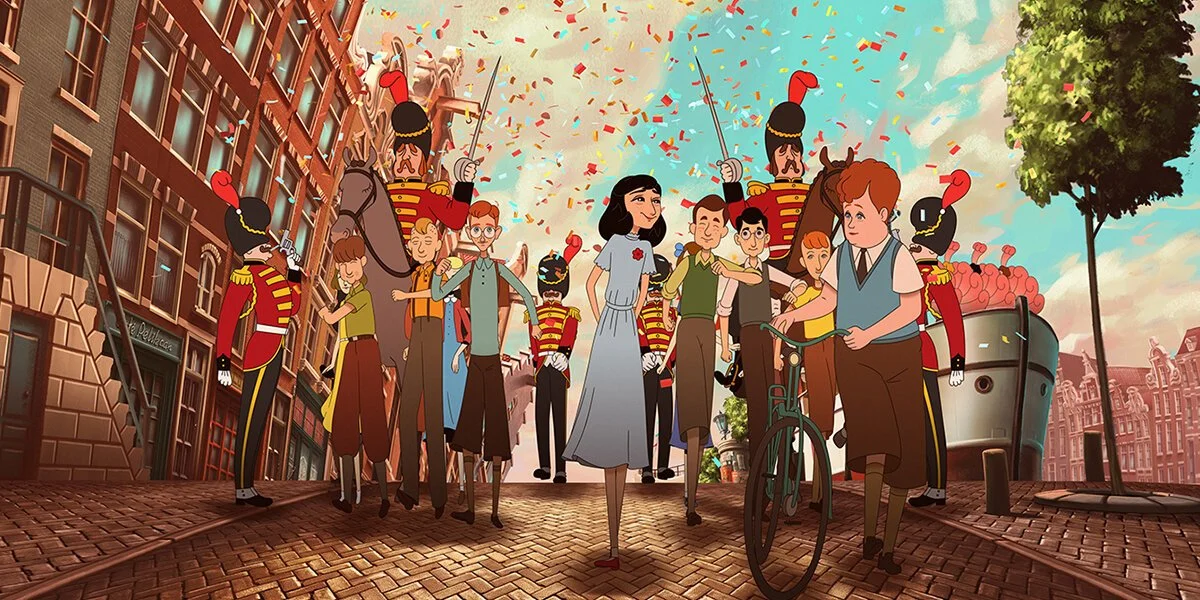
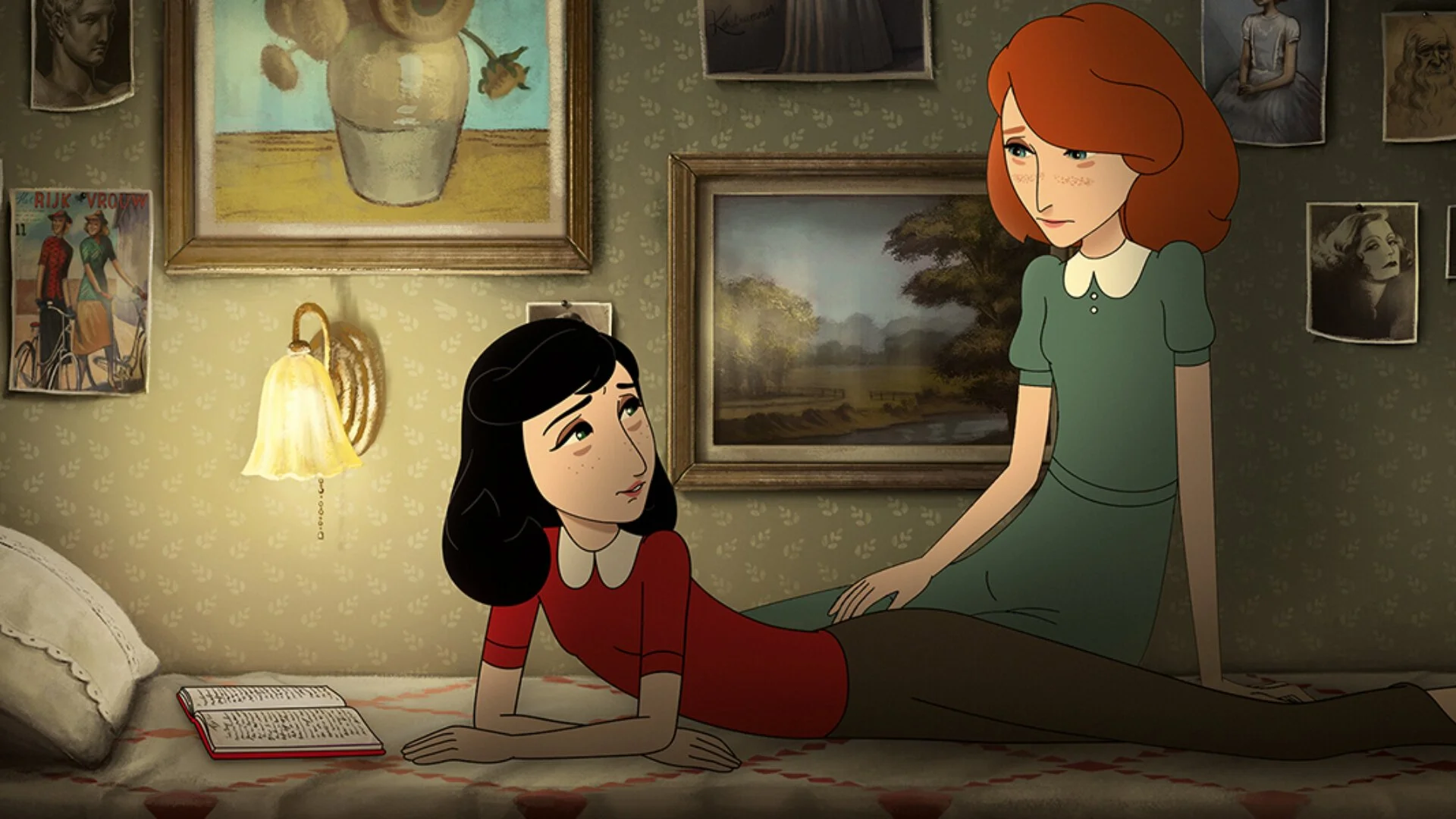
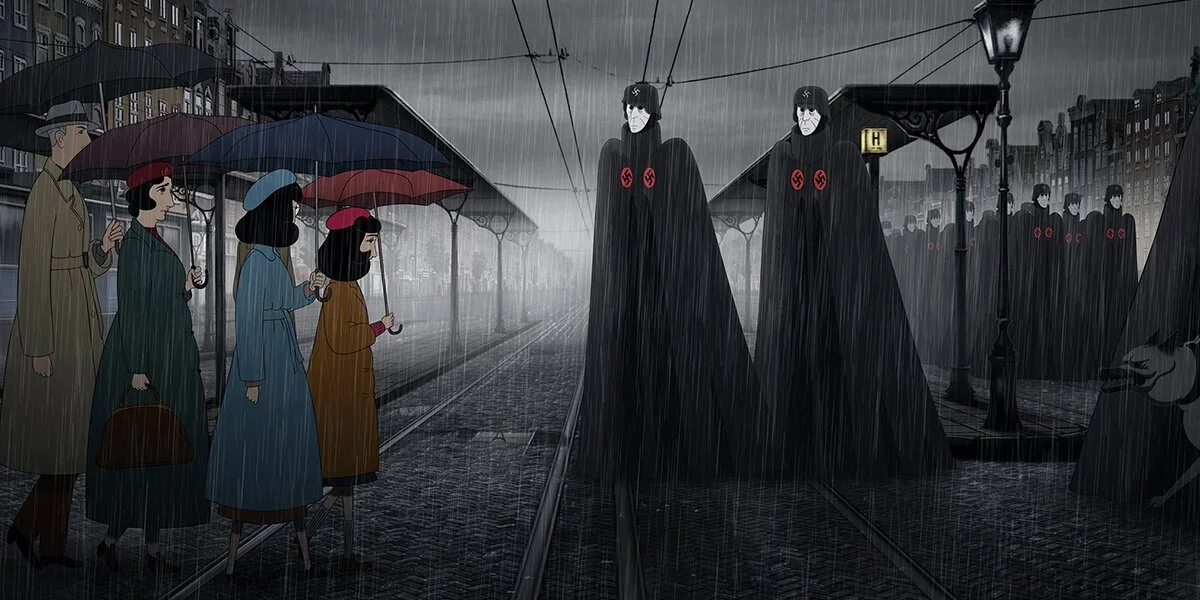
Where is Anne Frank is an eye-popping, mesmerizing visual splendor of animated excellence. The hand-drawn animation is so breathtakingly smooth in motion, it had me itching to see the pencil test art to see how Folman and his team of animators brought it to life. The film incorporates a variety of art styles that are distinctly unique and diverse in character design. Because of Folman’s heritage, he attempts to humanize Anne and her family, even down to her character design. Design-wise, the art style differs during imaginative sequences where Anne dreams she’s with her favorite movie stars (whose pictures are hung up on her bedroom walls), such as Clark Gable, and Greek heroes fighting against the Nazis. The celebrities she has hung up on her wall are drawn to be caricatures and the Nazis are designed as masked ghoulish figures straight out of a Ghibli horror. As Kitty comes to life and lives out her days in Anne Frank’s room with her original diary, she witnesses people who travel to Amsterdam for the tourist attraction that is the room. Outside of the soulless zombified Nazis, not one character model, even the background ones, is repeated to make this a larger-than-life odyssey between the past the present.
The luscious art direction and production design quickly immerse you into the film; it’s so detailed, especially if you’re watching on a big screen. The various techniques used to bring the Frank family’s house and modern-day Amsterdam to life are breathtakingly stylized. Time and research went into the production design to get the architecture of the city just right while translating it into animation with a unique flair. Though the film is hand-drawn, it incorporates 3D effects to widen the scope and scale of Amsterdam’s landscapes and it’s blended together so fluently. If you’re an animation connoisseur like myself, it’s truly a visual feast.
Folman put a lot of effort into the screenplay to give humanity to the titular character through flashbacks scenes. Whenever Kitty opens the diary and reads from the pages, she’s instantly transported into the 1940s where Anne begins journaling. Kitty’s leap into reality gives Anne a friend she can talk to and the intimate discussions they share help depict Anne as a real teenage girl full of imagination and rebellious attitude. As she spends her days isolated with her family during these scenes, she exhibits natural childlike emotions that are suitable for her age. Many of the diary’s signature moments are brought to life and while it feels watered down at times in regards to dialogue, it captures an earnest and imaginative light to make her feel human.
The same goes for Kitty, who is the central protagonist of the film and becomes a fully realized character rather than just a figment of Anne’s imagination. As she becomes visible in modern times, she treks outside the house to find the whereabouts of her best friend. Immediately, she comes to realize that her Anne is now a mere tourist attraction for Amsterdam. As she wanders the streets, Kitty witnesses marginalized homeless refugees from territories that have their own wars going on having their very ways of life threatened by Dutch government officials, who seek to deport them to the place they’re running away from. While the film tackles one too many themes, I give Folman credit for attempting to boldly discuss this relevant issue and introduce it to a new audience… even though it doesn’t feel organically interwoven with the scenes of Anne’s past.

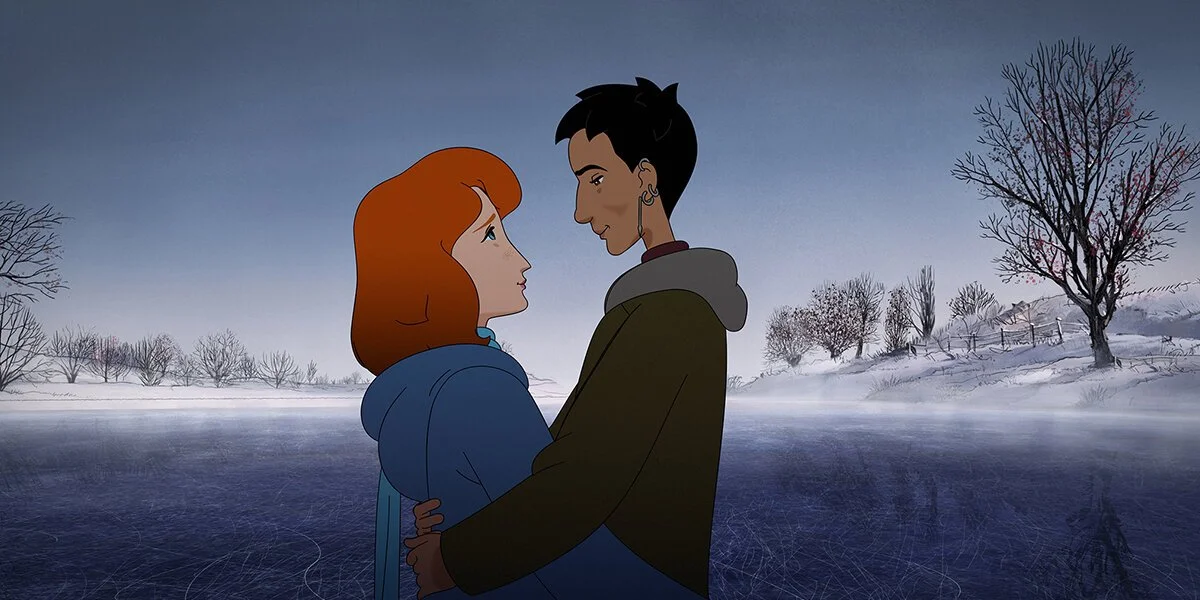
From a visual and animation standpoint, Where is Anne Frank is a masterpiece. That being said, the film suffers from an identity crisis. Does it want to be a biopic of Anne Frank’s diary? No, but a lot of the film’s runtime is dedicated to that. Does it want to make a statement about the commercialization of Anne Frank’s name? No, but a lot of the film’s runtime is dedicated to that. Does it want to be a coming-of-age story about an imaginary girl becoming sentient and finding her independence by fighting to uphold the values her best friend left behind? Do you see where I’m going with this? Folman throws everything and the kitchen sink into this feature and, while admirable, it needed to have its screenplay tightened. The scatterbrained focus becomes so loose that some of the bold swings in the film end up hitting foul balls. Plenty of the film’s emotional moments are underdeveloped and at times forced, one being a relationship Kitty shares with a young thief who quickly becomes her romantic interest. While it’s sweet and intimate, once he becomes aware of Kitty’s magical predicament it becomes something like a weird fan fiction rather than an earnest coming-of-age tale that gives Anne’s imaginary-turned-sentient friend some character.
Apart from that, the film does various things that in context come across as pandering to the young audience it’s aimed at. There are times that the film takes an early 2000s energy and incorporates high octane action sequences of Kitty trying to avoid the police, who claims that she stole Anne’s original diary, even though it’s the source that gives her life. It’s one of my pet peeves that animated movies try to be way too hip to appeal to kids. While it’s nothing too egregious, it’s noticeably off-putting. Come on man, you’re losing the integrity of the film by pandering. As aforementioned, it’s so amazingly crafted and exhilarating to witness, but in the grand scheme of things, it diverges from the main meat of the plot.

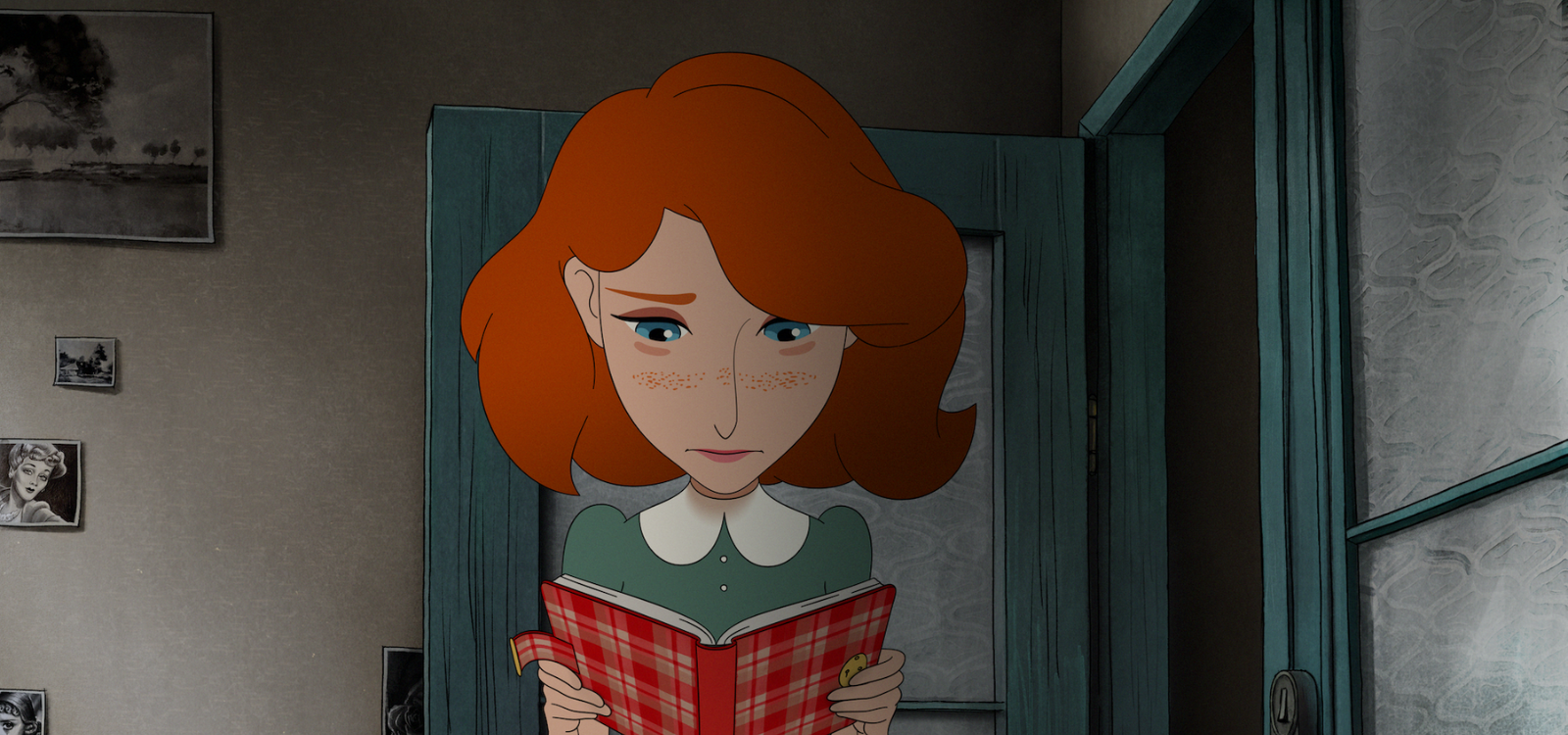
If you’re a non-Jewish person, chances are you didn’t learn about the Holocaust until you were in middle school. 11-14 were the ripe ages that history teachers got to educate us about the historic event. And by “taught”, I mean show us graphic films and call it a day. I was 12 and was shown both The Piano and Schindler’s List during WWII month. Needless to say, it left a ton of my peers and me traumatized. I remember having to leave class during a very triggering scene in The Piano and by the time the next class happened we were reluctant to point out which scene we saw last. Hell, I saw a girl straight up burst into tears once. So, with Where is Anne Frank, I’m thankful that somebody decided to make a Holocaust movie for kids while not shying away from the real horrors that occurred. Because Folman did his research, he incorporates some of the most educational moments into the film. He’s not even subtle with it, for there’s a scene where Kitty goes to a library to research her friend and you see animated copies of the signature book. They go full Liberty’s Kids with this, I swear. As someone who has never been to Amsterdam, the film educated me about the geography of the area and various aspects about Anne’s life I wasn’t even aware of. If you’re a teacher who has to have “the lesson” with your students, this is a decent introduction to the subject. They’ll be entertained by the animation and storytelling while being educated about the figure herself. Though Folman bites off more than he can chew as far as storytelling goes, it’s a decent effort worth recommending to students and even families.