
‘The Starling Girl’ Review: Eliza Scanlen Serves Teen Spirit with a Dash of Religious Guilt

The Starling Girl
R: Some sexuality
Runtime: 1 Hour and 56 Minutes
Production Companies: Pinky Promise, 2AM
Distributor: Bleecker Street
Director: Laurel Parmet
Writer: Laurel Parmet
Cast: Eliza Scanlen, Lewis Pullman, Jimmi Simpson, Wrenn Schmidt, Austin Abrams
Release Date: May 12, 2023
In Theaters Only

Growing up in a strict religious household as an adolescent can be the most confusing experience. Bodies develop hormones, and with lust classified as a sin, the psychological battle between pleasure and religious guilt begins. As someone who dealt with that issue for most of their adolescence as a Jehovah's Witness, it’s validating when filmmakers like Karen Maine (Yes, God, Yes) and ç helm narratives about teens feeling the crushing weight set by the parameters of religious institutions. With The Starling Girl, Parmet explores this through a thoughtful, feminist lens with a powerful acting showcase from Australian actress Eliza Scanlen.

17-year-old Jem Starling (Eliza Scanlen) is a squeaky-clean Kentuckian fundamentalist Christian girl that sets an example for her younger sisters. She also has an overbearing mother (Wrenn Schmidt) and a reformed alcoholic father (Jimmi Simpson). Jem’s world is dictated by her secular church, but she finds freedom performing with her dance troupe. Her religious faith wavers when a boy who’s never spoken to her is made to court her, and her elder married youth pastor Owen returns from a missionary trip. As Jem struggles to find her individuality, she forms a deep connection with Owen, resulting in a scandalous affair.
Through Starling’s screenplay, Laurel Parmet delivers resounding authenticity in her portrayal of the condescending atmosphere within Christian communities. She follows the checklist of faux personalities, ranging from the unspoken hierarchy of roles within the community (Owen being the pastor’s son, making him Prince Nepo Baby), the gossipy culture between church members, and the anxiety of being ostracized for contradicting the church. Judgment is a characteristic of Christian institutions where members criticize Jem for something as simple as wearing a white dress they can see through, projecting those insecurities by throwing God into the mix. Any non-religious viewer will point out how God is a scapegoat, but it accurately represents the environment. The stakes are immediately set in stone due to the minuscule size of the community. As Jem navigates through this tumultuous affair with Owen, Parmet examines the psychological effect that religious guilt has on teens, especially in a rural setting. It’s easy to sympathize with Jem, subjected to cultish traditions like courting, so when her innocence and naivety are taken advantage of—whether by her community or Owen—it’s objectively identifiable.

The realism of the setting’s portrayal is elevated by the acting, primarily by lead Eliza Scanlen. She confidently encapsulates the sensitivities and raging emotions of freedom teens desire. With a subtle cadence and consistently thick southern accent, Scanlen effortlessly sheds the innocence, naivety, and ignorance we all exhibited at 17. As tension in the community intensifies with her problematic romance, Scanlen traverses into dark material as graceful and confident as Jem’s dancing.
That sentiment also extends to Lewis Pullman, who holds his own as Owen Taylor. His character has a heavy hand of power in the relationship’s dynamic. Parmet unravels the fragility of this familiar type of man as Owen entertains Jem’s desire. Stuck in a failing marriage, Pullman’s showcase of emotional manipulation never comes across as overly dramatic. To say he shares good on-screen chemistry with Scanlen feels like a trap set by the FBI, but their acting carries the weight of the film’s conflict. Pullman and Scanlen are on the same level despite the power imbalance and cringe-inducing age gap between their characters.
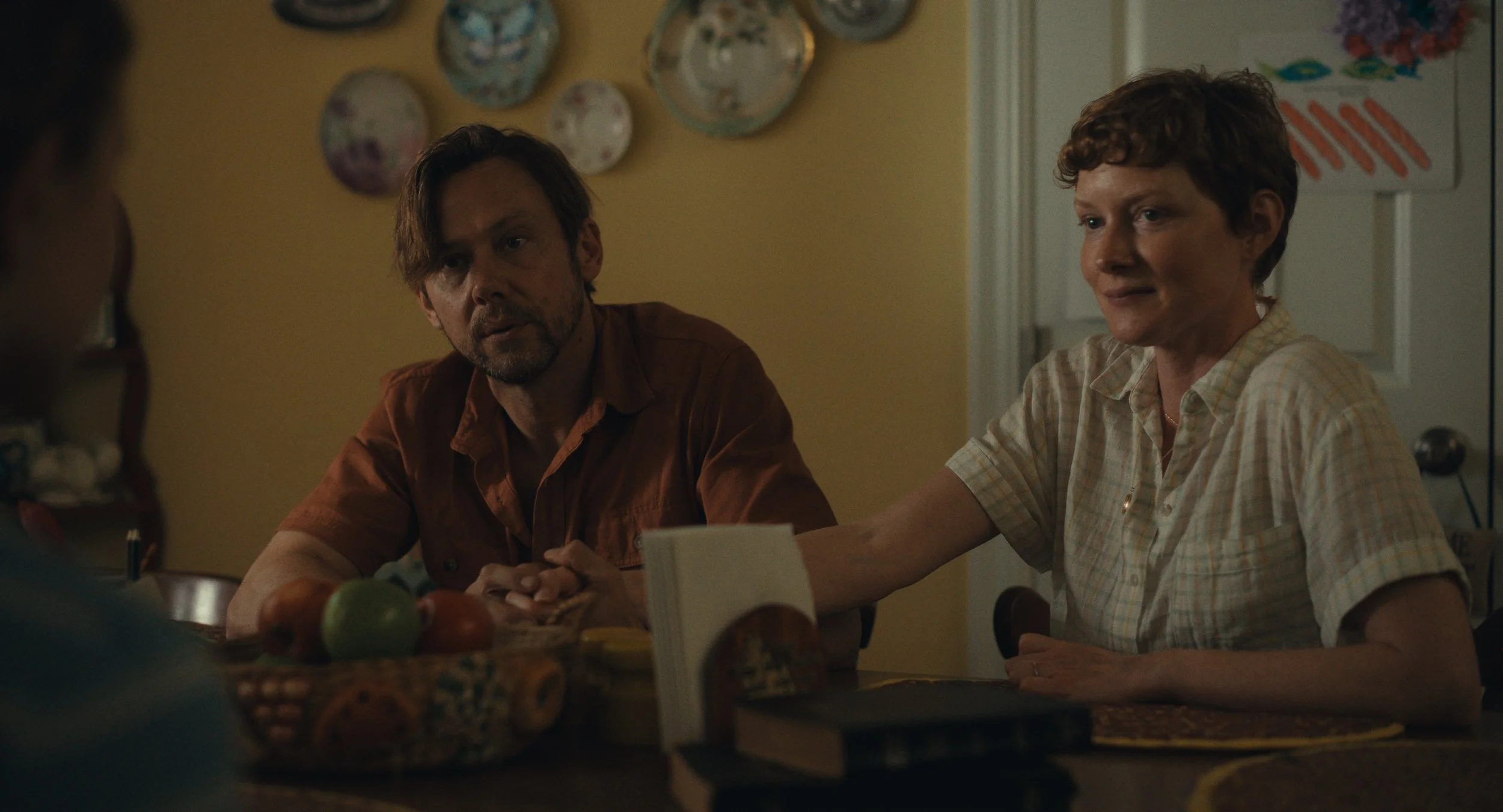
I was also surprised with supporting cast members Wrenn Schmidt and Jimmi Simpson as the Starling parents. In the background of Jem’s affair, the Starling family is impacted by the dad’s mourning of a former bandmate from his pre-fundamentalist, alcoholic days. With grief bearing a heavy toll on his soul, the patriarch’s gruffness escalates while he relapses. I’ve only seen Simpson in comedic roles, notably as Liam McPoyle from It’s Always Sunny, but he offers an MVP dramatic performance that earns chills with his heavy portrayal of grief. Parmet keeps the viewer in the dark about what Paul Starling will do next, and Simpson keeps you on your toes. The scenes shared between him and Scanlen are some of the most nuanced moments where Parmet develops a harrowing juxtaposition of forbidden romance in different toxic settings.

The Starling Girl’s coming-of-age narrative doesn’t stray from its predictable moments. Once the affair between Jem and Owen begins, you start checking your watch to timestamp the moment they’re exposed. Though it hits those familiar beats, Parmet’s screenplay is riddled with nuanced subversion, benefiting from its observational stance, for me to overlook the tropes. The accurate portrayal of the hypocritical community and religious trauma was far too strong, with some details hitting closer to home than they should’ve. Its non-satirical perspective makes me appreciate it more, showcasing how conservative Christian communities suck and you wholeheartedly root for Jem to leave.

Laurel Parmet’s The Starling Girl is a phenomenal examination of the hypocritical fundamentalist Christian institution and a rural teenage girl’s intense journey of self-discovery. Strengthened by a significant leading performance from Eliza Scanlen, this is a solid coming-of-age drama worth all the praise.

