
‘The Social Reckoning’ Review: Aaron Sorkin’s Sequel Needs Moderation of Its Own
Many will agree that Aaron Sorkin will never reach the heights he did with The Social Network. Since then, his downward decline has been meteoric, especially when he stepped behind the camera. He has little directorial sensibility, and his writing has become increasingly unbearable. Even so, his banality pales in comparison to that of rich wooden puppet Mark Zuckerberg, whose reckless chicanery in content moderation and non-regulation ruined American democracy and took over our everyday lives. Recently, Meta dropped their personal AI agent, Muse, a fuzzy Fall Guys bean-like mascot. I hope people aren’t stupid enough to be affected by its overly cute design.
Sorkin’s The Trial of the Chicago 7 and Being the Ricardos curbstomped me, so I wasn’t looking for a reward with his Social Network follow-up. The Social Reckoning chronicles how the damning 2021 Facebook data leak came to fruition. We all knew that with him behind the camera again, it’d be a major downgrade by default. At the same time, his subpar journalistic procedural flick is his most tolerable effort, seeing him less impulsive in his most egregious instincts.
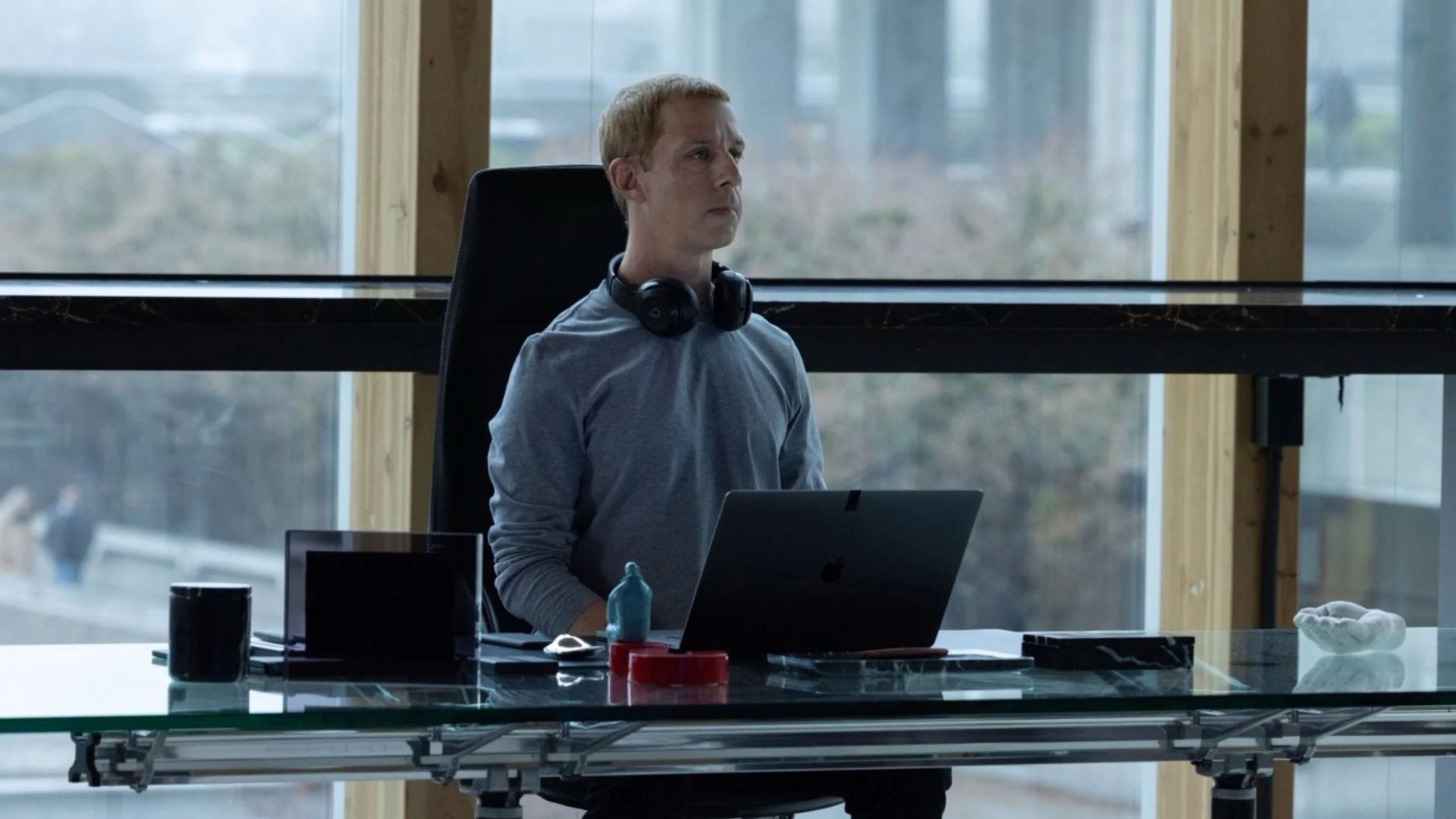
Image copyright (©) Courtesy of SONY
MPA Rating: R (for language.)
Runtime: 1 Hour and 52 Minutes (112 minutes)
Language: English
Production Companies: Columbia Pictures, Alcon Entertainment, The Gotham Group, Escape Artists
Distributor: Sony Pictures Releasing
Director: Aaron Sorkin
Screenwriter: Aaron Sorkin
Cast: Jeremy Strong, Mikey Madison, Jeremy Allen White, Bill Burr, Wunmi Mosaku, Betty Gilpin, Billy Magnussen
U.S Release Date: October 9, 2026
Set between 2019 and 2021 and told as a non‑linear narrative, the film follows Wall Street Journal reporter Jeff Horwitz (Jeremy Allen White) as he investigates Facebook’s lack of regulations, targeting its civic integrity department and messaging every employee on LinkedIn until the reclusive Frances Haugen (Mikey Madison) responds. The woman loves her job but agrees to share information after discovering that the algorithm steers users toward extremist groups through rage‑bait resharing and exposes minors to body‑image and self‑harm content. Meanwhile, in 2021, Mark Zuckerberg (Jeremy Strong) faces intense interrogation through congressional testimony on the website’s safety from his legal counsel, hitting an impasse with his team — specifically Gary (Bill Burr), who calls him out for refusing to take accountability for the company’s shady content moderation practices. As the clock ticks toward the whistleblowing article’s release, the film chronicles the extensive investigation to slam Facebook in the face… with a book.
The Social Reckoning makes Facebook’s whistleblowers the rebels.
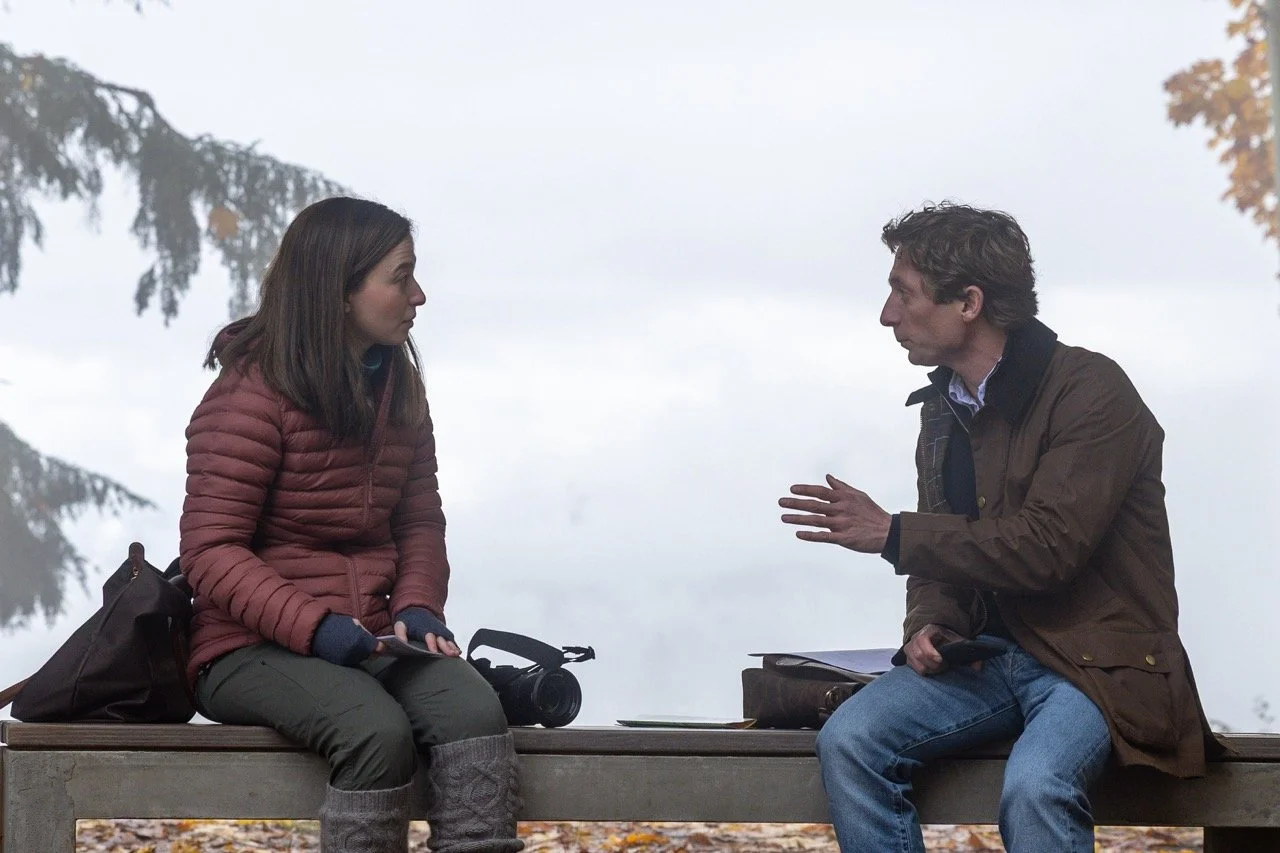
Mikey Madison, Jeremy Allen White in The Social Reckoning | Courtesy of SONY
Perhaps I just don’t expect much from him, or maybe it’s because Sorkin caught me at an afternoon screening when my caffeine intake was still high, but I’m shocked I didn’t outright dislike The Social Reckoning.
Social Reckoning emphasizes the exhilaration and endless time commitment that investigative journalism entails. And what can I say? It’s entertaining in that regard. Structurally, it’s a steady swing between the 2019 switch to the Horwitz and Haugen workflow and the years-long process leading to 2021, when Zuckerberg’s secrets went public. Sorkin is far from grasping the magnetism and grit his 2010 predecessor beholds, and with each directional misstep (dizzying camera rotations to the point of nausea), I long for David Fincher. However, you don’t feel him aim for The Social Network’s heights or attempt to do a carbon copy. With Zuckerberg’s humanity depleted, he operates on peak haterade, and it’s moderately entertaining.
Justifiably, Mark is positioned as a Darth Vader-like neurotic in the way of Sheldon Cooper. Facebook’s headquarters is merely a corporate Death Star, and with the whistleblowing elements, this might as well be Sorkin’s Rogue One. I adore how Jeremy Strong’s performance plays him like, “There's no Zuck now, only Zuul,” encapsulating Zuck’s cold, soulless disposition with his vacant stares, paused robotic responses, and short temper. Sometimes it seems more of a Kendall Roy character, but he got the modern Zuck speech pattern down pat.
Sorkin can’t resist turning a whistleblowing drama into an Aaron Sorkin show.
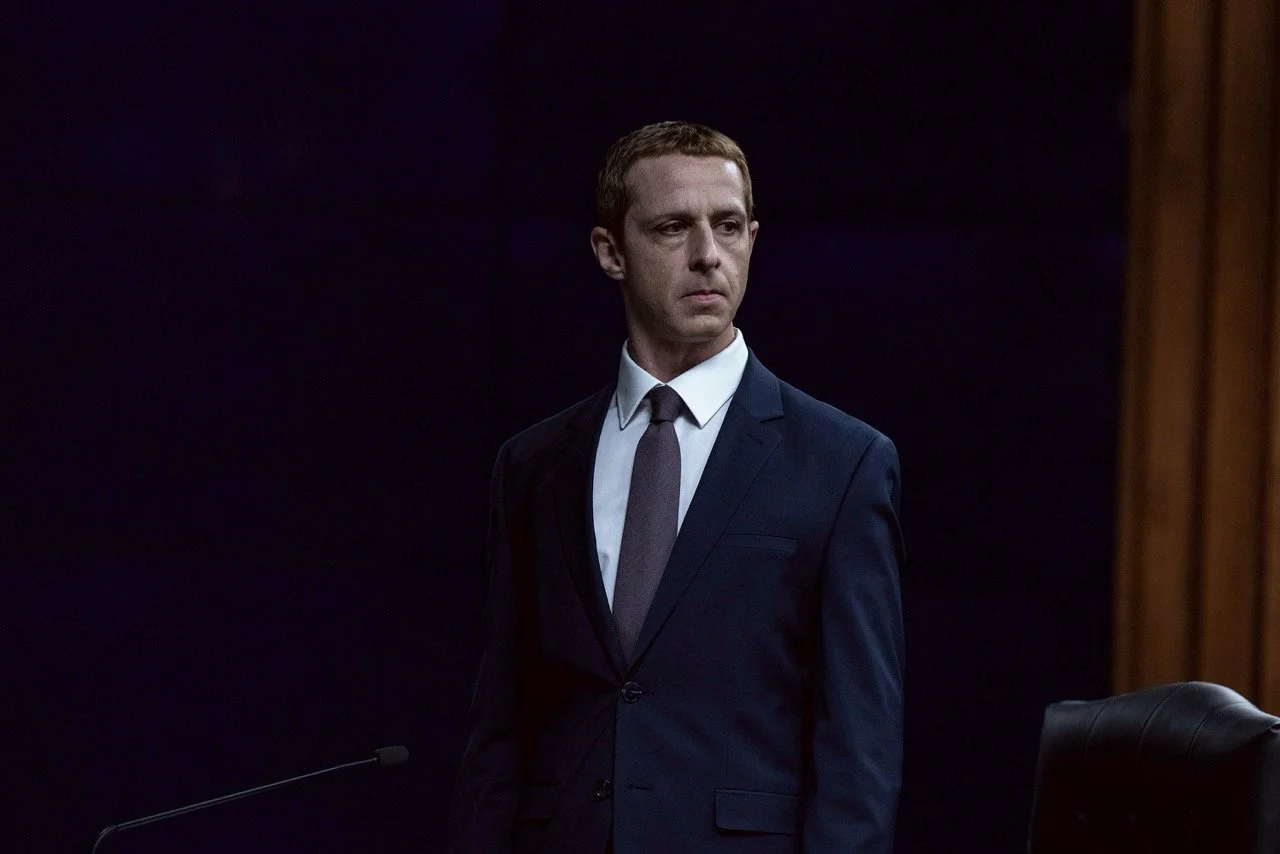
Jeremy Strong in The Social Reckoning | Courtesy of SONY
Sorkin’s snappy, matter-of-fact, fast-talking dialogue exchanges are the peaks and valleys throughout. Bill Burr’s Gary, the closest thing to the audience’s avatar, is so strong he’s impervious to Sorkin’s mouthpiece spell, having exhilarating back-and-forths with Strong’s Zuckerberg. Mikey Madison’s confident delivery of Haugen’s triumphant speech in her first post-Anora Oscar-winning role is also a standout. Sadly, those bright spots are sporadic, and the seesaw of quality is missing some balancing screws. At its worst, beyond his characters’ interactions seeming fucking alien, the man uses them as vessels to exercise his dated optics and oddities. There’s a horrendous “mansplaining” moment that had my press audience shocked, and weird fictionalized stretches like Haugen going incognito as a prostitute to enter Horwitz’s room to share information so she wouldn’t be seen as suspicious, with Madison wearing skimpy outfits. No, this did not happen, nor does she have a glucose allergy; it comes across as sexist given the real-life woman’s efforts. I can’t help but wonder what the real Haugen felt watching her be portrayed like a 2011 Tumblr sexy girl.
Madison and Allen White have a good scene with their smarmy banter and dynamic, but their thin writing at best hits Network TV quality. It’s weird in some cases because Sorkin essentially wrote fan fiction, making both the people he wants to champion look like pseudo love interests, or sometimes just mean-spirited for the sake of drama. Because of this, both performers get some battle scars, especially when they have to deliver broad, off-kilter jokes. Sometimes it’s intentionally funny, but then it gets to CW-tier humor with “Who the fuck even talks like this?” lines that had me facepalming.
As much as I want to give Reckoning the benefit of the doubt, because it’s not as smug as his previous flicks, the moment you think he’s ready to be consistent, Sorkin gets that helium hit to airhead status. Yes, the timeline involves January 6, and honestly, he nearly got me. I felt like Charlie Brown trying to kick Lucy’s football, thinking Sorkin would restrain himself from his worst impulses. But I’ll be damned, he recreated January 6, and I landed flat on my back. Good grief, I’m surprised that he caught me by surprise because we all knew he would tackle it, some way, somehow, the moment it happened. The inclusion of January 6, with people watching a screen à la Newsroom, is intercut with Haugen delivering her testimony while a loud operatic melody from Alexandre Desplat’s score blares in the background. It’s obnoxious, yet I couldn’t help but go, “LOL. LMAO, even.”
At the end of the day, The Social Reckoning’s storytelling is better than anything else within it. A movie about whistleblowing the lack of content moderation in desperate need of moderation itself is another example of Sorkin lacking directorial aptitude, resulting in a less-than-ideal but slightly engaging political drama.
