
'The Odyssey' Review: Christopher Nolan Defies Modern Blockbuster Norms With His Most Soulful Epic Yet
Christopher Nolan has become increasingly fascinated by man’s psyche, delivering harsh critiques of the catastrophes and evils they’ve wrought throughout time. As if he saw the worst type of cinephile bro latch onto his movies, he said, “Aight, bet,” and proceeded to have each blockbuster operate like a diss track to the entire gender. It was especially prominent in Oppenheimer, as he interrogated masculine ego, hubris, the devastation they leave behind and how it still ripples into our present day.
His latest blockbuster, The Odyssey, almost functions as an Oppenheimer companion piece, continuing the conversations he stirred there. Picking up where he left off, Nolan explores the themes of man’s impulsive and vain nature, but through an emotion-driven soulfulness, which I felt Oppy lacked.
Both a culmination of his recent work and profoundly intimate in its thematic storytelling, with some of the best ensemble performances this year, The Odyssey is an awe‑inspiring, epic filmmaking achievement. It gobsmacked me so hard, I couldn’t leave my IMAX 70MM seat long after the credits rolled.
MPA Rating: R (for violence and some language.)
Runtime: 2 Hours and 52 Minutes
Language: English
Production Companies: Syncopy, Universal Pictures
Distributor: Universal Pictures
Director: Christopher Nolan
Screenwriter: Christopher Nolan
Cast: Matt Damon, Tom Holland, Anne Hathaway, Robert Pattinson, Zendaya, Lupita Nyong’o, Charlize Theron, Mia Goth, Elliot Page, Benny Safdie, Jon Bernthal, Himesh Patel, Bill Irwin, Samantha Morton, Jesse Garcia, Will Yun Lee, Corey Hawkins, Josh Stewart, Jimmy Gonzales, Maurice Compte, John Leguizamo, Travis Scott, Logan Marshall Green
U.S Release Date: July 17, 2026
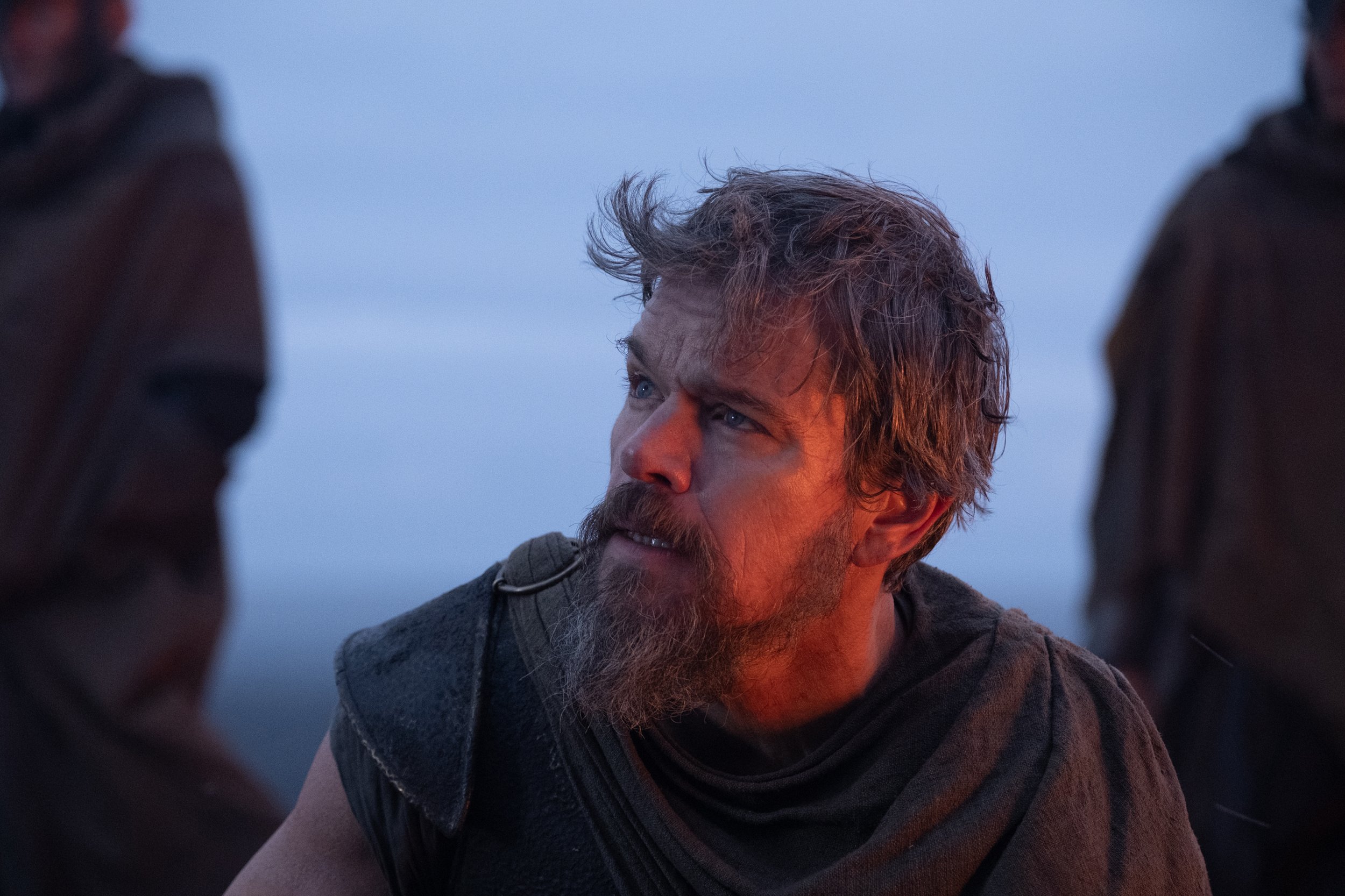
Trapped on an island with the nymph Calypso (Charlize Theron), high off the Blue Lotus, an amnesiac Odysseus (Matt Damon), King of Ithaca, struggles to piece together his own memory. After serving as general under Agamemnon (Benny Safdie) following the Trojan War, Odysseus and his men embark on a treacherous journey home. But with each pit stop, they face a series of challenges set by the gods, confronting figures like Polyphemus (Bill Irwin) and Circe (Samantha Morton), while haunted by the goddess Athena (Zendaya). Though everyone tells him the gods have prophesied he alone will survive, Odysseus is determined to defy fate and bring every last one of his men home alive.
Meanwhile, back in Ithaca, Odysseus’ son Telemachus (Tom Holland), whom he’s never met, grows tired of hosting boisterous suitors for his mother Penelope (Anne Hathaway). The self-assured queen weaves her shroud by day and unravels it each evening to avoid the obligation to find a suitor upon its completion, despite the weariness of her husband’s absence. Telemachus tries to piece together a portrait of his absent father from the men in his orbit, including Odysseus’ blind swineherd, Eumaeus (John Leguizamo). As the suitors line up to win Penelope’s hand, one in particular, Antinous (Robert Pattinson), schemes to take the throne for himself.
Nolan just built the damn thing…again.
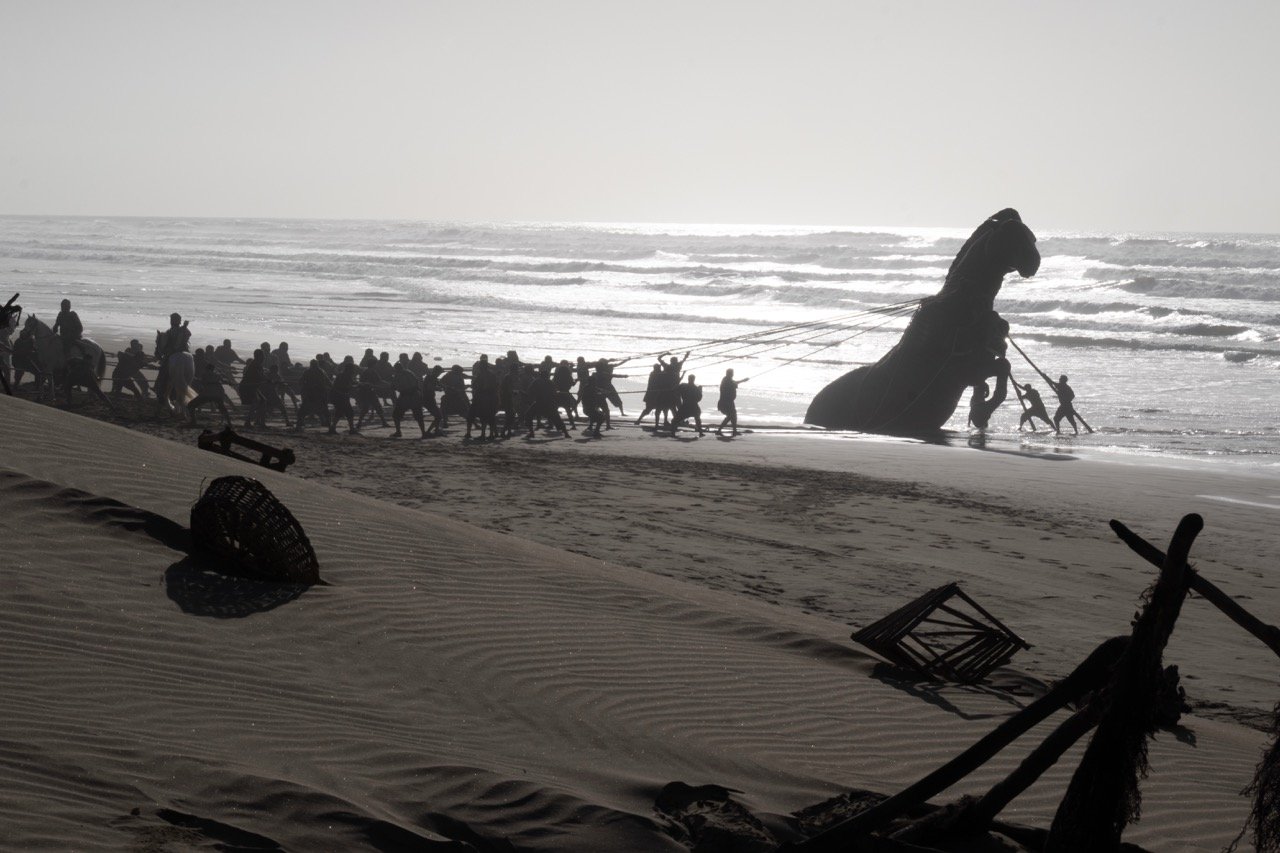
Trojan Horse at the beach in The Odyssey | Copyright © Universal Studios. All Rights Reserved.
We’re truly blessed to have a filmmaker like Nolan, whose insistence on practicality lends itself to true cinematic greatness and leaves other blockbusters quaking and hiding in their Trojan horses. With each project, I find myself asking the same question: “How tf did he do that?” With The Odyssey being a more action‑oriented fantasy text, you’ll be questioning how he captured everything he did, as each set piece outdoes the last, leaving you completely stunned throughout. It's satisfying to see so much scale and effort poured into the production. From the lavish Ithaca castles to the towering walls of Troy and the deceptive Trojan Horse, it’s all physically brought to life on location rather than on a goddamn volume stage. I wouldn’t be surprised if Nolan conjured a real cyclops and just asked Bill Irwin to take credit.
Nolan defies the expectations of a modern summer blockbuster, whereas in the past, he followed the archetype by blowing shit up and beautifully capturing it on film. The spectacle of The Odyssey is derived from visceral emotion and a grounded lens rather than from heightened gravitas. He employs handheld camerawork to achieve a distinct blend of mindfulness and grand scale. Its decentralization of the “LOOK AT OUR VFX” conventions may draw criticism, especially regarding the more fantastical elements, but the risk pays off handsomely. His critique of man’s atrocities lets his characters settle into their karmic consequences in such a palpable, sometimes horrifying manner.
There’s a grim grandeur throughout. Whether on land or at sea, the shaky cam evokes genuine terror in scenes where Odysseus and his crew escape bloodthirsty creatures. Uncommonly, Nolan even leans into horror. The steady, personable lens allows many of his emotional swings to land without ever compromising his epic ambitions.
There’s a breathtaking Greek elegance in its natural visuals, guided by frequent collaborators. DP Hoyte van Hoytema brings a phenomenal framework, and Ludwig Göransson provides his umpteenth banger composition, complementing each striking sequence. He utilizes synths reminiscent of Daniel Pemberton’s Spider‑Verse work during the Polyphemus encounter and intense percussion in the Trojan War sequence, where his inner Hans Zimmer is unleashed. The film’s embedded narrative and dual stories are expertly paced by editor Jennifer Lame, who employs an Oppenheimer-meets-Memento approach. The film’s nearly three-hour runtime is never felt as she’s working at the height of her power.
The downside of the shaky cam is that it lends itself to rough combat sequences that are sometimes sloppy. The man has to finally work with a second unit director because he can’t shoot action. There’s a good seven minutes dedicated to climactic swordplay and weapon-oriented action, and it’s so choppy, poorly staged, and blocked. It’s Nolan reverting to his 2005-era Batman Begins persona, which had the same glaring flaw in combat. It’s like watching an A student showing how that one subject he’s not good at still gets him a C.
The Odyssey turns Greek mythology into a mirror.
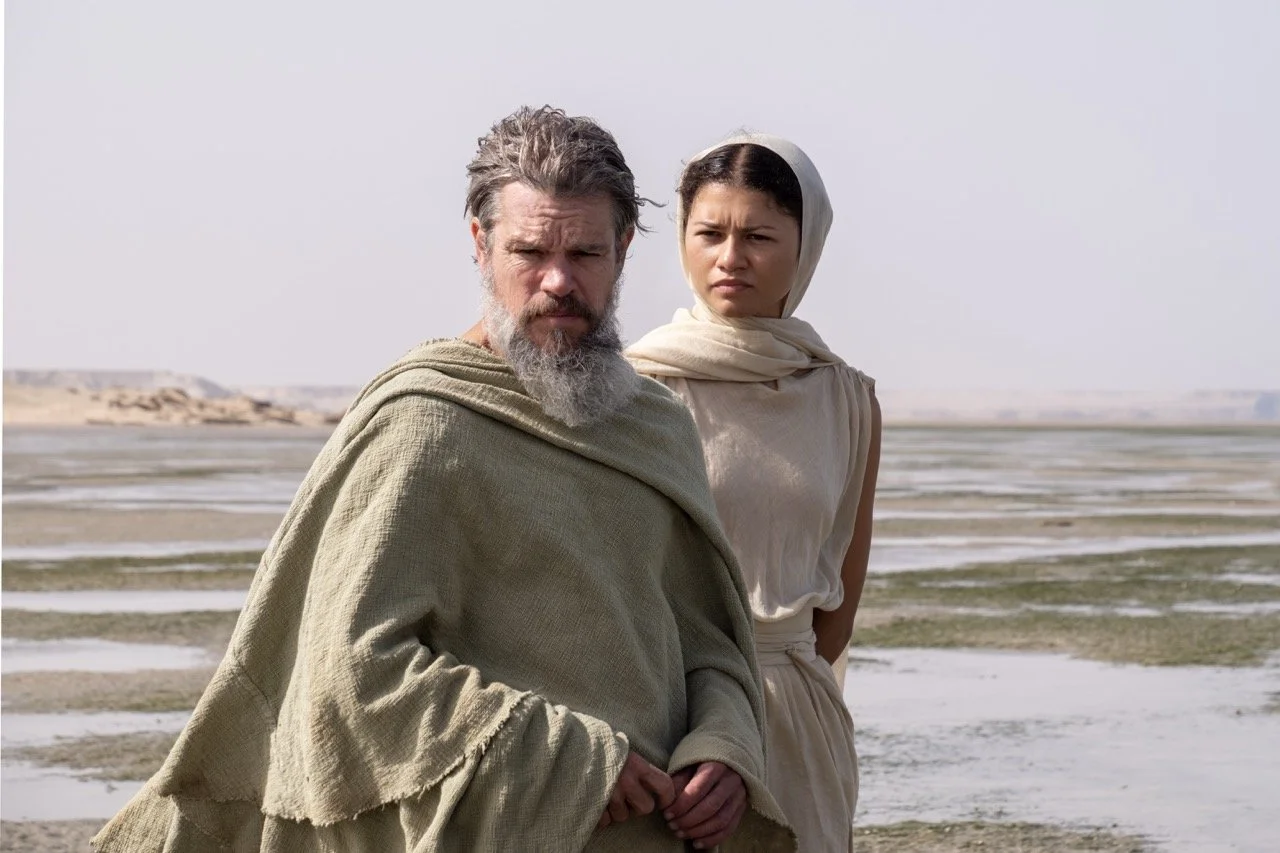
L to R: Matt Damon is Odysseus and Zendaya is Athena in THE ODYSSEY, written, produced, and directed by Christopher Nolan
The Odyssey is primarily concerned with the critique of man’s apathy, which is a result of the brutalization of masculinity through religious doctrine, ego, and hubris. Odysseus’ biblical‑like journey is fueled by “Zeus’ law,” a sacred code of hospitality and morality. But after the Trojan Horse and the war that followed, the gods were pissed. Using Nolan’s embedded narrative technique, Odysseus’ trips back home slowly reveal a conversation about how man’s pride is used to hurt others through religion and how their rude behavior and sheer arrogance bring them down. Each set piece, as vignette‑like as they seem, threads together a shattering critique of a gender so fueled by hyper‑masculinity that it renders them languished under the eyes of the gods. Each site is more ominous about the repercussions of war and Odysseus’ men’s ignorant belief that their barbaric, militant actions will have them hailed as heroes.
While Zeus’ law has its roots in Greek mythology, it’s not too far-fetched to compare it to many countries where people have twisted and weaponized basic rules and customs with ill intentions. As a non‑binary American raised in a Christian background, this deeply affected me; Zeus’ law could have simply been “God’s plan” in disguise. The symbolism of the infamous horse, when put in the context of Nolan’s potent screenplay, is so damning especially when put into a true context within a later reflective monologue scene that left me stricken. He may be an Englishman, but Nolan’s depiction of the lies and betrayal of the Horse doesn’t stray far from the atrocities pilgrim men committed on the Native American land we stand on. That Trojan Horse echoes the colonial myths many nations continue to tell themselves This applies to other countries that have also pillaged and occupied others that still continue to this very day.
The Odyssey strikes with a God-tier ensemble.
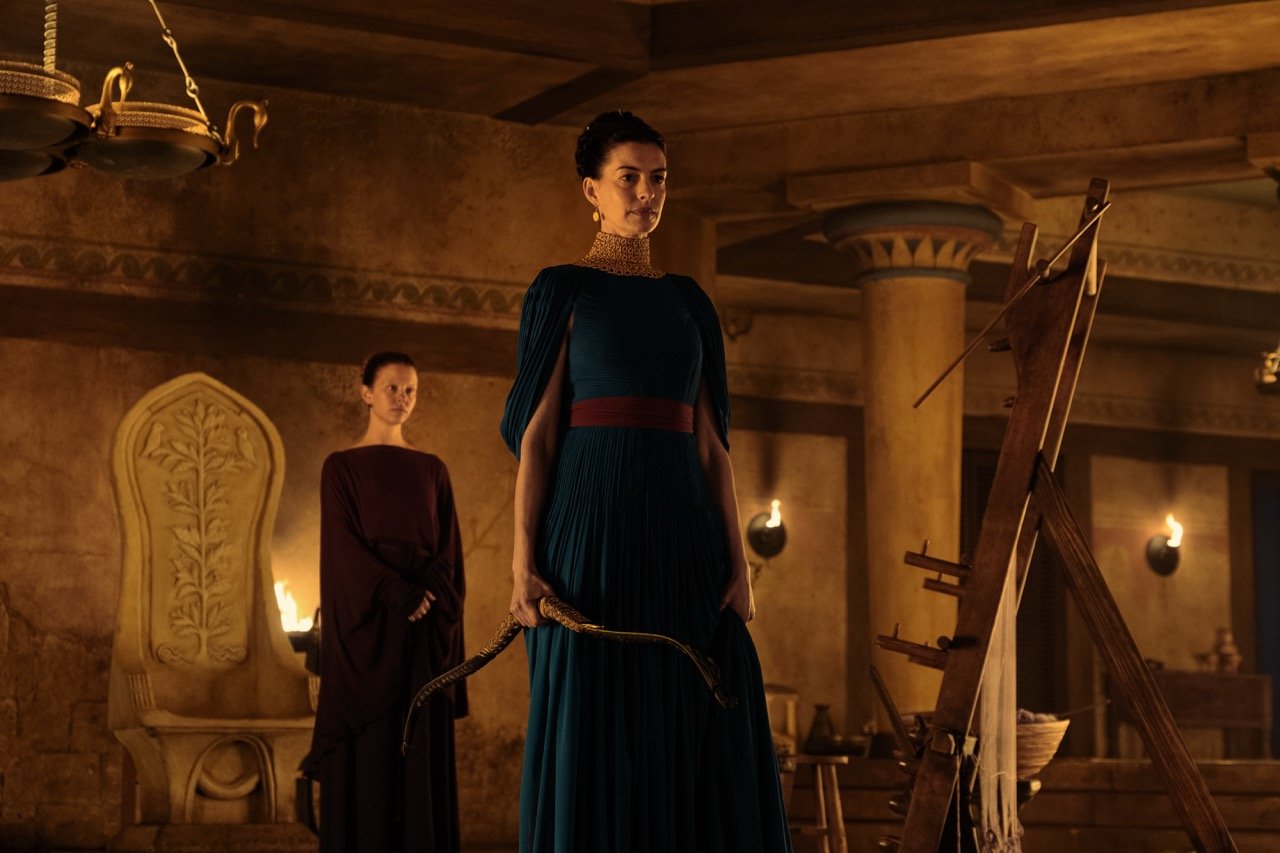
L to R: Mia Goth is Melantho and Anne Hathaway is Penelope in THE ODYSSEY, written, produced, and directed by Christopher Nolan.
Similar to Oppenheimer, The Odyssey features a sublime ensemble. And if you're one of those folks whose main "gripes" before entering are its diverse cast—take your ass back to Troy.
Zendaya's fierce Athena delivers some of the strongest feats of character introspection for Odysseus. Lupita Nyong'o's Helen has little screen time but is unforgettable, her sullen disgust cutting deep as Telemachus watches Menelaus (Jon Bernthal) boast about the Trojan War. Elliot Page, who initially seems to have a small role as Sinon, lands a standout monologue – and Nolan having the sole transmasc actor in the cast portray true bravery adds profound weight. Himesh Patel's Eurylochus is the perfect foil to Odysseus's godly wisdom, while John Leguizamo pours kindhearted charm into the loyal Eumaeus. Travis Scott's Bard appears in only two scenes and works fine for reciting poems, because that's the earliest form of rap.
It’s an effectively conscious, contemporary minded casting at its finest, and its deliberate nature adds immense meaning to the adaptation. It's such a non‑issue that anyone who complains about it just sounds like an utter, chronically online loser who shouldn't be a voice in judging art.
Matt Damon anchors the hell out of this film. He perfectly captures the wavering humility and regret – the humanity that haunts Odysseus on his journey home. Blurring stoicism and bravery, he textures each step of his arc with gradual weight, becoming not just a man of conviction and ruggedness, but a person of wisdom.
Speaking of weak-willed men, Robert Pattinson’s Antinous might be my favorite. He's basically Scar from The Lion King, except Pattinson turns him into a sniveling, deeply pathetic little bitch. At the slightest inconvenience Antinous faces, Pattinson does a petty hemifacial spasm and it’s comedy gold.
Tom Holland is fine, though clearly the weakest link among his co-stars. He works well for Telemachus’ wide-eyed curiosity, but he’s out of his depth, surrounded by immeasurable talent who pours emotion into mannerisms and expressions that he still can’t pull off. Still, it's a far better showcase than Hollywood's failed "dark Tom Holland" experiment we had with The Devil All the Time.
Anne Hathaway is utterly phenomenal. I usually take umbrage with how weakly Nolan writes women, but she’s the most realized character – perhaps thanks to the strength of Penelope within Homer’s text. Nolan’s script gives her some stellar zingers. She’s distraught in her husband’s absence, showcasing resilience and mental untethering with deliciously confident, take‑no‑shit energy, even toward her foolish son. The disparity in talent between Hathaway and Holland is palpable, especially in an argument where she tells him off, calling him “just a boy.” The diva‑esque delivery sent chills down my spine.
Last Statement
Out of Nolan’s filmography (I’m admittedly 70‑30 on him), this is among his best – alongside The Dark Knight and Interstellar – and one of his most rewatchable. The Odyssey is a near-perfect work, meticulously crafted with a personalized, stirring execution and a tight thematic cultivation of the commentary Nolan has previously explored. It is a beautiful, lyrical fable that explores the themes of accountability and growth, transcending the gender one was born into. The true resilience of the human spirit is demonstrated in the throne of Ithaca, where Penelope rejects unworthy suitors, and Odysseus transcends his arrogance through settling with his consequences. It’s introspective, poignant, and unfathomably epic that transforms Homer's myth into Christopher Nolan's most emotionally resonant film yet.
