
'The Monkey King' Review: Legendary Chinese Monkey's Netflix Animated Flick Dons American Clothing
PG: For action/violence and brief thematic material
Runtime: 1 Hour and 32 Minutes
Production Companies: Netflix Animation, Pearl Studio, Reel FX Animation, Star Overseas
Distributor: Netflix
Director: Anthony Stacchi
Writers: Steve Bencich, Ron J. Friedman, Rita Hsiao
Cast: Jimmy O. Yang, Bowen Yang, Jo Koy, Stephanie Hsu, BD Wong, Jolie Haong-Rappaport, Ron Yuan, Hoon Lee, Andrew Pang, Andrew Kishino, Jodi Long, James Sie
Release Date: August 18, 2023
Only on Netflix
This piece was written during the 2023 WGA and SAG-AFTRA strikes. Without the labor of the writers and actors currently on strike, the [series/movie/etc.] being covered here wouldn't exist.
I'm sure few non-Asian American kids know about the Chinese-based mythological legend, The Monkey King—at least the ones who aren't weebs. The hairy monkey-man action hero from Wu Cheng'en's Journey to the West, who slayed demon spirits and wielded a magical wooden Stick, always got the bottom banana in Western media representation, especially compared to Roman and Greek mythology. He inspired Shonen Jump characters like Dragon Ball's Son Goku and One Piece's Luffy, but they're Japanese-originated. This year, The Monkey King's iconography made it to the States. One place was Disney's American Born Chinese, in which Daniel Wu played him while wearing heavy hairy makeup. The legend is in the spotlight with an anthropomorphized face-lift in the latest Netflix family animated feature, The Monkey King. Though his lore is Chinese-originated, he got a very Americanized fab fable (derogatory).
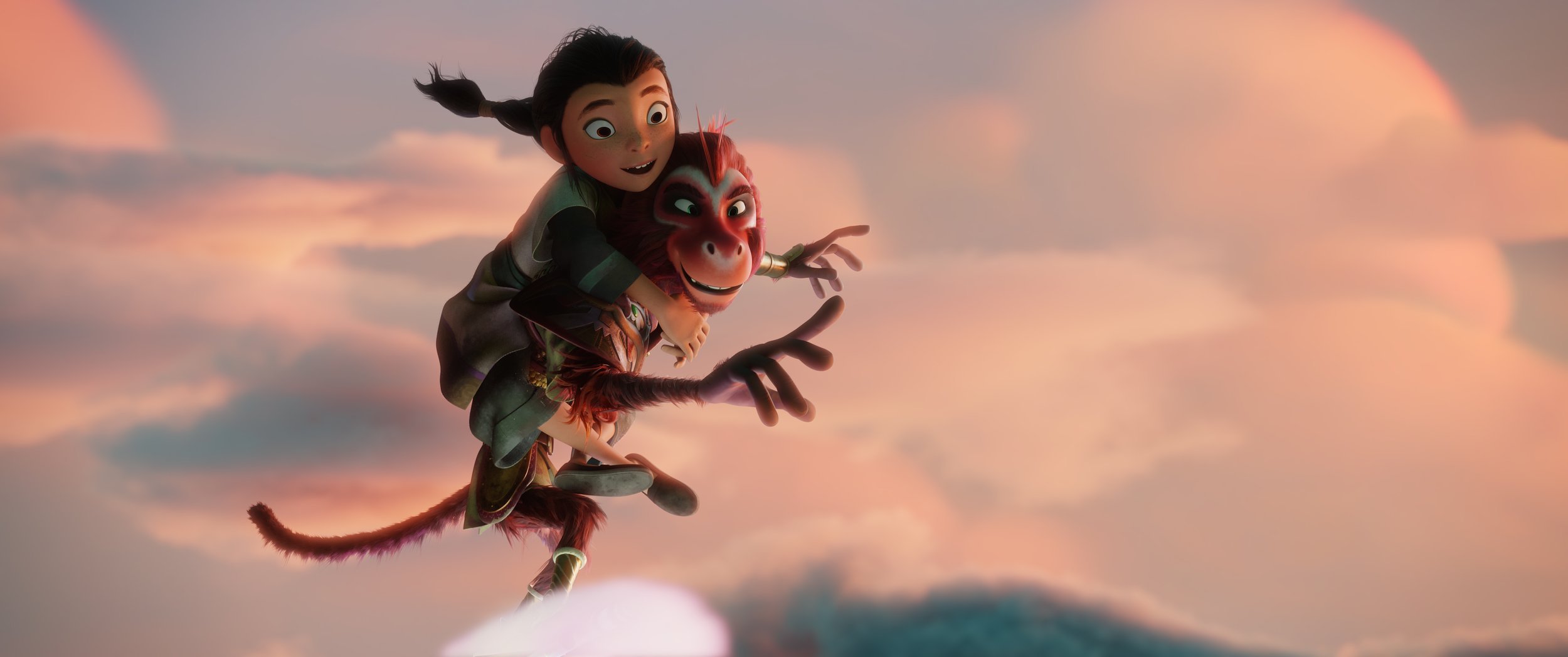
In a realm of Gods and Demons, an egotistical yet determined red Monkey (Jimmy O. Yang), born from a mystical rock, is rejected by a monkey tribe. He finds a magical Stick belonging to an eccentric Dragon King (Bowen Yang) at the bottom of the ocean and defeats a Tiger Demon who terrorizes the tribe. But Monkey believes he has a higher calling: to live in the clouds alongside the ancient gods. The tribe elder tells Monkey they'll never accept him unless he beats 100 demons, so Monkey and his Stick embark on a quest to do just that. Upon one of his battles in a human village, he meets Lin (Jolie Hoang-Rappaport), a humble village girl who enlists herself as his assistant. Monkey, Stick, and Lin travel through mystical lands to get Monkey's immortality (and possibly an ego check).
The Monkey King continues the streak of Chinese-American animated productions (Next Gen, Over the Moon, Abominable) that feature a predominantly, if not solely, Asian voice cast, adding authenticity to the film's environment and cultural background. The Monkey King’s great talents include Jo Koy, Stephanie Hsu, BD Wong, Ron Yuan, and Hoon Lee. But it is Jimmy O. Yang's voice performance as the titular Monkey that carries the movie. His natural voice matches the character's immaturity, and his stand-up comic experience aids the silly humor. Yang's comic timing in his oblivious-driven dialogue lands some laughs.
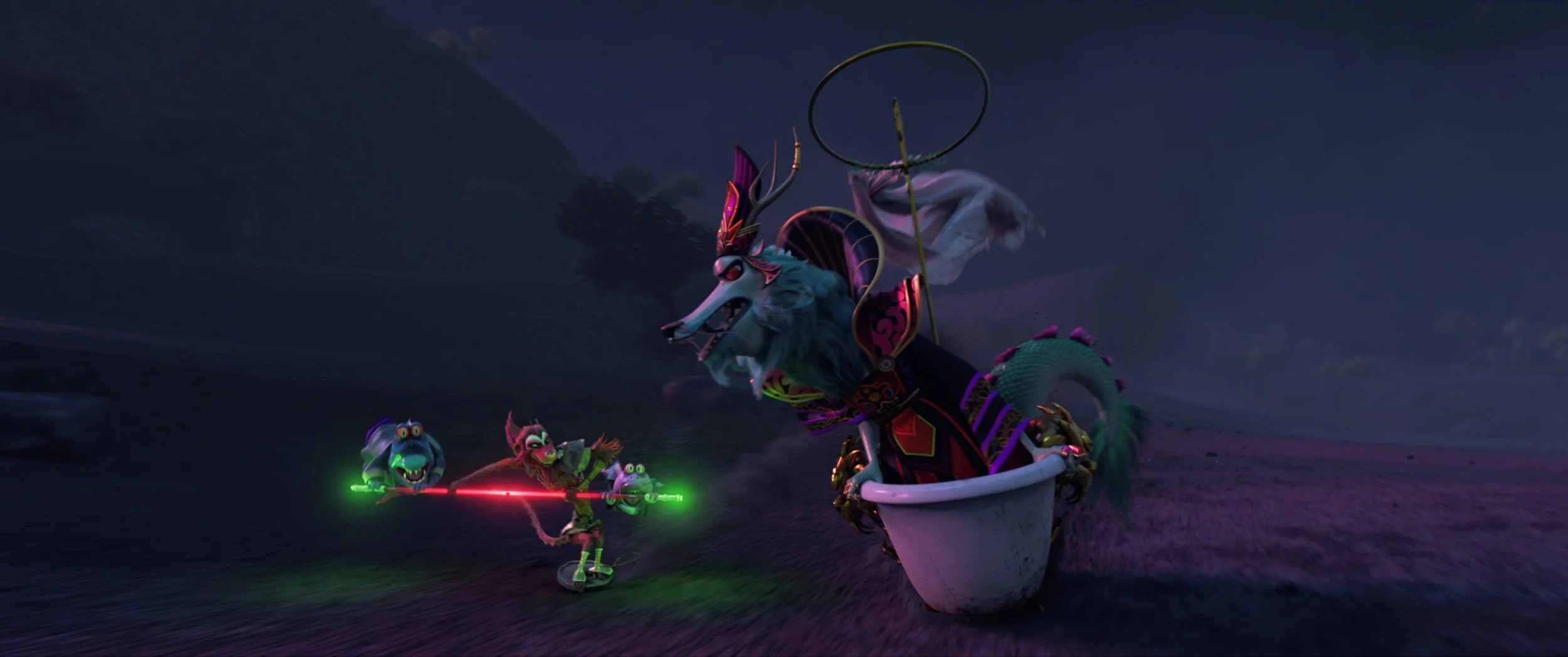
Bowen Yang, who puts the "drag" in his Dragon King role, is another standout who steals the show. He’s like if Aku from Samurai Jack was gay and had a skincare obsession, but his seriousness remained. Yang gives Dragon King a refreshing prima donna personality, and every little detail in his schemes to trick Monkey furthers that queer identity. Oh, and he has a showstopping villain number. The flick is not a musical—though its few songs are penned by Six's Toby Marlow and Lucy Moss—but it seized that ripe opportunity to have Bowen Yang sing. Plus, every other aspect of Dragon King is impressive. His design is like a mix of a dragon and a blue werewolf, composing many aquatic colors and donning a Peking opera fit, which suits his “theater major” personality. He also has the funniest running gag when pursuing Monkey and Lin; while on land, his two Pain and Panic-type henchmen, Benbo (Jo Koy) and Babbo (Ron Yuan), carry him in a bathtub because his scales immediately flake in dry air. Dry skin is every queer's worst enemy.
Co-produced by Reel FX (The Book of Life, Scoob!) and China's Pearl Studio (Over the Moon, Abominable), the film's animation quality isn’t up to par with previous productions either studio has done. It's nothing to write home about but is full of a Chinese-inspired kaleidoscopic pop that'll dazzle younger audiences. The production design and backgrounds particularly stand out, for each scenery has a distinctive aesthetic, reflecting the atmosphere of the dangerous demons or spiritual figures who reside there.
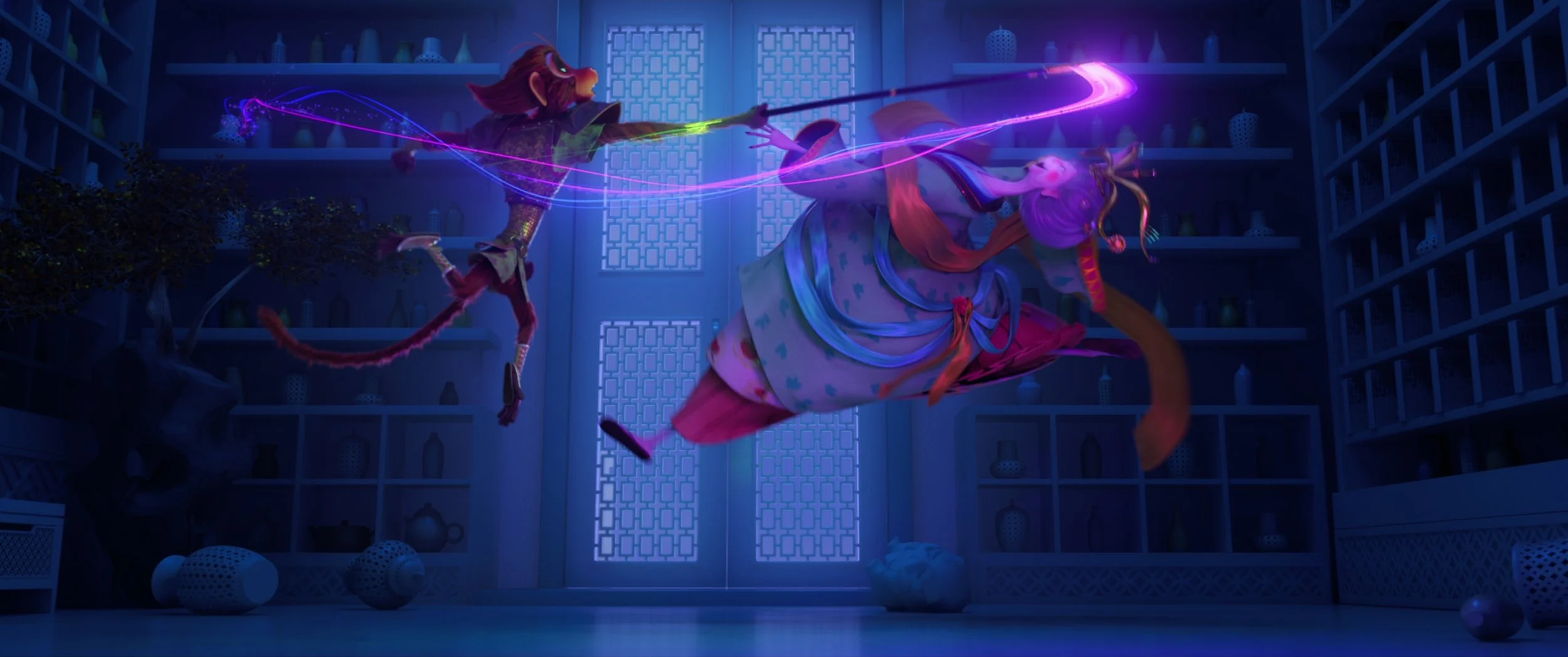
What The Monkey King lacks in animation quality, it makes up for in its exciting direction. It's worth mentioning that Kung Fu Hustle's Stephen Chow serves as a producer, and director Anthony Stacchi (The Boxtrolls) attempts to bring the same exhilarating kinetic martial arts influence from Chow's work into animation form. He succeeds with every set piece full of swashbuckling energy with decent slapstick comedy. Stacchi particularly impresses through stunning tracking shots (which is always cool since the animation process is lengthy). The camera swiftly sweeps around as Monkey King and Stick are in combat.
Importing and dressing a popular international figure in American clothing is a lazy tactic. I'm still reeling from the wounds of Doogal to this day. Thankfully, The Monkey King doesn't fall into most Western animated film tropes, such as random pop tunes and Hollywood A-lister casting, but he does arrive wearing a Disney outfit. The script by writers Rita Hsiao (Toy Story 2), Steve Bencich, and Ron J. Friedman (Chicken Little, Brother Bear) strips the cloth of Disney's Hercules and Emperor's New Groove and patches it onto the titular lead. The story is simply ‘97 Hercules beat for beat and played with a generic point A to B plot. If Hercules were a Monkey with a Stick but had Kuzco's selfishness (but not as funny), he'd be Monkey. Even his Pacha counterpart is a little village girl he constantly demeans. Whereas Kuzco had a clear character arc, the Monkey King writers forgot to install that component, heart, charm, or anything to make a likable protagonist.
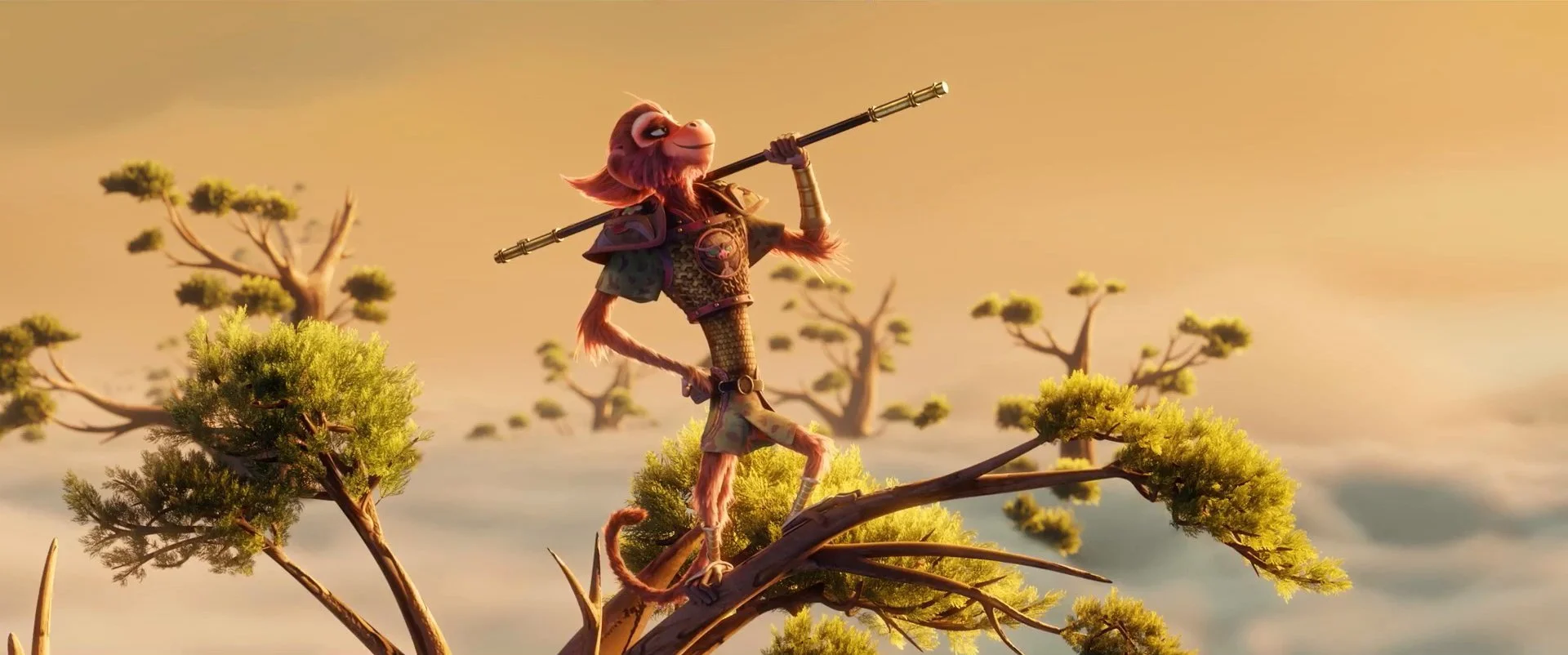
The titular Monkey King is the film's most significant flaw, for he's written with an insufferable, mean-spirited attitude. My American self read that the Monkey King is supposed to be brave and confident, but in this film, he's a self-obsessed bully with little remorse or compassion. Monkey's overpowered abilities and skills are hardly fun to watch despite the well-directed action, for he defeats everybody effortlessly, raising his ego. Jimmy O. Yang tries his hardest to ground him through his line deliveries, but the screenplay rids him of a soul. It tries to dive into the character's loneliness and wanting to belong. Still, his reckless attitude goes off the deep end, detracting from engaging stakes. Even the persistent and endearing Lin has no strength to rein him in. Due to that, the belated emotional beats where the two "connect" feel unearned. The film is far too laser-focused on serving as an action flick, breezing from set piece to set piece, that while it may entertain viewers, it lacks any soul to appeal to the whole family—something symbolic of Bencich and Friedman's previous works. Maybe hiring American shmoes with a poor track record to pen a film about an international mythological legend was a bad idea.

Despite its exciting martial arts action, Netflix's animated family flick The Monkey King imports the Chinese legend, dressing him in Mickey Mouse clothing via an uninspired story with a grating lead and average animation.

