'The Card Counter' Review
R: For some disturbing violence, graphic nudity, language, and brief sexuality
Runtime: 1 Hr and 52 Minutes
Production Companies: Saturn Streaming, Astrakan Films AB, RedLine Entertainment, LB Entertainment, Enriched Media Group, One Two Twenty Entertainment
Distributor: Focus Features
Director: Paul Schrader
Writer: Paul Schrader
Cast: Oscar Isaac, Tiffany Haddish, Tye Sheridan, Willem Dafoe
Release Date: September 10, 2021
In Theaters

William Tell (Oscar Isaac) — formerly Private First Class William Tillich — is a special ops soldier carrying the moral weight of harrowing crimes in Iraq. After serving time in prison, he reinvents himself as a professional gambler on the American poker circuit, but his actions abroad haunt him to his core, even after he swaps isolation and despair for love and connection. His only solution is to violently reckon with his own past.

Throughout his career, writer/director Paul Schrader has had an intriguing hit-to-miss ratio in terms of quality with the films he writes and/or directs. In 2018, he returned to form with the dramatic thriller First Reformed, which earned him his first Oscar nomination. With that being his first major hit in eons, everyone was pumped to see if his lighting could strike twice. With The Card Counter, you can see the cumulonimbus clouds forming.

Recently, war-related dramas such as The Report and The Kill Team have openly discussed the topic of American war crimes during the Iraq War, especially regarding the torture of innocent Afghani people by American soldiers during the Bush era. This is used as the basis of Willam Tell. While it bears the familiar archetype of a man with a violent past, it’s given a new spin based on an under-discussed subject. The more time you spend with Tell and see the intense and inhuman pieces of his past, the more you understand the psychological effects it has on him and his lifestyle.
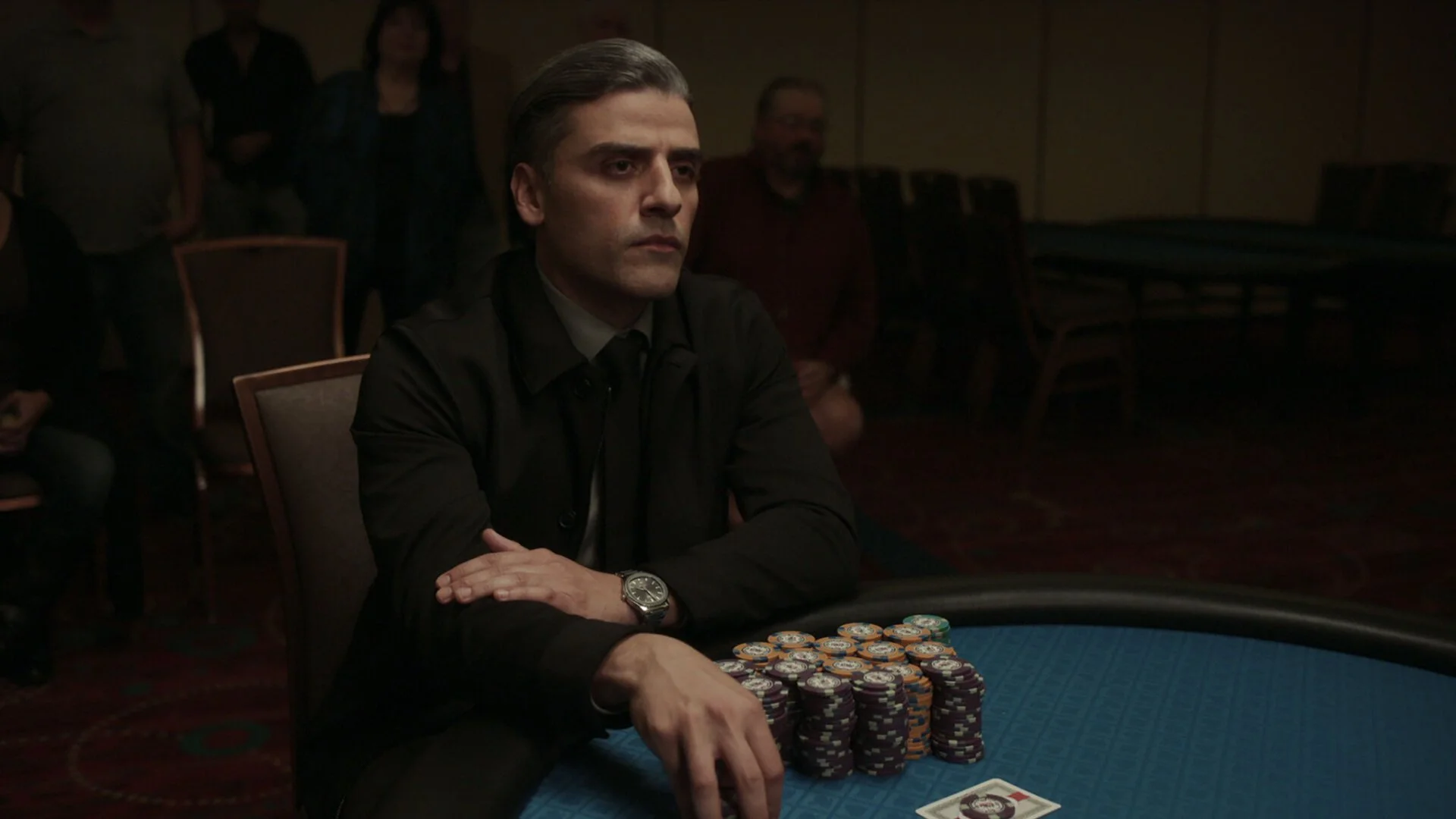
Tell lives his post-special ops/incarceration days in casinos playing various card games like blackjack and poker to pass his time. He leads a minimal and low-key lifestyle that one might see as banal, but he is content with it. Schrader keeps you attached to his lead and gets into their psyche through their actions and voiceover narration. Through the lens of Tell and Schrader’s swift direction, you are transported within the confines of casinos, which are showcased to look both inviting yet self-contained. When Tell crosses paths with a misguided yet vengeful college dropout Cirk (Tye Sheridan), who has ties to his Bush-era war crime days, Tell gets his own perspective and takes him under his wing. I love how he conducts himself with a calm and collected demeanor. When things around him begin to get chaotic, he doesn’t overreact or mess up his beautiful, slicked hair. Much like the games he loves to play, he considers his options before heading towards the last resort. I adore his ability to keep his reality and past life that Cirk is aware of undisclosed and separate from his current journey with his financial backer La Linda (Tiffany Haddish).

Holy hell, Oscar Isaac delivers such a refreshing and badass performance. He seamlessly brings this character to life with such dedication through contained actions and sullen (but not soft) delivery. Whatever pratfalls Schrader’s screenplay makes, it’s compensated for with Oscar Issac who is so powerful, making this character study of a narrative shine and worth the price of admission alone. This is the sexiest he’s been in ages and when he’s paired with Tiffany Haddish’s La Linda, who is a direct contrast of him, ooh boy it gives you instant heartburn.
I initially felt that Haddish was miscast given the film’s genre, but given her character’s occupation and what she represents in the field, her natural and easy-going nature grew on me and the chemistry she shares with Isaac is steamy. There’s a decent build of romantic tension between the two that you can smell cooking from a mile away, but they serve such sexy looks and are of such a mature mindset that it works.


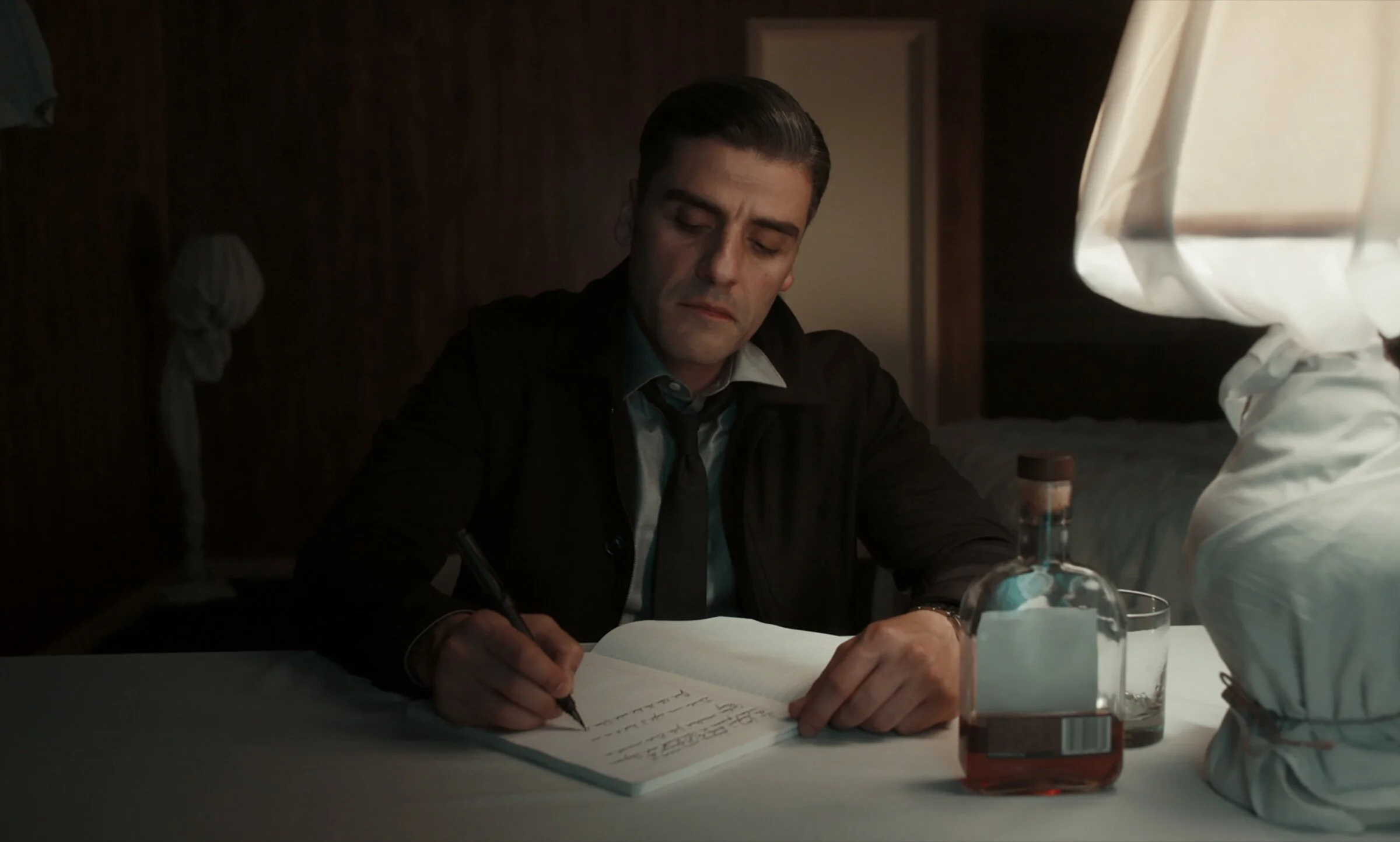
Schrader has done a ton of character studies in his career thus far, and while some characters are more realized than others, The Card Counter is just average due to the lack of substance outside of Tell’s arc. As a character study, the film is effective though it can’t help but retread some character details from First Reformed in order to convey the life that Tell leads. There are elements about Tell’s lifestyle that are either underdeveloped or too excessive regarding how reclusive he is. He tries his best to move like a ghost when he stays at motels and covers everything in his room with linen sheets. However, there isn’t a scene that shows how he maintains that perfect hair. Like, show that hair routine, dude. It’s perfectly gelled in every scene and you never get to see him do his hair.
Between the realistic American guilt overlaid with his upward rise to becoming a competitive professional gambler and seeking his own personal redemption, the consistency with Tell’s character begins to blur. When Tell agrees to become La Linda’s client and gets public traction within the competitive card community, it doesn’t fully acknowledge how he’s handling the notion of becoming visible when he desires a low-key life. Some of Isaac's narration is compelling but then he goes on these philosophical tangents that are self-indulgent and unnecessary. Its poignancy works best when Tell is doing his own thing in the casinos, for that’s where it feels like he’s his own individual and not just another archetype of Schrader’s previous leads.
The film’s first half is sub-par as far as storytelling and dialogue go. When the supporting players, Cirk and La Linda, who are of vastly different worlds, make their way into the fray of Tell’s life, the setup feels blatantly hamfisted. Everyone interacts with Tell with this in-your-face bluntness that ranges from feeling telegraphed to derivative. Tye Sheridan’s Cirk is an enticing character, primarily when his backstory and motivation for vengeance on Tell’s former commanding officer (Willem Dafoe) comes to the forefront. Sheridan and Isaac share a few great moments together, but their characters’ relationship doesn’t entirely come together due to the film’s pivot towards the third act.
As unevenly as the film handles the concepts of past and present, the midpoint is where I grew to appreciate it. Granted, it still has major pacing issues that many will perceive as dull and indulgent. The Card Counter is a mid-tier effort that presents a barrage of bold ideas with varying degrees of impact, ranging from strong to middling at best. The storytelling is uneven as it takes one too many cues from Schrader’s previous successful works while being too scatterbrained and underdeveloped to weave its own web, but Oscar Isaac’s captivating performance alone warrants a recommendation of sorts.