'Spider-Man: Across the Spider-Verse' Review: Masterful Spidey Sequel Swings Higher Than Ever Before
PG: Sequences of animated action violence, some language, and thematic elements
Runtime: 2 Hours and 16 Minutes
Production Companies: Columbia Pictures, Sony Pictures Animation, Marvel Entertainment, Arad Productions, Lord Miller Productions, Pascal Pictures
Distributor: Sony
Directors: Joaquim Dos Santos, Kemp Powers, Justin K. Thompson
Writers: Phil Lord, Christopher Miller, David Callaham
Cast: Shameik Moore, Hailee Steinfeld, Brian Tyree Henry, Luna Lauren Vélez, Jake Johnson, Jason Schwartzman, Issa Rae, Karan Soni, Daniel Kaluuya, Oscar Isaac
Release Date: June 2, 2023
In Theaters Only
Something in the universe shifted when Sony Pictures Animation swung Spider-Man: Into the Spider-Verse into theaters at the tail end of 2018. Nobody could’ve predicted its impact on superhero movies and the animation medium. During a time when animated films burned millions to evoke realism, Miles Morales webbed up the game with a stylized 2D-3D mashup unlike anything seen before. After Miles snatched himself an Oscar, the animation industry took a nice Spidey-inspired pivot. Big league studios like DreamWorks and Disney caught the bug and kicked realism to the curb with their slew of stylized animated films. Into the Spider-Verse’s legacy exemplifies the achievement of masterful filmmaking. The long-awaited follow-up, Across the Spider-Verse, had some big shoes to fill. To my delight, the team at Sony Animation once again pushes the boundaries of animation to breathtaking new heights in a spectacular second chapter of Miles Morales’ epic story.
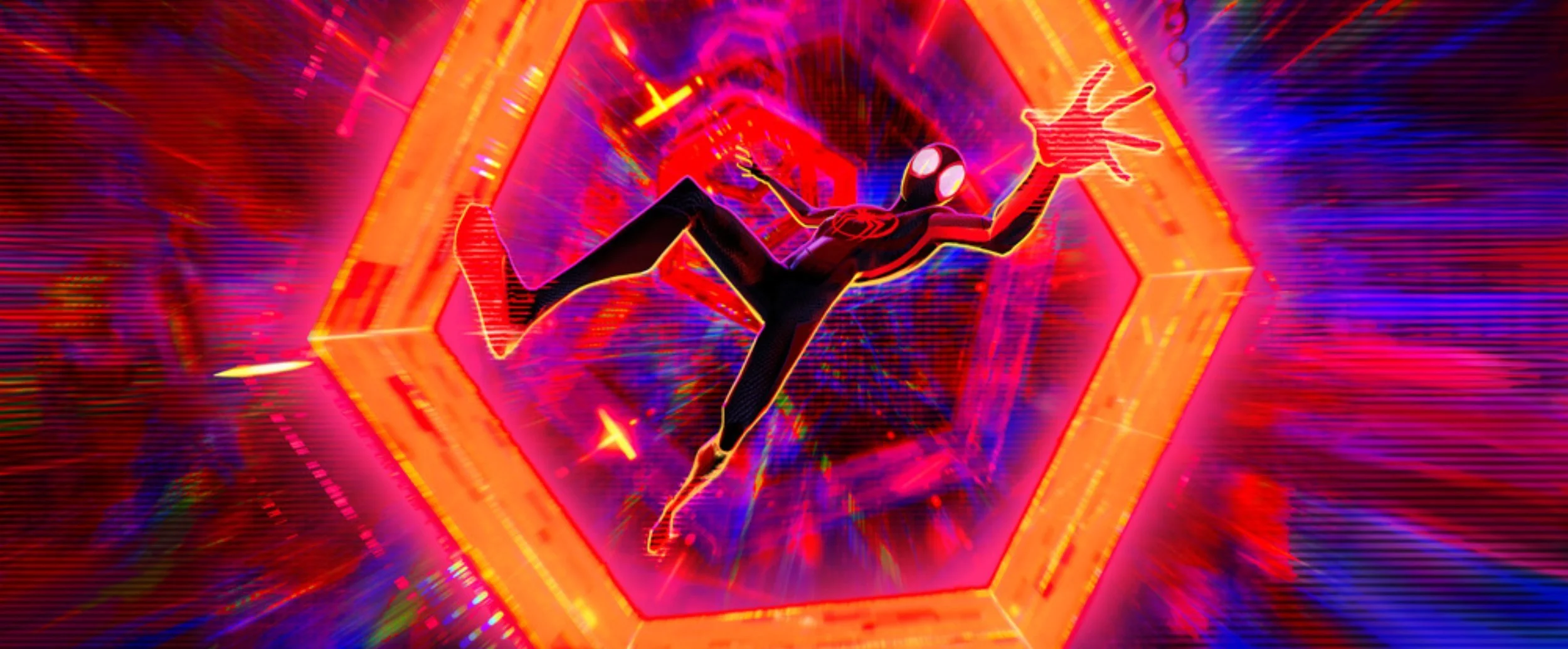
A year into being his universe’s one and only Spider-Man, 15-year-old Miles Morales (Shameik Moore) is having a tough time juggling crime-fighting and being a dutiful son for his parents, Rio (Lauren Vélez) and Jeff (Brian Tyree Henry). The weight of great expectations bodes to be unbearable for the lonesome Morales. All that changes when a black-and-white spotted villain with cross-dimensional abilities, The Spot (Jason Schwartzman), appears. This catches the attention of Spider-Man 2099/Miguel O’Hara (Oscar Isaac) and his small interdimensional Spidey-strike force: Jessica Drew (Issa Rae) and recruit Gwen Stacy (Hailee Steinfeld). When Gwen and Miles’ worlds collide again, he follows her across the multiverse and meets an assembly of Spider-people in the collective Spidey Society O’Hara founded. While Miles wants him, O’Hara rebukes him. As their ideological differences clash, it’s a race against time to track down Spot before he tears Miles’ life and the multiverse apart.

Multiverse stories have been all the rage these days in Hollywood. On one end of the spectrum, you have something like the MCU that flaunts it for unrewarding fan service. Then, you have films as distinct as Everything Everywhere All at Once that embrace the zany possibilities of a multiverse to tell a heartwarming tale about generational family links. Across the Spider-Verse takes advantage of its multiverse aspect by pushing the limits of animation, crafting an epic kaleidoscope of visual splendor from the first frame to its very last.

While its predecessor was self-contained with Miles Morales’ universe, Across ambitiously expands itself to integrate different animation techniques, giving every designated Spidey character or environment a signature flair tailored for them. Gwen Stacy’s universe has a watercolor backdrop with ever-changing blue, pink, and white hues—Stacy’s signature colors—appointing whatever emotions she feels. Miguel O’Hara’s universe features a coating of futuristic art style. A collage style composes Spider-Punk (a hilarious Daniel Kaluuya), a standout Spidey character. Across the Spider-Verse rapid-fires every art technique and style known to man, widening the animated multiverse’s scope. The characters’ techniques and movements feature many intricate details, The Spot being a standout. I was so captivated by his simplistic figure drawing design and how visible his stencil-like linework is. Whenever he’s enraged, black blots fill the screen as he aggressively distorts. Agh, it’s so darn cool!
This level of artistry is overwhelming, but it’s astonishing to behold. Writing this review feels tricky since Rendy Reviews’ artist, Nina Vazquez (who did the GOOD, BAD, and RENDY art on the site), worked as a matte painter on Across the Spider-Verse. With each frame, you feel the passion, dedication, and unified collaboration of each artist who crafts this film to be a unique celebration of the animation medium.

As the first entry of a designated two-parter, Dune-style, screenwriters Phil Lord, Christopher Miller, and Dave Callaham formulate a bold expansion on Miles’ coming-of-Spidey with a significantly darker tone. With every Spider-Man tale—let alone MOST superhero origins—death and loss play a principal role in their identity. One detriment to No Way Home’s narrative was how Tobey Maguire and Andrew Garfield’s Peter Parkers appear just to tell Tom Holland’s Peter Parker, “You have to go through the death of a relative to find your way. It’s in our rubric. Abide by it.” Across the Spider-Verse cleverly explores that trope through Miles’ overlying conflict with the menacing/macho Miguel O’Hara. Miguel, a tragic Spider-Man in his own right, plays a surveillance operative, ensuring the Spidey Bible remains intact. The film provides a thought-provoking perspective on super-heroism tropes when Miles and Miguel disagree. Lord, Miller, and Callaham get into the nitty-gritty about defining what makes your Spider-Man identity remarkable.
I could tell you how many Spider-Men in media history appear in this movie and how satisfying it is to see them all at once, but I won’t do that because nostalgia is a capitalistic curse. I’ll commend the fan service for utilizing all the Spider-Men to solidify O’Hara’s argument. Miles’ singularity attempts to defy what every Spider-Man has done before, including his friends Gwen and Peter B. Parker (Jake Johnson). It’s a genius focal point to Miles’ arc, adding weight and intense stakes.
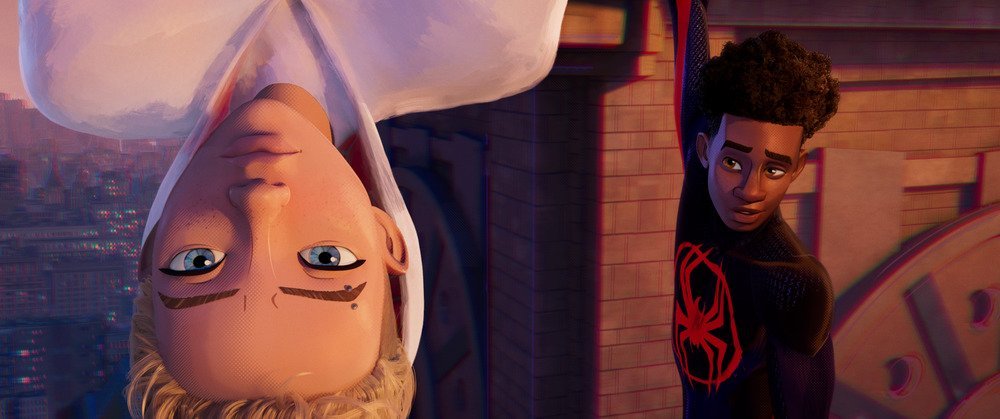
I love the expanded roles of most supporting characters from the predecessor. There’s more interplay with the Morales family dynamics. Given that Miles is at a rebellious age, seeing how that Afro-Latina household runs where Rio wears the pants is legitimately funny. Jeff may be the cop, but Rio runs the house. Like every Spider-person, the secrecy of his identity is a slippery slope, and I love how this film hits elements similar to Sam Raimi’s Spider-Man 2. Being Spider-Man can be a burden when crime-fighting interferes with significant life events. Whereas Raimi screamed, “He’s burnt out!” directors Joaquim Dos Santos, Kemp Powers, and Justin K. Thompson held hands and shouted, “He’s lonely!”
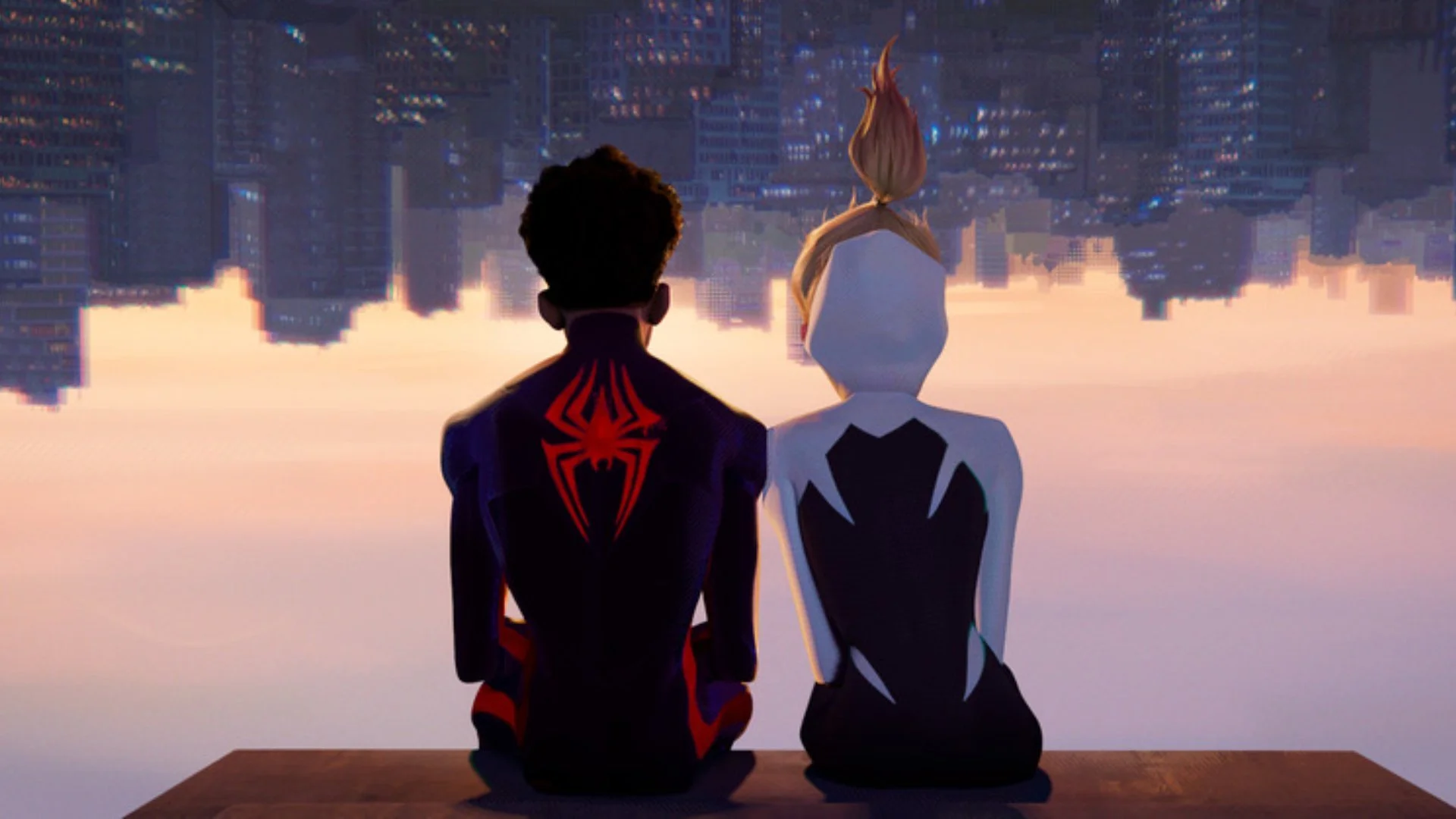
While this is Miles’ story, they dedicate much attention to Gwen Stacy, who becomes a fleshed-out character. The filmmakers contrast Miles' loneliness with Gwen's through a subplot that involves her dad, Captain George Stacy (Shea Whigham). Nothing like a Lord/Miller movie with a few daddy issues, right?

Oh, Sony. You couldn’t leave well enough alone. You just had to have that one executive tell the animators, “Hey, can you link our lil Sony-Spidey-properties into this, please?” unaware that it would disrupt the self-contained nature that worked so perfectly in the predecessor. It’s a minor complaint, but I could’ve done without them incorporating several mixed-media cameos. Some people are present to please studio demands rather than contribute any valuable fan service.

Just when you thought Everything Everywhere was the peak of multiverse stories, Spider-Man: Across the Spider-Verse swings in to take Miles Morales’ narrative and the animation medium to the next level. This movie made me feel the way sci-fi nerds felt about Dune: Part One: watering at the mouth, wanting the next chapter immediately. Across the Spider-Verse is a transcendent work of art with bold storytelling and awe-inspiring visuals, making it one of 2023’s best pictures.