
'May December' Review: Todd Haynes' Complex and Campy Melodrama Magnifies Manipulative Family Pains

R: Some sexual content, graphic nudity, drug use and language
Runtime: 1 Hour and 57 Minutes
Production Companies: MountainA, Gloria Sanchez Productions, Killer Films, Taylor & Dodge, Project Infinity
Distributor: Netflix
Director: Todd Haynes
Writers: Samy Burch
Cast: Natalie Portman, Julianne Moore, Charles Melton
Release Date: November 22, 2023 | December 1, 2023
In Theaters + Netflix
Todd Haynes' latest, May December, has lingered with me since September's 61st New York Film Festival. By the time of my screening, I'd seen 30 movies in a month. Most films from NYFF and TIFF left my memory, but May December lived in my head, rent-free. It's the second riff on the infamous Mary Katherine "Mary Kay" Fualaau scandal following Adam Sandler's That's My Boy. Albeit, not specifically a comedy per se yet, May December is much funnier than That's My Boy without ever teetering into the outrageous insensitivity. All in the while of being a heartbreaking experience. That’s the power of Todd Haynes, baby.

In 2015, actress Elizabeth Berry (Natalie Portman) is preparing to play Gracie Atherton-Yoo (Julianne Moore) in an indie drama. Atherton-Yoo became infamous in 1992 when she, at 36 with a husband and son, was caught having sex with 13-year-old Joe Yoo at a pet shop where they used to work. She was then imprisoned while pregnant with their first child and became a registered sex offender. Over 23 years later, Joe and Gracie are married and have three kids: college-aged Honor (Piper Curda) and senior high school twins Charlie (Gabriel Chung) and Mary (Elizabeth Yu). On the heels of the twins' upcoming graduation, Berry arrives at their home in Savannah, Georgia, to meet with the Atherton-Yoos, studying their lives for the authenticity of her performance. The Atherton-Yoos hope her performance illuminates the nation on the truth of their marriage. Elizabeth, however, has other plans as she goes about the island, asking community members and Gracie's former family about their relationship.

Despite the sensitive hebephilia subject matter, May December finds Haynes at his cheekiest. He places the viewer in a third-eyed perspective and frames the layered drama with the same backbone as a Lifetime original movie. He applies the familiar trashy attributes––i.e., the suburban small-town location, reusing the same tracks from another movie (The Go-Between) for humorous purposes, and a love triangle––with a loving embrace while grounding his characters in reality.

May December expertly mixes its melodrama with a campy sense of humor. Samy Burch's screenplay texturize the psychological effects every person in the Atherton-Yoo orbit faced with nuance. The setting is 2015, but the damage done by Grace in the ‘90s was irreversible. As Elizabeth investigates, several associative townsfolk, including Grace's former family, ex-husband Tom (D.W. Moffett), and adult son Georgie (Cory Michael Smith), reveal how they have to walk on eggshells around her. Those enlightening details add weight to the scandal’s impact on the whole town and it’s shocking.
Burch's screenplay strikes natural hilarity and chills without either component overstepping its lane. The comedy never comes across as tasteless or out of left field, and the drama never frames any of its figures as sympathetic people. It operates in all the gray areas of morality where people think they're in the right to act on impulse with their emotions, whereas the viewer knows it's straight-up deranged.
Most of the humor stems from Elizabeth's plastic Hollywood nature clashing with the idiosyncratic behaviors of the couple and the town's normalcy. Elizabeth is a character straight out of The Other Two or BoJack Horseman, for she wears her artificiality on her sleeve, using "finding the truth" as an excuse for interfering in people's lives.
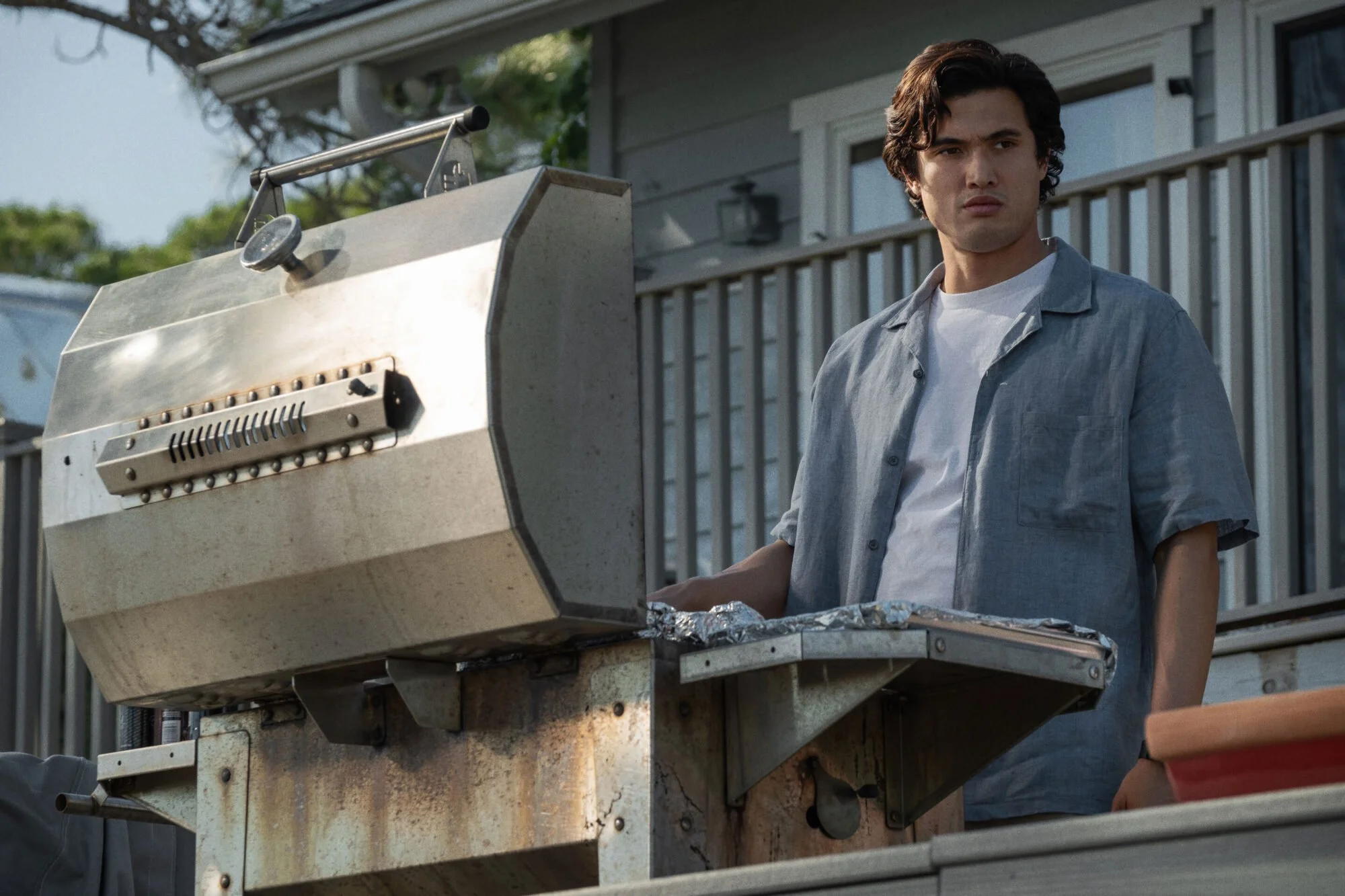
As more pieces of their past gradually unravel, the focus deviates to the victim, Joe, and his man-child demeanor despite his 37 years of age. He’s not a "man-child" in a conventional Judd Apatow sense, but a person with real repression and mental damage due to his loss of childhood. It’s in his stammering under stress and the painful heart-to-hearts he shares with his kids, who have surpassed the adolescent stages he never got to experience.
Charles Melton. I did not know he had that power within him. He walked onto that set as if rent was due. Todd Haynes had him playing an older character with a specific arrested development, and he performed as if his life depended on it. Melton plays Joe with ingenuity, for he’s the emotional soul, single-handedly switching the tone to melodrama whenever he’s on screen. He's a man of few words, and it's hard to read him at first. Yet, as the story progresses, his haunted past, triggered by Elizabeth's prowess, pressures him to face an existential crisis realizing his manipulated childhood. Man, does Melton deliver unforgettable, devastating lines towards his kids that left me breathless to the verge of tears.

Natalie Portman is at her finest in a mighty chess game—with herself more so than Julianne Moore—as an immoral actress trying to mime another person for comical value but also ground her in reality. This year, there will be no funnier visual than Natalie Portman copying Julianne Moore's mannerisms in the mirror.
Do I need to express in words how great Julianne Moore is in this film? She brings complex humanity and flaws to her character. Little dialect details like her in-and-out lisp are so naturalistic as she fleshes out this controversial figure, but never in a way that makes the audience sympathize with her actions.

Within May December lies an in-your-face metaphor regarding butterflies. There's on-the-nose, and then there's “squeezing your nose.” Haynes does the latter so often that it nearly took me out.

Anchored by Moore and Portman’s “mother-off” warfare, Melton’s breathtaking performance, and Burch’s expertly toned screenplay, Todd Haynes' May December is remarkable. It masterfully dances with its comedy and melodrama through its shattering display of family pains rooted in sexual abuse under the lens of an exploitative starlet.

