'Kingdom of the Planet of the Apes' Review: 'A New Hope' With Apes Installment Arrives Devolved
The Peter Chernin-produced Planet of the Apes prequel reboot trilogy – Rise, Dawn, and War – accomplished numerous feats. It made everyone forget about Tim Burton's “Marky Mark and the Monkey Bunch” iteration and revolutionized the summer blockbuster. The saga revolves around the ape Caesar (Andy Serkis, who deserved an Oscar for his portrayal in all three entries), and his rise to power amid a worldwide pandemic wiping out the human race. The philosophically sound, character-driven stories were far too potent to classify as mere popcorn content. What other franchise asked its audience to make ASL its primary language? Americans hate subtitles! Following the Ten Commandments-coded War, which ended with Caesar finally leading his apes to freedom and then unceremoniously dying, it felt like it would be the series’ bookend. Alas, Caesar wasn't the end-all-be-all because, like Bebe’s Kids, apes don't die. They multiply.
Meant to usher in a new trilogy, a la Star Wars: Episode IV - A New Hope, the latest Planet of the Apes installment, Kingdom of the Planet of the Apes, faces the sticky situation of following in Caesar's footsteps as a worthy successor. Unfortunately, it can’t seem to find its footing.
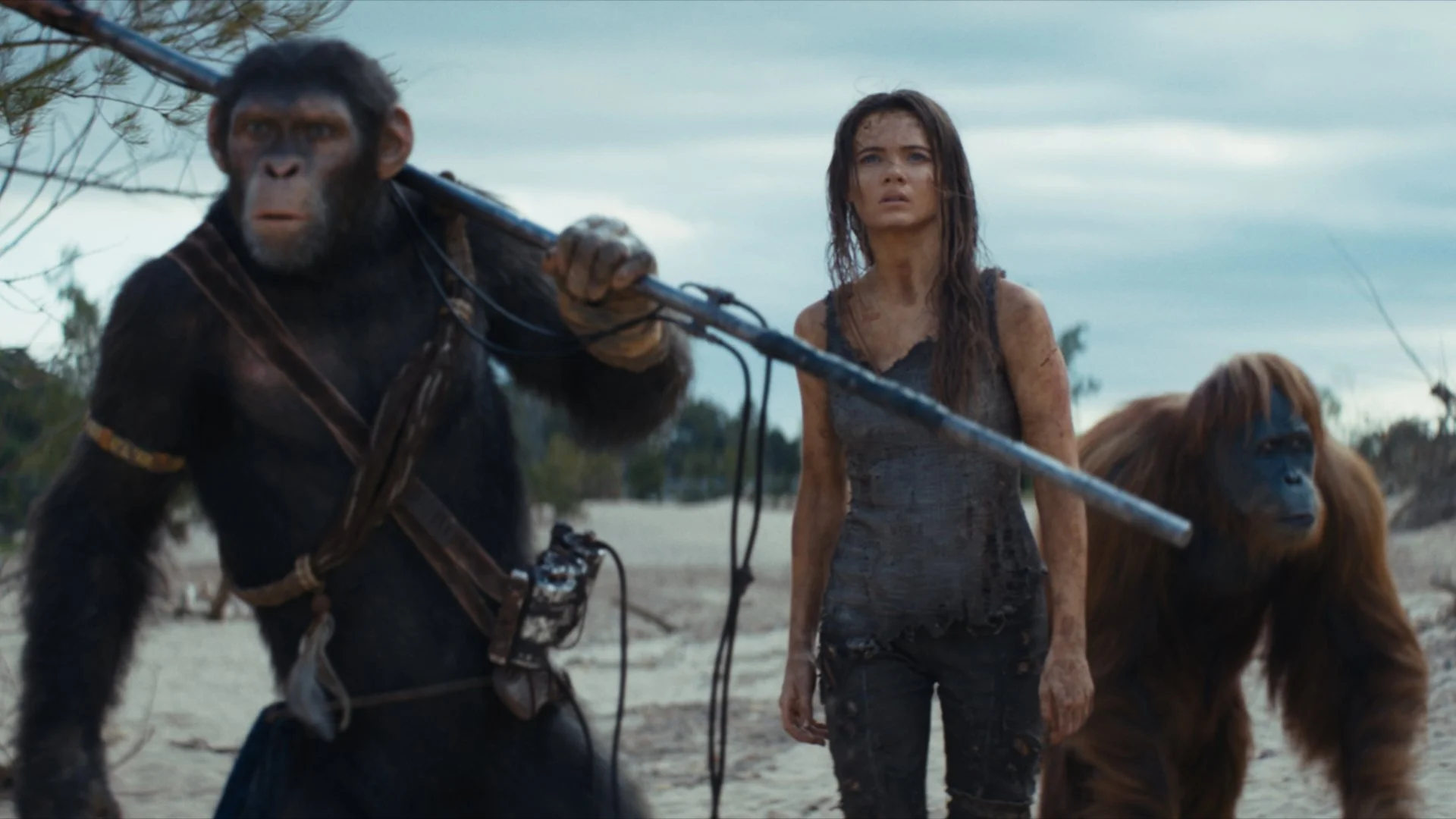
Courtesy of 20th Century Studios
PG13: Intense sequences of sci-fi violence/action
Runtime: 2 Hrs and 25 Minutes
Production Companies: Oddball Entertainment, Jason T. Reed Productions
Distributor: 20th Century Studios
Director: Wes Ball
Writer: Josh Friedman
Cast: Owen Teague, Freya Allan, Kevin Durand, Peter Macon, William H. Macy
Release Date: May 10, 2024
In Theaters
Apes have become the dominant species 300 years after Caesar's death. Today, they all spread among various tribes and factions and speak perfect, fluent English. Noa (Owen Teague) is a young chimp hunter in a pescetarian-based village where protecting eggs and birding hawks is part of their culture. A distant advancing ape colony invades his home and kidnaps his tribe, including his mother and friends Anaya (Travis Jeffery) and Soona (Lydia Peckham). As the attack's sole survivor, Noa journeys to find their base. Along the way, a shifty, feral, silent human, Mae (Freya Allan), tags behind him. He also meets Raka (Peter Macon), an orangutan who follows Caesar's practices. Upon discovering the empire, Noa must square off against the tyrannical ape leader Proximus Caesar (Kevin Durand), who is keen on kidnapping apes and forcing them to work on opening a human ship that holds the secrets to humans and apes past.

Much like the Noa to Caesar, director Wes Ball has to hit the precedent set by Matt Reeves' high-quality work on Dawn and War. Ball confidently relies on his visual effects proficiency, seen in previous works like the Maze Runner movies and his test video for the Mouse Guard film adaptation that Disney canned when they acquired Fox. Much of the naturalistic look and scope from his past experiences, even the test footage, is noticeably imported to Kingdom, bearing a similar large-scale adventure as his characters trek through grassy terrains. Kingdom seems like a form of healing for Ball, who finally got to do his anthropomorphic animal adventure flick.
Shooting on location in natural lighting with his cast in mo-cap suits, as opposed to the normalized green-screen practice in studio blockbuster filmmaking, lends to the film looking rather beautiful. As evident in his Maze Runner movies, which I will defend (from a directional standpoint), the staging and filmmaking of Kingdom's action sequences are exciting and thrilling.
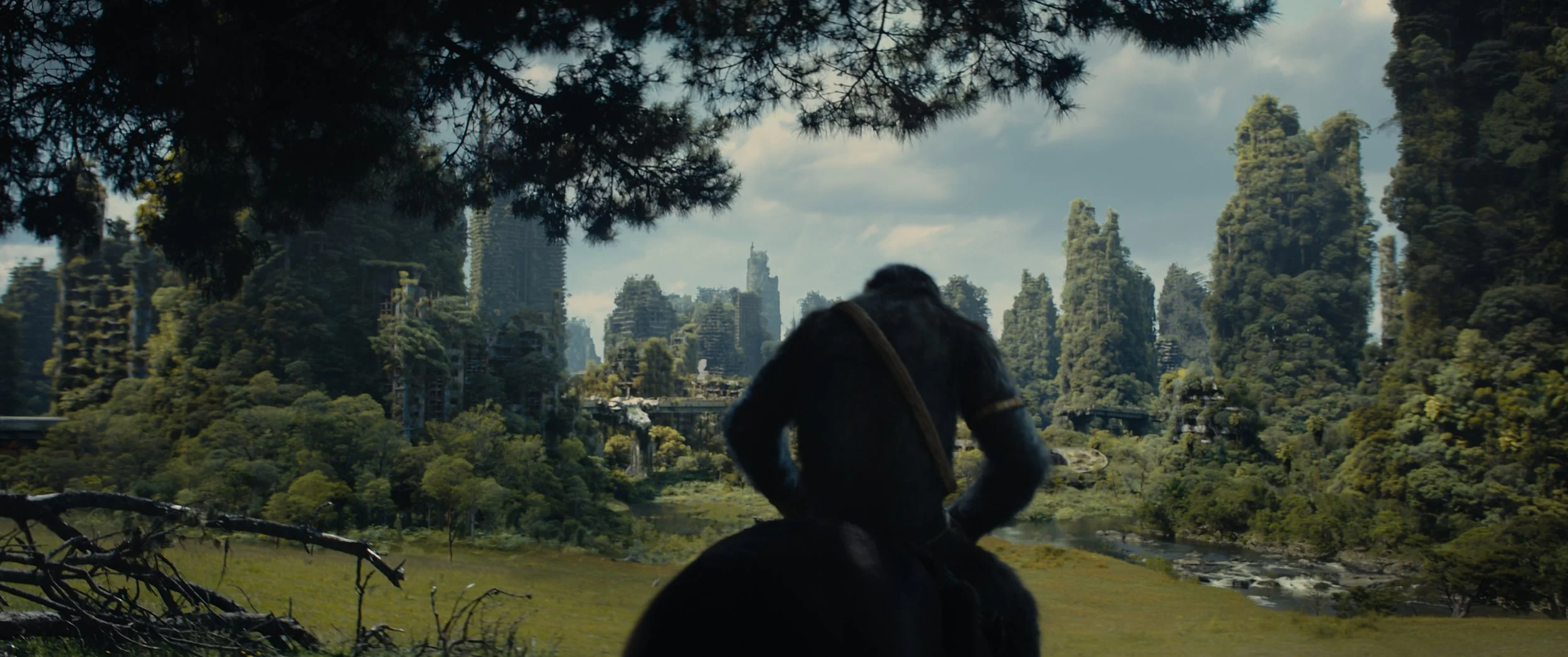
Upon Noa's rescue mission, Weta FX flaunts their feathers, showing that these apes still look great in new terrains. There’s sheer beauty in Gyula Pados' (Ball's frequent DP collaborator) cinematography while showcasing an Americana through a fascinating cinematic lens. Some moments bear noticeable downgrades, particularly on wide shots and motion-blurred camera movement during several action sequences. But when Ball and his team go big with those set pieces they knock it out of the park.
Acting as a new standalone installment with the previous films in mind, Kingdom heavily leans into the religious themes set up by War’s transparent framing of Caesar as Moses and Jesus. In Caesar's passing, he became “Ape Jesus,” for his commandments are now a religion. Even the shape of the attic window Caesar was raised in took on new meaning like a cross. And cleverly so, similar to every other religion trying to survive in modern civilization, that higher power’s practices and beliefs have become co-opted by evil forces. It's an intelligent element within Josh Friedman's screenplay that adds complexity to Noa's encounters with Raka and Proximas Caesar, two sides of the chimp-Christian follower coin.
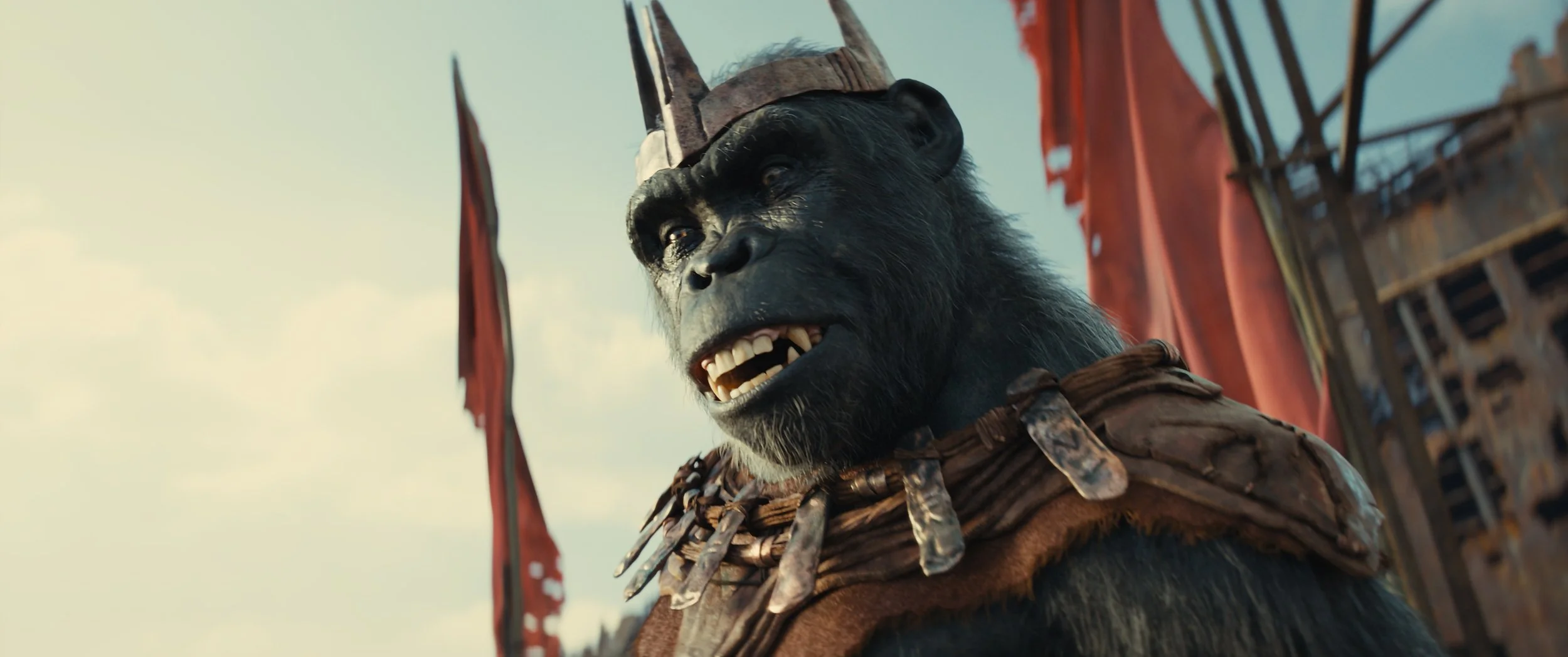
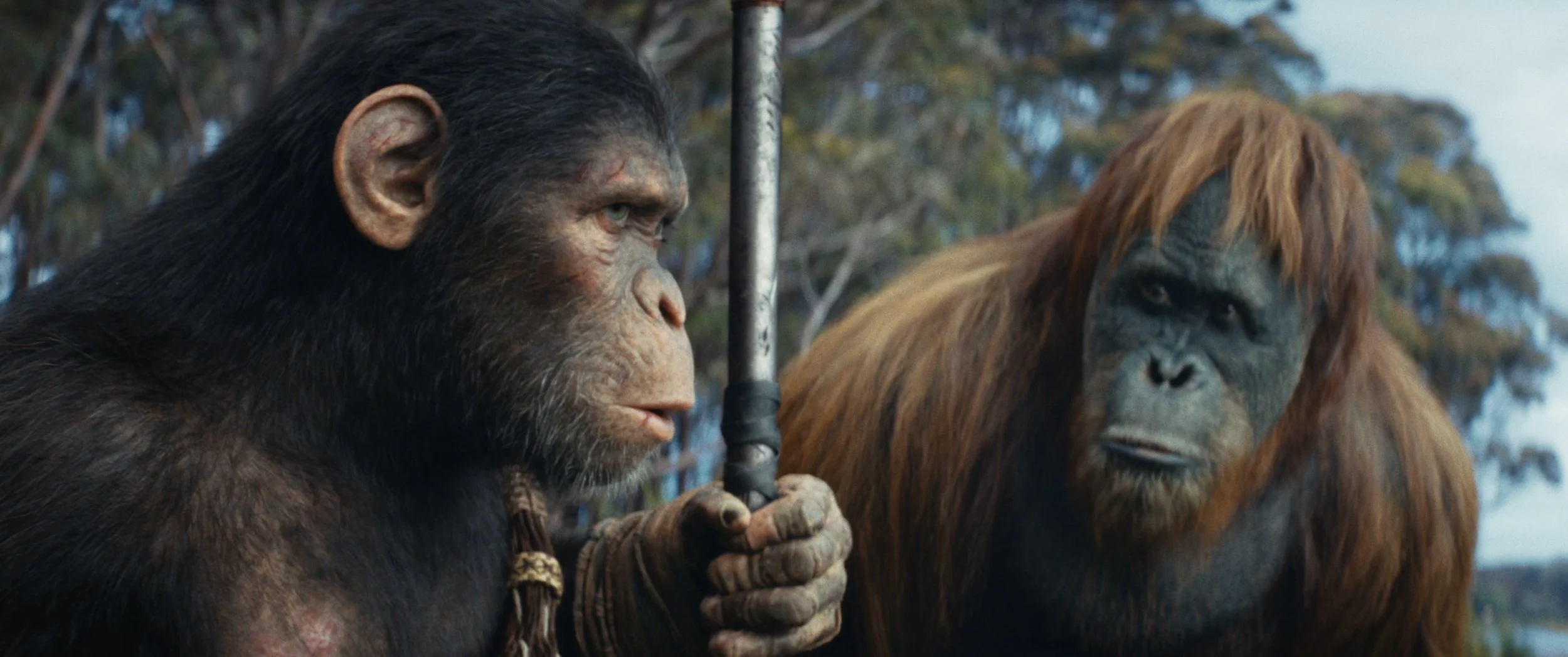
RAKA! Oh, I adore that nerdy, Bible-based orangutan and his buoyant personality. Raka is the first and possibly only well-rounded character Kingdom offers. It’s as if Peter Macon was channeling Beast from the X-Men and he killed it. Then, you have Kevin Durand as the tyrannical Proximus Caesar. Yeah, it’s that Elon Musk-looking muscle man from Abigail. Durand sheds sheer charisma and command as Proximus Caesar, upheaving a fun mustache-twirly villain. Despite not coming anywhere close to other antagonists, he is the most spirited to date. Durand kept chewing on the scenery, and his bites broke through the second act's roughly paced barrier, compensating for the shortcomings of his and Noa’s conflict.

I know it's unfair to compare the newly introduced Noa to Caesar, whose footprints left a huge mark at the end of his first installment. But notice I’m not mentioning Noa in the Good bracket. It’s because I never saw him as a fleshed-out character. He is the audience’s reintroduction to this world and a vessel for Friedman’s religious and philosophical themes. His overly familiar “hero's journey” arc lacks weight outside of having him question the past, present, and future. I get what Friedman's script was going for, having Noa enter his peach fuzz stage in preparation for stronger development later. While the always great Owen Teague holds his own, Noa winds up a middling protagonist, only becoming interesting when the Caesar-loving side characters drop down from their tree.
That sentiment also applies to Mae, a relatively weak and uninteresting human character. Through her, furthering the social structures between humans and apes comes into play, sometimes working in hand with religious themes or overtaking them. Once again, she is a vessel for themes meant to be excruciatingly teased for future stories.
It’s been seven years since War for the Planet of the Apes, which is more than enough time to warrant a sequel, but Kingdom's regression to simplicity is a disservice to its audience. We have grown to expect smarter content by this point. It harps so much on Caesar’s trilogy and legacy, retaining key components that made the previous entries effective while still being emotionally resonant, story-driven pieces – with moments tracing back to the original's thematic nature. Kingdom, unfortunately, can't shake off that dingy "episode 4 of this saga" smell its new owner sprayed onto it. Still, it's superior to most summer movies usually dropped around this time of year, and that's nothing to scoo-ooh-ahh-ahh-off at.
Rating: 3/5 | 67%