
Glass Review
PG-13: Violence including some bloody images, thematic elements, and language
Universal Pictures, Blinding Edge Pictures, Blumhouse Productions
2 Hrs and 9 Minutes
Writer/Dir: M. Night Shyamalan
Cast: James McAvoy, Bruce Willis, Anya Taylor-Joy, Sarah Paulson, Samuel L. Jackson, Spencer Treat Clark, Charlayne Woodard
Release Date: January 18th 2019
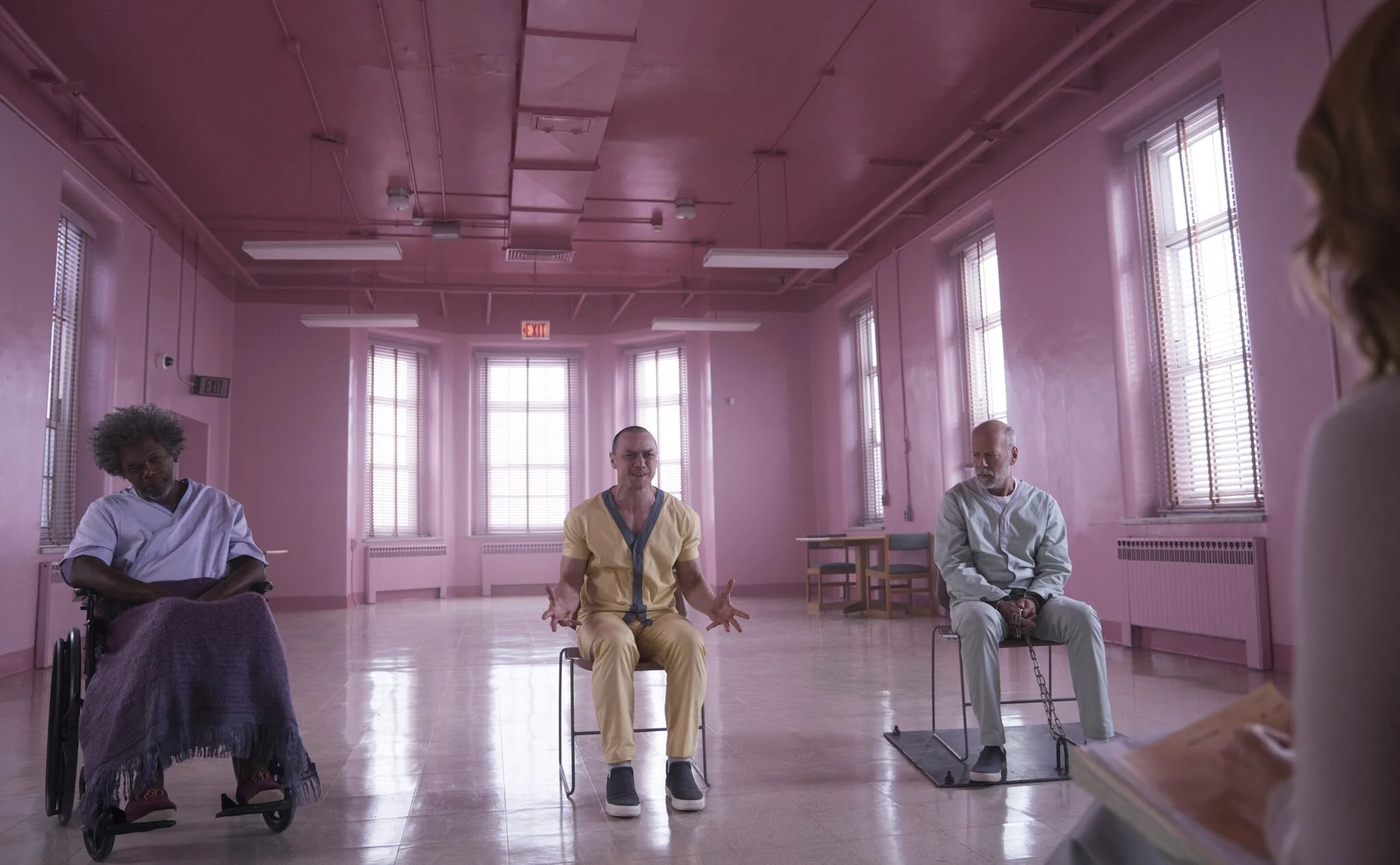
Following the conclusion of Split, Glass finds Dunn pursuing Crumb’s superhuman figure of The Beast in a series of escalating encounters, while the shadowy presence of Price emerges as an orchestrator who holds secrets critical to both men.

With Glass being the long-awaited union of Unbreakable and Split, the most positive thing that I admired about the movie is everything related to Split. Just like in Split, the film is primarily James McAvoy’s show. Glass may be titled and centered around Samuel L. Jackson’s character but, while he does deliver a fun and chilling performance, this doesn’t occur until halfway into the film. This allows McAvoy to take center stage and for the most part he steals the show. All the scenes written for his character, now entitled “The Horde,” are pretty intense due to the many personalities he exhibits. In Split he displayed around six or seven different personalities out of the twenty three they kept marketing. Here, we get what I believe to be around seventeen of them and he keeps his scenes engaging by being impressively charismatic. Personally, the scene that stood out the most to me is where The Horde is tortured by lights and he immediately shifts into over ten personalities all in one tracking shot while exhibiting new personalities, including one who is literally an NYU film student. I’m not joking. By the time that scene concludes, you just want to give McAvoy a standing ovation, for this is a perfect acting showcase of his talent and what is to come in his upcoming SNL episode.
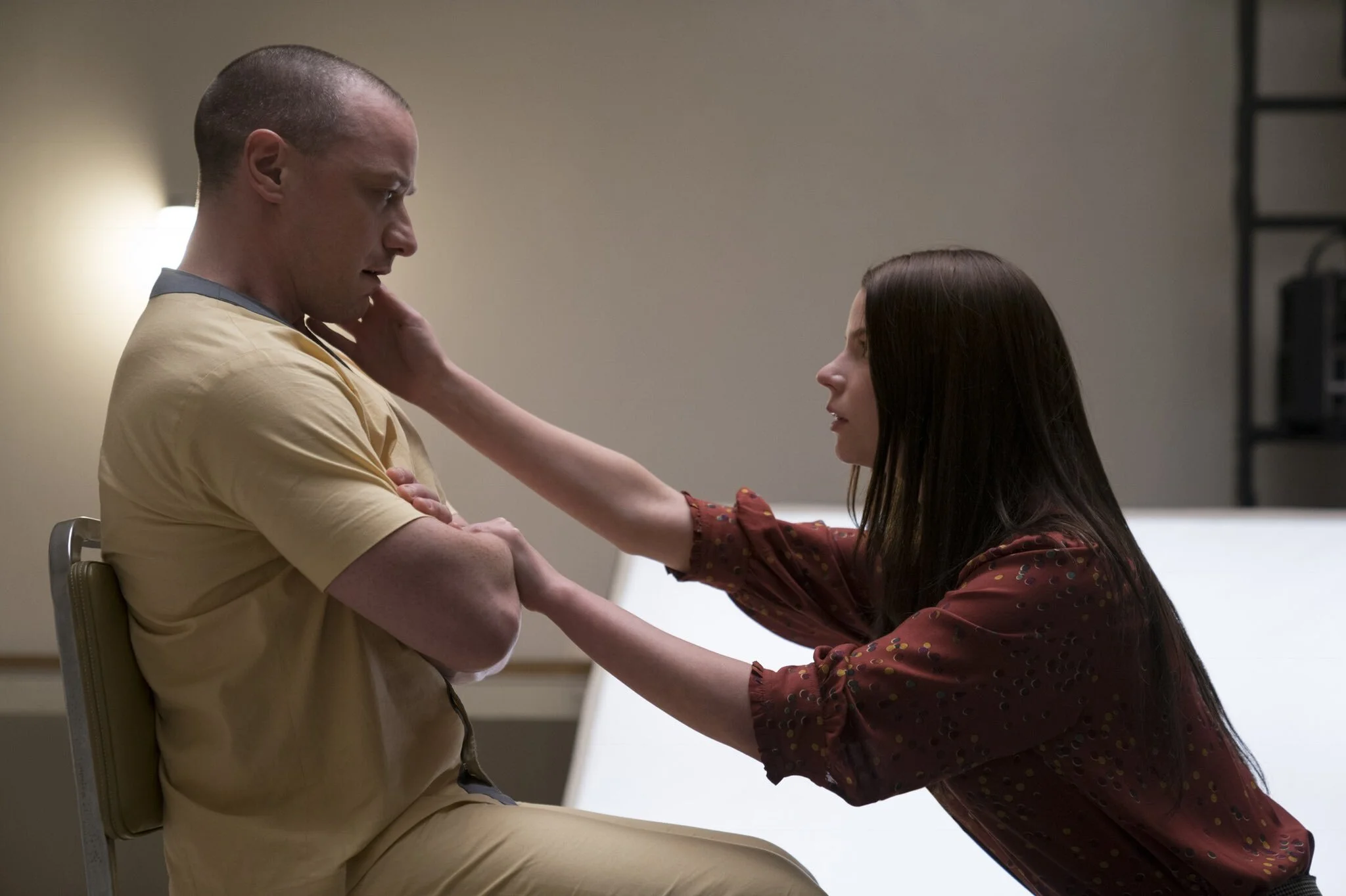
Even the scenes where Anya Taylor Joy (who reprises her role as Casey) returns are powerful. The chemistry that they share is strong and their scenes are well written. The way she’s able to switch around alongside Kevin’s many personalities is amazing. Hell, there is a scene that they share that nearly brought a tear to my eye. As a direct sequel to Split, their segments are great. I even love McAvoy working alongside Jackson where Kevin is the brawn while Glass is the brain of the entire operation. Elijah is the titular character of the movie and when the focus shifts to him being the major focal point of the narrative, Sam Jackson steals McAvoy’s spotlight and kills it as per usual.
For a sequel that was 19 years in the making, I’m glad to see some of the characters from Unbreakable reprise their roles. Spencer Treat Clark, who portrayed David Dunn’s son Joseph, reprises his role. When it comes to long-awaited sequels, child actors who portrayed a character are usually recast in order for the project to be more marketable. So, to see Clark as Joseph again is a nice touch. It adds a layer of authenticity to the film. Elijah’s mother Mrs. Price is also played by the original actress, Charlayne Woodard.

When Split concluded and it was revealed to be a sequel to Unbreakable in a shared universe, everyone was surprised and they immediately jumped onboard. Split meets Unbreakable? Conceptually it was a smart idea and considering how good his previous film was on its own, you would think Shyamalan would return to form by now with this film, his defining return to respectable form. Unfortunately, Glass fails in its execution by being unable to organically unite the two films. Aforementioned, every aspect that revolves around Split, from the writing to the performances by McAvoy and Taylor-Joy, works. Now, when it comes to the Unbreakable parts…
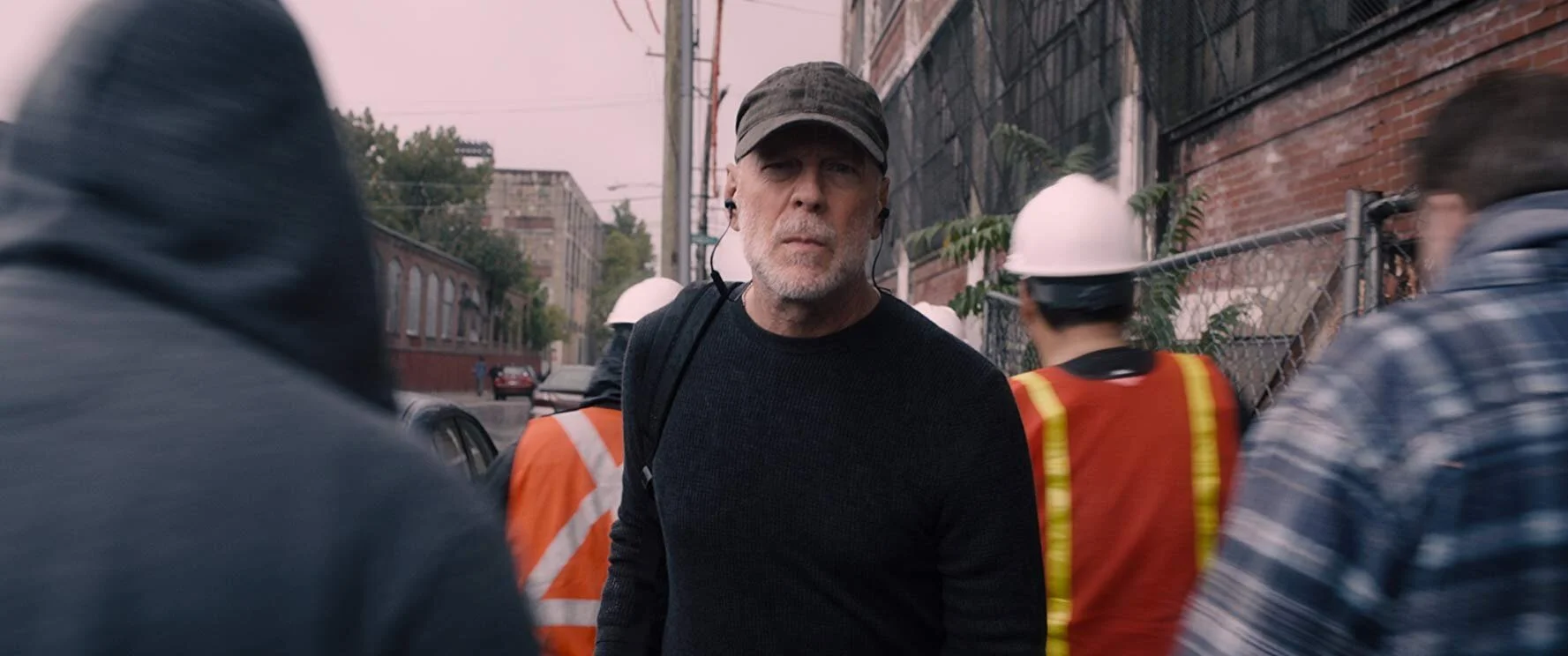
When it comes to the portions in the beginning where we follow the Unbreakable characters David and Joseph Dunn, most of their elements don’t work. For starters, Bruce Willis does not look like he wants to be in this movie at all and with each shot, you can read the exhaustion on his face. He doesn’t have that much overall screen time, for it centers on Kevin and Elijah more. Yet, during the action sequences he has against The Horde, you can see how little he’s invested by the GoPro rig on Willis’ face. Then, his son Spencer Treat Clark delivers a very flat performance and delivers his lines very poorly. I don’t know if it was because all that child actor innocence is now lost or if it was Shyamalan’s direction, but seeing how active Clark is in his career makes me think it’s the latter. None of them are able to capture the right emotion. Whenever the Dunns are onscreen together, their dynamic is unable to light the same spark they had 19 years ago. McAvoy and Paulson just run circles around them.
Some of the many negatives that shatter Glass (hehe) are the technical aspects regarding post and shot composition. From the get go, the film is completely unbalanced in its setup where scenes would abruptly cut from one set of characters to another before adding any form of tension to connect the two universes. An ample amount of scenes don’t even lead into anything significant to progress the narrative. Then, the shot composition is rather odd. Don’t get me wrong, there is some impressive framework present, but a ton of the shots are comprised of so many awkwardly framed close ups, especially during scenes where you need to see the entire setting. During several action sequences, there are more shots of McAvoy mugging the camera instead of actually showing what’s going on around him.
What Shyamalan does with this third entry is rather bold where he goes against superhero film tropes by attempting to go in depth with the neurological psychology of superheroes and their powers. While the mainstream audience won’t be a fan of it, I respect his intentions. The main problem with the script is that, while you know what Shyamalan wants to say, he doesn’t know how to execute it. He doesn’t have enough strength as a screenwriter to convey the ideas he theorizes. I’m sorry but the only person I can think of who can do this well is Alex Garland (Ex Machina, Annihilation) because when he establishes a theme, he does it early on and keeps it consistent throughout his features. The entire science aspect is delivered around 30 minutes in when we meet Sarah Paulson’s character (who is pretty much an Amanda Waller type). Honestly, anyone like myself who was anticipating this will be turned off by the second act where the psychology lesson occurs making the film both slow and dull. Mind you, it’s already over two hours long. I find it excruciating when superhero movie focus so much on science when it’s rooted from simplicity (and sometimes stupidity). Venom did it last year and so did Incredible Hulk back in ‘08.
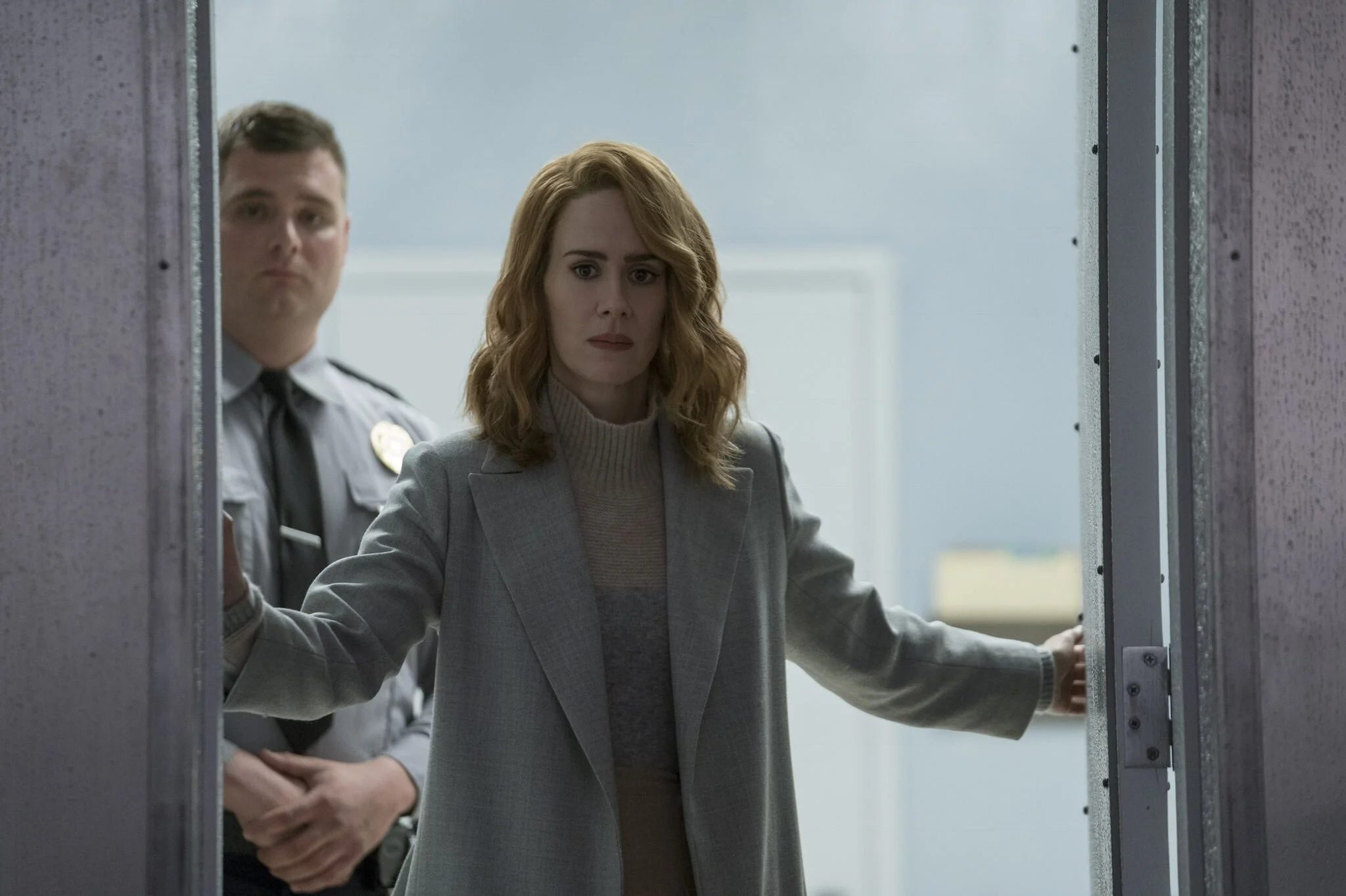
I’m concerned about how public audiences will receive the film, for this was marketed as a superhero/thriller but falls short in both categories. It plays as this dull drama that occasionally becomes superhero-ish. It feels like a spit in the face to audiences who were expecting something exciting that gets everyone’s hopes up... only to let us down. In other words, it leads you on. Glass leads you on to believe this will be a fun and thrilling superhero universe that Shyamalan set up for nearly two decades, only for him to ramble on about society's outlook on heroes and public menaces. Other superhero films from reputable comic book companies were able to convey these familiar themes effectively. Sequences of exposition to remind the audience of the two films (which people are familiarized with by now) is presented awkwardly as well. For what everything is built up to, it goes without saying:

I never saw Unbreakable so I walked into Glass thinking I could potentially be lost half the time. Luckily, that isn’t the case. There’s plenty of dialogue to tell you exactly what’s going on. A lot of it. So. Much. Dialogue. Sarah Paulson’s character has an explanation and an answer for everything and you WILL listen to her. And when Sarah Paulson isn’t explaining something, Samuel L. Jackson is!
James McAvoy is the true star of this film. His talent knows no bounds and I had a lot of fun watching all of his character personalities collide. Aside from that, the film is too long-winded and the main idea is a little stupid. On the bright side, it’s nowhere near Shyamalan’s worst.

Underdeveloped and poorly executed, Glass is an inadequate conclusion to whatever superhero concept Shyamalan had planned for 19 years.
I’ll definitely take disappointment over disastrous any day though.
Rating: 2/5: 47%

Super Scene: Glass uses glass.
