'Black Bear' Review

R: Language throughout, sexual content, drug use, and some nudity
Runtime: 1 Hr and 44 Minutes
Production Companies: Oakhurst Entertainment, Productivity Media, Tandem Pictures, Blue Creek Pictures
Distributor: Momentum Pictures
Director: Lawrence Michael Levine
Writer: Lawrence Michael Levine
Cast: Aubrey Plaza, Christopher Abbott, Sarah Gadon, Paola Lázaro, Grantham Coleman
Release Date: December 4, 2020

At a remote lake house in the Adirondack Mountains, a couple entertains an out-of-town guest looking for inspiration in her filmmaking. The group quickly falls into a calculated game of desire, manipulation, and jealousy, unaware of how dangerously convoluted their lives will soon become in the filmmaker’s pursuit of a work of art, which blurs the boundaries between autobiography and invention.

Many people will have a difficult time placing Black Bear under a specific genre. I found it hard to decide on a suitable description for the film considering how significantly different its two halves are in both style and tone. After two viewings — one at Sundance earlier this year and another just recently — I uhhh… still don’t know how to describe it. So, let me deconstruct it while I review it.
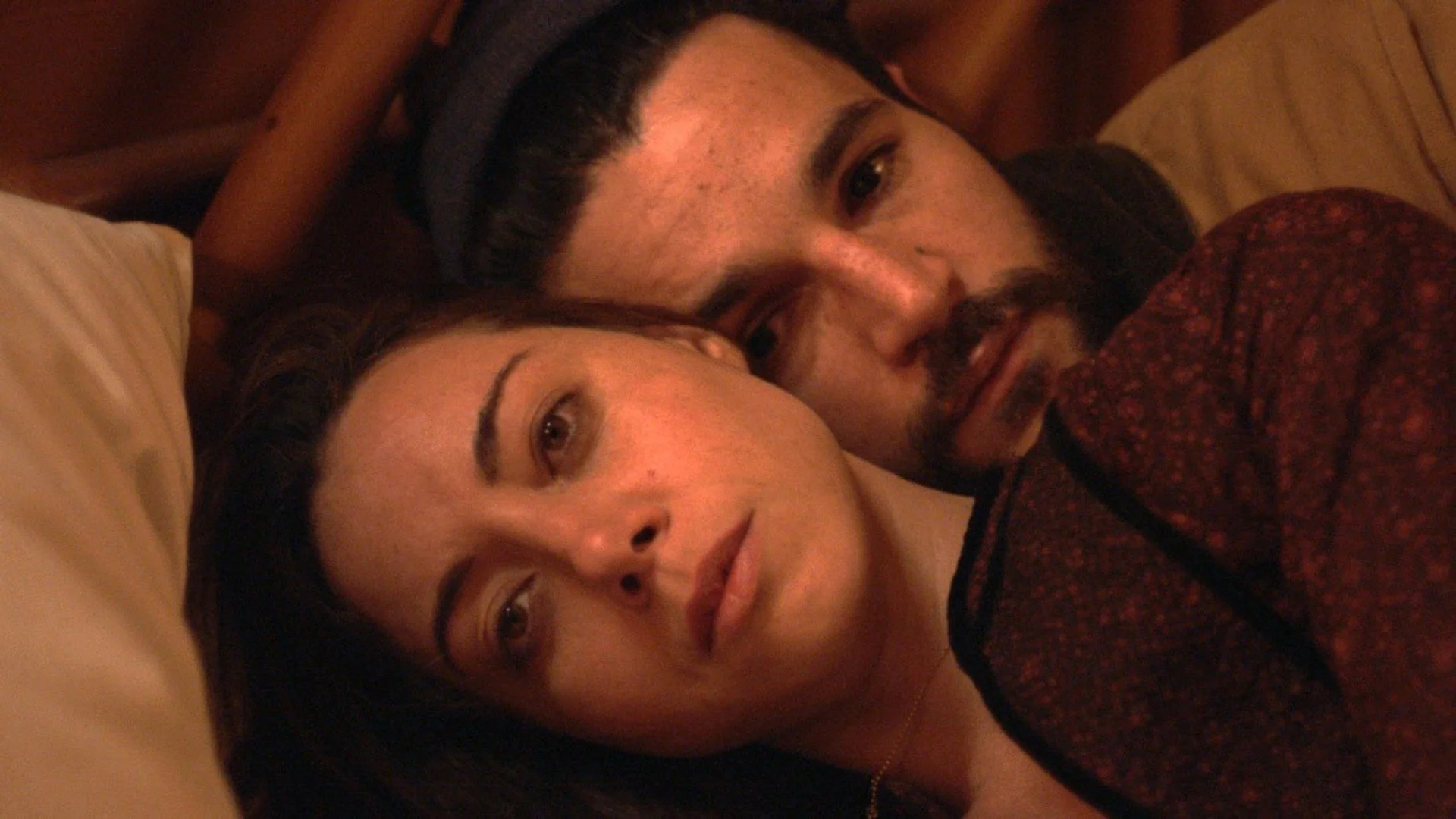
The film is divided into two parts, both told through the perspective of Allison (Aubrey Plaza), a slick, hot, chic filmmaker who stays at a remote lake house in the midst of writing a new feature. The lines between inspiration and autobiography blur as the viewer travels through her fragmented mind and we see two separate situations. While both take place in a single remote setting and center around an affair amongst three central characters — Allison, Blair, and Gabe — the two narratives are divided into two parts, which are two separate beasts of their own.
The first half is a slow-burn erotic drama where Allison, a successful, sardonic director, arrives at a cabin house in the Adirondack Mountains. Her presence becomes a wedge in the relationship between Gabe and Blair, a couple who are expecting. The nihilistic Gabe gets under his partner’s skin due to his traditionalist male views while being openly attracted to Allison.
The second half of Black Bear makes an ambitious, pivotal shift that will either get viewers on board or make them drop like flies. The narrative morphs into a dark workplace comedy centered on Allison shooting a movie as Gabe, her director/spouse, manipulates and emotionally abuses her in front of his crew, toying with her emotions as he gets closer to Blair, the script supervisor. It takes a more comedic approach as you observe the chaotic set from a third-person perspective. Stylistically, it’s a departure from the first half of the film, but it maintains an uncomfortable atmosphere that is bone-chillingly suspenseful.
I find it rather intriguing how actress Aubrey Plaza, who has proven to be somewhat of a cinephile herself (watch the Hiking With Kevin episode where she expresses that Elaine May is her favorite filmmaker and references Cassavetes while holding Kevin Nealon’s selfie stick), now stars in a psychological dramedy that bears the tonal essence of the works of those filmmakers she adores. That being said, Aubrey Plaza truly delivers a masterful performance. Plaza has been adding many unexpected/experimental projects to her belt and has proven to be an incredible actress who can deliver bone-chilling, dramatic performances. Her role as Allison in Black Bear is without a doubt one of her most impressive performances to date. She is an absolute marvel to watch. Of course, she incorporates her signature deadpan, sardonic essence to this emotionally reserved character with an alluring seductive edge, but she also showcases how she can deliver a show-stopping display of a vulnerable, unhinged woman at her limit.
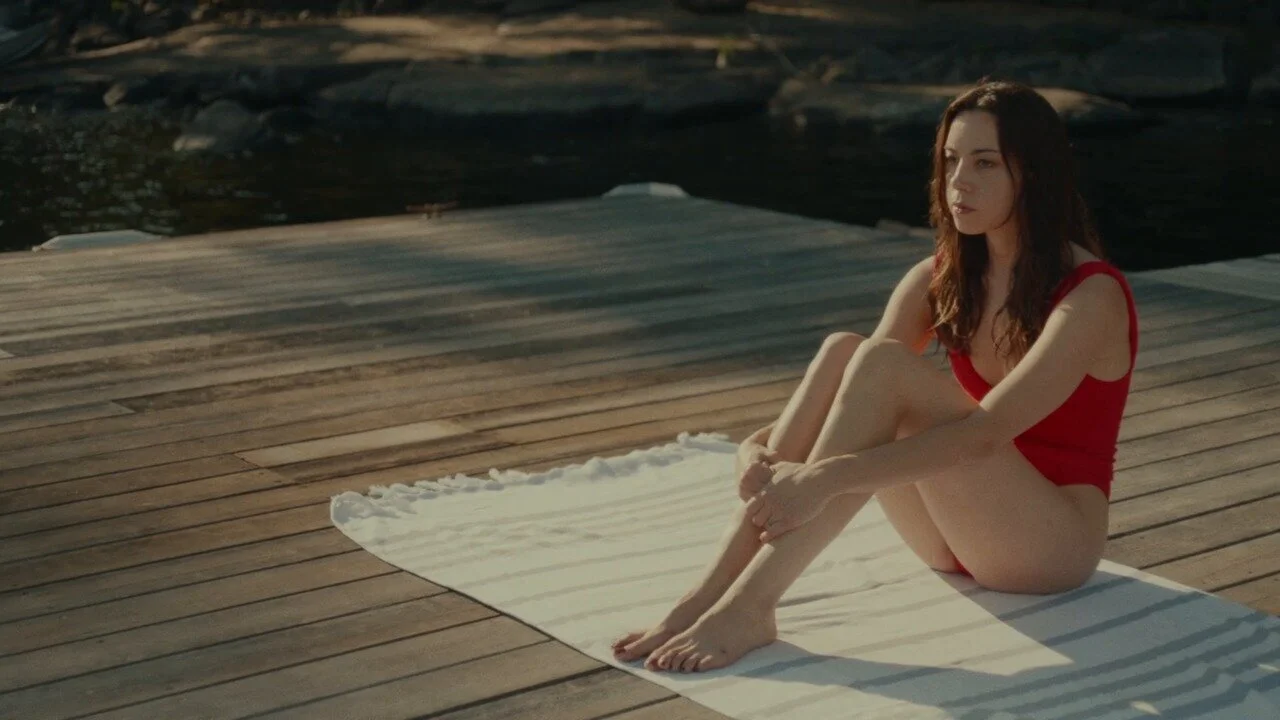
Supporting actors Christopher Abbott and Sarah Gadon commit to their roles and deliver magnetic performances that work in tune with Plaza. So much of the film as a whole focuses on an internal affair between the three and their performances keep you enthralled throughout.
While I really admire Black Bear for what it is, it never becomes anything memorable. It’s a very in-the-moment movie that keeps you enticed. It’s one of those films that leaves much to be interpreted. Granted, its connection becomes more transparent by the time the credits roll, but it still keeps you guessing. I’ve come to the conclusion that Lawrence Michael Levine’s Black Bear is a psychological dark dramedy that is as devilishly ambitious as it is a captivating farce. I still don’t fully get it, but I think it’s neat. Now, if you’ll excuse me, I’m going to join my sisters in arm in the Aubrey Plaza fan club.