
How 'The Invite' Production Designer Jade Healy Made an Apartment the Real Star of Olivia Wilde's Marriage Story
One of the most striking qualities within Olivia Wilde’s rambunctious marital comedy, The Invite, lies within Joe (Seth Rogen) and Angela’s (Wilde) pre-war San Francisco-based apartment. The long passageways are packed with endless picture frames and books across each corner, the vintage objects across the furniture, and their bedroom where it’s as empty and void as the flame of their marriage. Once Pina (Penélope Cruz) and Hawk (Edward Norton) arrive at their complex, intimate details across the length of their relationship unfold in the materials dressed across their crib.
Setting the stage for the single-set mayhem of unbridled horniness is production designer Jade Healy, whose works include Marriage Story, I, Tonya, A Ghost Story, and Tony Gilroy’s upcoming Behemoth! With The Invite, she admitted to Wilde, “There is no other movie I can watch more than this one.”
In my conversation with Healy, she discusses finding the authenticity in the houses’ imperfections, the relationship between color palette and the characters’ emotional states, the realistic furnishings through digital thrifting and local artists (including hand-drawn artwork from the film team), and the organic design choices for the final piano shot.
What was one of the first discussions you had with Olivia [Wilde] about crafting Joe and Angela’s apartment? Finding the perfect San Francisco spot for the ensemble?
We started by talking about the kind of movie we wanted to make, some of our visual references, and how we wanted it to feel. We knew we wanted to create something bigger than what was on the page. I don’t mean by scale; I mean, narratively speaking, we wanted to create something you would be able to sink your teeth into. So those were our first discussions.
Then, I start thinking about how I’m going to design it. It’s really fun because the director often has an idea for the movie’s visuals, but they don’t necessarily have any idea of the layout or look of the apartment. And it’s fun to have that job. To then be able to present it to them, and for them to be like, “Wow, yeah, I couldn’t have imagined. This is great.” So we started with the look and feel.
We knew we wanted pre-war. We both leaned towards that kind of aesthetic, older pre-war details. And then I jumped in and started thinking about how I wanted to craft the space.
What was the look in crafting the architecture and objects?
I do extensive lookbooks that tell a story. Usually, I do it from the beginning to the end of the movie, especially for this one, which tells everything in order in one space. First, it’s the color, the style. Then I go into architectural details, and then into the set-dressing specifics. So it’s very detailed. It’s fun to look back at the lookbook and go, “Yep, that’s what we did.” And it’s always ever-changing.
I find inspiration through photographs, through film, through different designers on Instagram, because I was trying to do a more “DIY” approach and not really looking at some maximalist design books, of course, which is sort of a different aesthetic than I usually do. So, really just starting there and slowly crafting the characters. It never comes all at once. I have one immediate lookbook that I’m like, “This is it.” And then I carve away at it, and it becomes more detailed as I go.
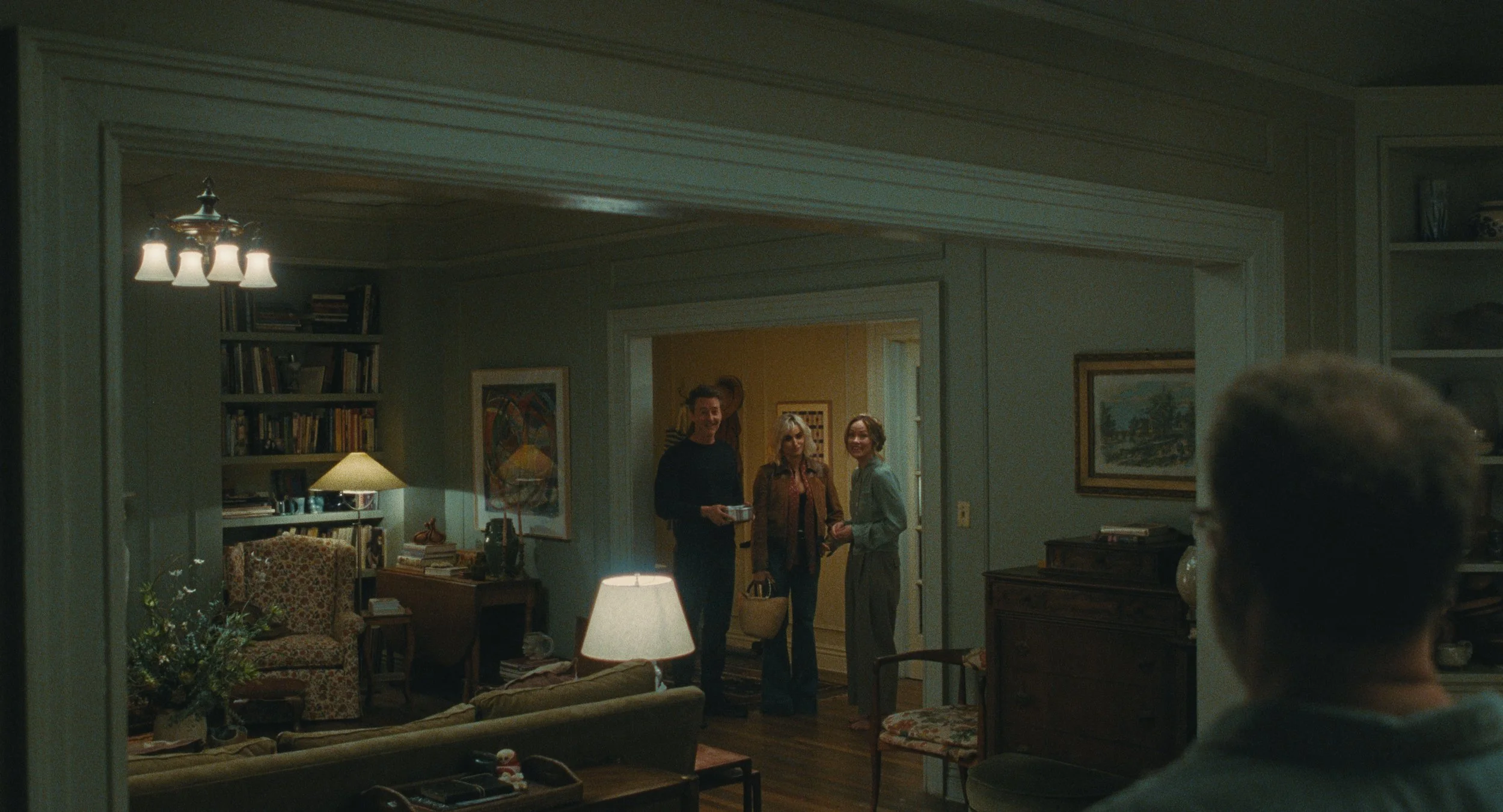
(L-R) Olivia Wilde, Seth Rogen, Edward Norton, Penélope Cruz Credit: Courtesy of A24
What were the color language discussions like? Because the film has such a beautiful combination of muted dull gray and blue mixed with beige and yellowish hues. And I think that perfectly represents Joe and Angela specifically as characters.
Yeah, their state of mind. Usually, I start by thinking about the colors, and I present them to the director. I really was strongly leaning towards these sorts of grayish greens and blues. Not too overly bright or saturated, but something that’s been sort of dulled in time, like their marriage.
I really was attached to this idea of almost feeling like Angela’s underwater. She’s drowning in this relationship that she’s in that both of them are unable to get out of. I was working with that and really wanted the hallways to feel almost like these neutral passageways in between that they’re moving through the different spaces. So I started with that. We color-tested, and we all loved where we landed in the colors. Then, we talked about Angela and Joe blending into the walls, which came with Arianne [Phillips], our great costume designer, when she started.
Once we figured out the color, then she built the shirt to really just disappear into, because she’s sort of disappearing into this apartment, into her relationship. She doesn’t even know who she is anymore. She sort of lost herself in her marriage, which often happens in relationships. And we were really looking at that dynamic between couples, how they change when they first were in love, and they had a young family, and where they landed. And when you design, you really start from the beginning.
You start from 0, and you’re filling in all the gaps that aren’t in the story. What did their apartment look like first? Where did they live before they lived here? What piece of furniture did they bring into this new apartment? Where did those pieces go? When did she start replacing them? So it’s a process, and it never wants to look like it was just decorated perfectly. That’s not who they are as characters. They’re not the kind of couple that has an interior designer. So I was really trying to make sure it never looked too perfect, that parts of it felt layered and realistic.
I think that also lends itself to the house clutter. And it’s one of my favorite details about the film, where every frame, or every part of the shot selection, I’m seeing five different picture frames on the wall that I haven’t seen before, or 20 different books just loaded somewhere. Tell me about the passage of time playing into that with the materials.
I was really leaning towards maximalism with Angela; this is where she puts her energy. In her life, everything goes into this apartment. So it’s constant, and it needs to be almost overfilled. This is where she gets gratification – through this apartment – because she’s filling a void she has in her life and her marriage. So, too many paintings on the wall. Usually, I don’t do a picture wall. I’m like, “Oh, it’s hard for me.” But I was like, “That’s Angela.” She goes for it. It’s almost too much. A lot of stuff. It’s excess because that’s where she can express herself, and she’s not able to express herself in a relationship. She’s struggling to figure out who she even is anymore. So she expresses herself through her apartment.
In opposition to that, Joe is stuck in his music room, where there’s very little new expression of who he is. He’s stuck back in time in the version he used to be. It’s buried over and over and over. Whatever he used to be, the piano is full of stuff, the books, the music things, it’s clutter and chaos. He’s lost himself. So they’ve both lost themselves in different ways.

(L-R) Olivia Wilde Credit: Courtesy of A24
When it comes to the comedy, I love how the film’s objects play into the physical and visual humor, like Joe tripping over his bookshelf, the garbage with the soufflé, and the jamón. Can you tell me how you made sure the object placements were perfect for Adam Newport-Berra’s camera?
It’s all fun. That’s a stunt at the end of the day, really… I was talking about the ebb and flow. What’s so beautiful about Olivia [Wilde] and her process is that everything had this beautiful flow; it wasn’t linear. It was almost like this circular [...] creative process where we knew that things could change and adjust. We were starting in one place, and we might not end exactly where we thought, which was very liberating creatively, I think, for everybody: for the actors, for Olivia, the director, for Adam, for, of course, the crew and cast. But that came later. Suddenly, a couple of days ahead of time, or maybe it was a week or so, they were like, “He’s going to fall, and we want this whole bookshelf to fall.”
So then we go in and adjust, make sure everything’s safe, make sure we can achieve what they want. And then the same thing with the soufflé. We knew when the soufflé would have to go. We were figuring out what it looks like when it’s fallen. “How do we make the soufflé work?” I love that moment so much when she just goes straight into the garbage. It was really working with an incredible crew who were up for anything whenever there was an adjustment or a change.
And of course, we were in one location, so they weren’t huge asks, to be honest. Every day we’re coming back to the same place. We weren’t moving to a new location with a new set. So [adjusting] those elements was really not a problem.
I read elsewhere that a lot of their income was put into consideration with the objects they have, like the rug and their couches. How do you translate that aspect as a production designer, showing that this is how much they’re making through everything that they have in their home?
Crucial. It’s a crucial consideration because the characters need to jump off the screen and be real. So I really wanted to make sure the stuff that I was purchasing/renting was realistic for their income bracket. Of course, they live in this beautiful house because they inherited it from Joe’s parents. It was the parents’ apartment, so that allowed for that. But it was an affordable apartment as far as the furniture.
So much of it was bought at real local furniture stores. It was like, “Okay, we got these nightstands for 200 bucks. So we found this bed at Ikea.” I wanted to make sure to mix things in that felt realistic. And then we did a lot of Facebook Marketplace. So much Facebook Marketplace. What made us able to afford even doing [this] on the budget we had was that we really dug into finding stuff on there, Craigslist, going to flea markets, and going to Long Beach stores that we knew to have more affordable things. All the stuff that Angela would spend her time looking for. So there wasn’t anything in there that was overly expensive.
I also like to always think about stuff that isn’t perfect in there that she might replace in the future. So maybe she has a light that’s hanging that isn’t the most amazing, because that’s going to be something that she gets to later, which is how my house is, which is how a lot of people’s real houses are. You see them in a moment of flux. Where was it five years ago, two years ago? Where is it going to be in a year from now? It’s not perfect yet. So there are little things.
I think I got the light hanging in the foyer [...] probably from Etsy or something. It was a $150 Moroccan starlight. It wasn’t some expensive light, but I was inspired by the light in Who’s Afraid of Virginia Woolf, which was such a big inspiration for us. And I was like, “Oh, I want to do the same Moroccan light.” And so it wasn’t an expensive light. It was very affordable, something that she could get.
Then maybe one day she’ll get a nicer one, a nice antique version. But it’s a process where, in my house, I have chairs I don’t love, and that’s what I have. And then I’m going to find better ones, which I know a lot of people do.
I have a best friend who’s constantly changing out her chairs. She’s like, “My husband says I need to get therapy every time I send him new chairs.” It’s not about the chair, and that’s for Angela. It’s not about the chair, the table, or the couch. This exercise of constantly buying new stuff, where Joe’s like, “Did you get another new rug?” It’s like, “Yeah, because she’s trying to fill a void.”
She feels a sense of control when she can buy a chair that she likes somewhere, and that’s what it’s about. It’s really not about the chair anymore. So I wanted the feeling that there’s actually going to be stuff changing, and it isn’t perfect.
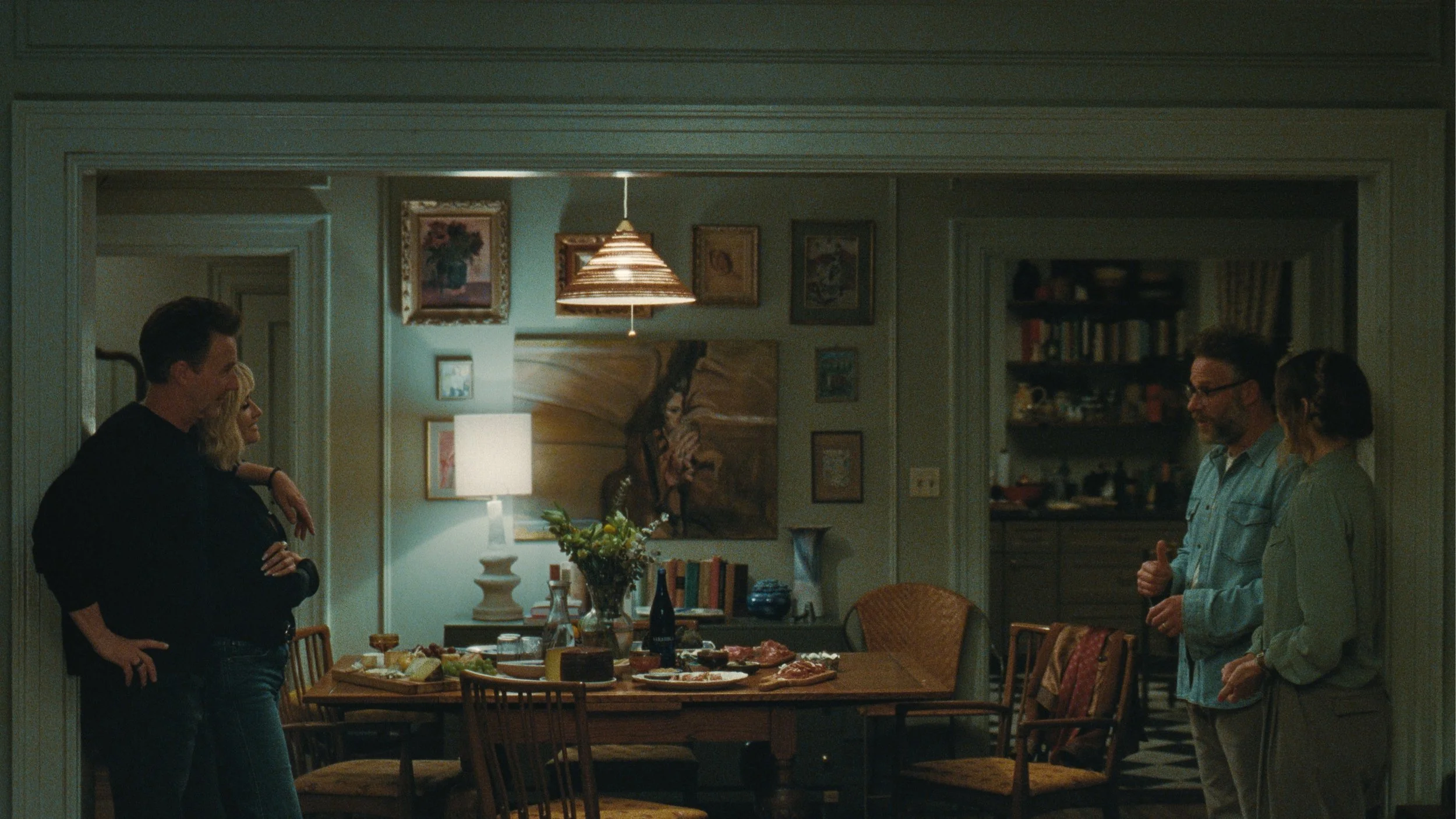
(L-R) Edward Norton, Penélope Cruz, Olivia Wilde, Seth Rogen Credit: Courtesy of A24
The last shot of Angela and Joe on the piano is so beautiful. I love how it’s framed. I was just so curious about finding the piano itself and optimizing the placement for that final sequence.
Well, those are the happy accidents that happen with design and a great cinematographer. We didn’t know that was even the last shot, so it wasn’t written as “through a window.” The way I designed the airshaft wasn’t described in the script that way. The script was just described as a window that looked into another window. So when I designed the apartment, I was thinking of different viewpoints. And then I thought it would be really interesting if it were actually a shaft. This way, you could see all the way around the windows, into the windows, from the hallway, into there. We started thinking, “Oh, it’d be so amazing. Angela could be sitting on the bed, and she could look through the windows. She could see Joe there.” So that was just something that came along afterwards.
And that shot is just so beautiful. It’s my favorite shot of the movie. And the piano was something I found on Facebook Marketplace. Amazing. I think it was a hundred something dollars. People were just trying to get rid of pianos. They’re like, “Oh, it’s so small. We can’t get it to move.” So I wanted a beautiful wood one, and yeah, I found that, we owned it, and that was it.
Thank you, Facebook Marketplace. We have the best shot of the year.
They’re like, “Get it out of here. Just getting someone to move a piano costs money.” And we knew we wanted a baby grand and something small, but not like a standup. We wanted something that we could really cover with stuff. So that was sort of where we landed.
I hope the former owners of that piano get to see the movie and be like, “Wait, that used to be ours.”
I know. I wonder. I remember there’s this one chair in Joe’s office that this woman, I went to estate sales where you go to people who are cleaning out storage lockers, and this was in Orange County, and always had a lot of stuff, filler books, everything.
There was this one chair that she was using. And I said, “Oh, I love that chair. Are you selling it?” She was like, “Oh no, we kind of use this chair.” I was like, “Oh, that’s such a perfect chair for Joe’s office.” And she was like, “You can have it, just bring it back.” I was like, “Well, do you want me to rent it?” She goes, “No, no, no. I trust you. Just take the chair.” And it’s those little things like that. So I was like, “Keep an eye out for it.”
So I hope she’s paying attention. It’s just the humanity of people who trust. I could have just never gone back. I went myself to take the chair back because I was like, “I got to make sure this chair goes back.” I’d forgotten about it, because the designer’s in charge of those things. And I was like, “Oh my God, the chair has to go back.”
There are a lot of little beautiful moments. There are some hand drawings I did myself in there. One of the costumers did a lot of the sketches that are in there. So it was just very beautiful, familial. [I have] a lot of friends who are artists. I always post on Instagram, looking for art in this kind of style. It’s fun to see the stuff people send you because I always want to use real art that I can find and support artists. So it’s fun now for those artists because I don’t think they expected their art to be so central. This one woman, Lizzie, has her art, which is that one big painting that’s in the dining room, and it’s just constantly visible.
The one that’s in the middle.
The one that’s in the middle. Another amazing artist, Susan Moss, who’s 84 years old – she’s just been painting forever. I have two of her beautiful pieces in there that are so amazing. It’s really nice to be able to give artists a platform where their art is being seen in another way, and especially when they don’t expect it. When someone’s like, “Hey, can I use your art for a movie?” They’re like, “Okay???” It feels like a nice way to give back to the local artistic community of Los Angeles.
Well, thank you so much for taking the time for this. I adore the film. I’ve seen it three times.
I told Olivia this. I said, “I made a lot of great movies, and I feel so lucky, but there is no other movie I can watch more than this one.” Because sometimes some of the other movies I’ve done are hard to watch. I don’t want to sit and watch The Killing of a Sacred Deer too many times. But this movie’s so funny, and it’s so fun that I’m like, “I could just keep watching this movie,” and that’s amazing. But it also makes me cry, and I never cringe, which, often as any artist, they watch stuff of theirs, and they’re like, “Ugh, I watched this movie, and I’m just like… I love it. I’m so proud of it.” I’m like, “Congratulations. We did a good job.”
I was going to say, this is coming from someone who uses the Marriage Story punch on the wall as a meme to all my friends.
I know, that’s my biggest meme. So I wonder what meme will come out of this one. I’m so excited. It’s very funny that two of my most successful movies will be the uncoupling marriages, and that’s going to be my thing now. I’ll just be called for those ending-of-marriage movies. But I understand it. As a child of divorce, I get it.
