
'Sinners' Actor and Songwriter Miles Caton on Self-Reflection and Collaboration in Discovering Sammie's Soul
Photo credit: Mihailo Andic
Out of all the breakthrough performers this year, nobody stood out to me more than Sinners' Miles Caton.
On my first viewing of Ryan Coogler's original horror epic, Caton's performance was like witnessing a once-in-a-lifetime star being born. The moment his character Sammie starts singing "Travelin'," I reacted just like Michael B. Jordan's Stack hearing his voice for the first time - or like a Black auntie at a church going, "Sing it, baby!" That feeling only deepens during "I Lied to You," which is not only one of the best scenes of the year but, personally speaking, one of the best scenes I’ve ever seen in any film.
As I wrote in my review, "For this being his first role, he has immense screen presence, remarkable chemistry with his co-stars while still holding his own, undeniable rizz, and a set of pipes that will send chills down your spine - all while carrying the crux of the film’s commentary."
Sinners marked the first film role for the 20-year-old Brooklyn-based R&B singer. His work on "Last Time (I Seen the Sun)," alongside co-songwriters Alice Smith and composer Ludwig Göransson, is also Caton's first songwriting credit in a motion picture. The track - along with "I Lied to You," is shaping up to be a contender for Best Original Song at the upcoming Oscars.
I had the pleasure of speaking to Caton and in our conversation, he discussed the process of finding Sammie, what it meant to embody the film’s central themes of balancing religious values with the pursuit of the "Black American dream," and his collaborative experience of co-writing with Göransson and Smith.
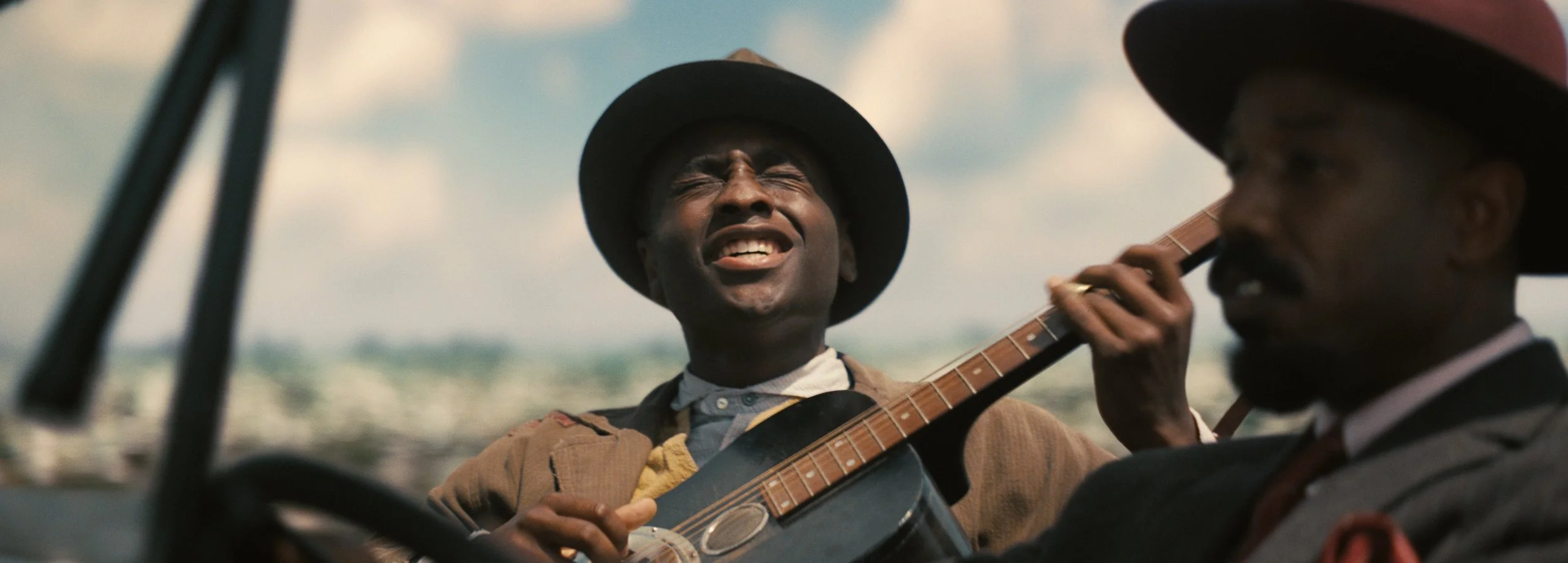
MILES CATON as Sammie Moore and MICHAEL B. JORDAN as Smoke in Warner Bros. Pictures’ “SINNERS,” a Warner Bros. Pictures release.
In my eyes, Sammie is the emotional centerpiece of the film. You're carrying so much of the story’s core themes, its spirit, and the pursuit of the Black American dream - and this is your first movie. What was your reaction to the script? Did you feel any pressure seeing how much responsibility Sammie carried?
My first reaction to the script, I was definitely just blown away. The first time I read it, I was kind of speechless. Then I had to read it again to really dive in and kind of just break it down for myself. But it was definitely after that second read where I kind of understood the importance of the film. And in the early talks with Ryan on Zoom calls, he really explained the world to me and how important Sammie would be.
Of course, I didn't know how the role would turn out - how big it would be or how much I’d appear in the film. But Ryan explained to me that Sammie is the lens for the audience. He's receiving all this knowledge and information, and he’s seeing so many different things. His life is a very redundant cycle - sharecropping, taking care of his family, going to church, repeating it. Outside of that, there's really nothing else going on. He's not really going to different places. So when he gets picked up by his cousins, he's kind of introduced to a new world that he's never seen before, so you kind of just see him trying to navigate through all of that.
Coming from a musical gospel background and entering film for the first time, how did you prepare for this new medium and working on a film set for the first time?
I just used all the experience I already had to help me. Coming from music and performing, I’m used to being in front of crowds and cameras. That part felt comfortable. But the acting side was something new. I'm glad that I had music as a comfort going into it so I could focus on acting and do other things. Once I was able to gain that comfortability, I was able to work with Beth McGuire. She's an incredible acting and dialect coach, and she gave me a crash course of the different techniques that I could use to bring out those emotions and have that range when I was acting.
What's one specific thing that you remember that's like you carry on with you today?
I mean, there's a million different physical techniques as far as breathing, and especially when it comes to dialect, just doing different things with your voice to get in the pocket of that dialect and where someone is from. But when it comes to the actual acting, I think it was just how she explained it to me. That really was the technique for me. She just told me the importance of having a conversation in the scene. The acting should kind of fade away. It shouldn't feel like acting - it should feel like a conversation. So that's what I kept in mind. That was the main thing - just really having a conversation, letting all of that other stuff go away, and using your past experiences to really fall into the character and create an authentic moment.
Guide me through finding the process. I'm talking to Miles from Brooklyn, but tell me about finding Sammie from Mississippi, not only just in his dialect, but finding his naivete and his rizz. Those are two separate things, yet you bring such a beautiful naturalism in both.
I appreciate it. Yeah, I mean, that was definitely tricky. Being a city kid, you grow up already knowing certain things - how to move, being aware of your surroundings, and having older people or peers that you can reference to kind of stay on point. So it was definitely interesting falling into a character that is so unsure, doesn't really know a lot, and doesn't really know what to do.
So that was something I had to fall back into - when I was a kid, just wanting to do anything, just being wild, not really being aware. That was something I had to lock back into. Then, when it came to the accent, that was another thing I was worried about. But Beth, she really helped me a lot. We listened to old interviews of Sun House, Muddy Waters, and Howling Wolf. We listened to those guys and their rhythms, how they were speaking, and the different slangs that they would use back then. So I could kind of, not mimic it, but use it as a reference point to make sure I'm staying in that realm. It was definitely tough detail work, but it was a lot of fun.
There are so many Black Americans, myself included, who have seen themselves through Sammie - finding individualism, following their dreams outside of religion. Because that's such a big part of Black culture, and you, coming from that background and having this movie that is wrestling with those themes, has any of that affected you or how you find your middle ground?
I think that's what it is - it’s finding a middle ground for sure. When you come from those morals or those values, I think it's important to keep them. Those are the things that keep you grounded and protected from certain things. When you go out, you venture off into different things. So I think that was something that Sammie was probably trying to convey to his father, but just, I think when you grow up one way and you grow up seeing a certain thing, you get stuck in that, especially as you get older. So I think that was something that Sammie was trying to relay to his father, but it is always a tough situation. For me, it's always been important for me to just stay grounded in those values and in those principles, no matter where I go.
Seeing the IMAX 70 mm cut for the first time, seeing “I Lied to You” for the first time, tell me what was that experience like? Watching it with an audience? It’s becoming one of the cinematic pillars of 2025, not just in Black cinema, but cinema overall.
It’s honestly still hard to describe. I remember seeing it for the first time. We saw a rough cut of it, and it was crazy to see. Then, I think it was unexpected because when you're filming, and you read the script, you kind of form an image of how you think the movie's going to be in the exact order of things.
But when it comes to the editing and other things, everything kind of gets chopped up and put in different places. So I think the first shock was just seeing and understanding that new order. But then we did the New York premiere for the press run, and we were at Lincoln Square and we saw it in 70 mm with the whole cast, family, and friends, and that second time it just hit differently.
As a songwriter, what was the collaboration between you, Ludwig Göransson, and Alice Smith for “The Last Time (I Had Seen The Sun)?” It's such a beautiful bookend - not just to the story, but to the cinematic experience.
It was special, like the icing on top of the cake for sure. We had maybe like a month or two after we had filmed the movie, and we were all back home. Ludwig and Serena [Göransson], called me on a random day and they were like, “Hey, we want you to come and write the end credit song.” And I was like, “What?” It was like one thing after another with this man. I literally got to do a little bit of everything in this film. I grew up watching horror, so the fact that I got to do that, I got to do stunts, special effects, the scar, and music. Then to be able to write and show my artistic creativity in that way, it was crazy.
It was after we filmed. They called me. We flew out to LA and went to the studio with Ludwig. He introduced me to Alice, and she's amazing and so funny. I remember he played her the ending scene with older versions of Sammie, Buddy Guy, Stack, and Mary, and Stack says, “Last time I seen my brother was last time I’ve seen the sun.” And we just listened to that line right there, and were like, “That's what the song has to be.”
We got to figure out a way to sum up this whole film and really beyond it, just a true message for the audience to take with them afterwards. So we started writing, and the words just flowed. It was super easy and super organic. Ludwig had already been working on the music and the strings. Everything was there. The feeling was there. We just had to put the right words to it, and we finished the whole song in that one session, and the next time we heard it was in the theater.
You're performing all these songs live and you're doing all these different takes. How do you keep your vocals still strong after so many…how many takes did it even take for scenes like “Travelin’” and “I Lied To You?”
Yeah, I mean, when it comes to location shoots, they're always tough because you never know how the weather's going to treat you. So we traveled in that car, probably three or four times and did maybe five or more takes on each day, but we shot that on a couple different days because of weather and the sun going down. You have to catch it at the right moment. So we shot that a lot of times. But for me, I didn't have a problem. Like I'm trying to perfect it and get it as good as I can. So I mean, I think the key is just to make sure you have your energy up, do your due diligence in the morning, make sure your body's right, and then warm up. Of course, I got to warm up, made sure the vocals were strong, and then just stayed warmed throughout the day.
Sinners is now streaming on HBO MAX
